Aa
  • Read, Watch, Listen
  • TJI Series
  • Community Action
  • Events
  • Zedi
Follow us and continue the conversation
  • LinkedIn
  • Instagram
  • FaceBook
  • X
  • YouTube
Test yourself with the TJI Quiz!

Adjust size of text

Aa

Follow us and continue the conversation

  • LinkedIn
  • Instagram
  • FaceBook
  • X
  • YouTube

Your saved articles

You haven't saved any articles

What are you looking for?

Original reporting, insightful analysis and diverse views, delivered straight to your inbox

  • LinkedIn
  • Instagram
  • FaceBook
  • X
  • YouTube
Your support fuels our mission to inform, entertain and inspire.

The Jewish Independent is bound by the Standards of Practice of the Australian Press Council. If you believe the Standards may have been breached, you may approach The Jewish Independent or make a complaint to the Australian Press Council in writing at www.presscouncil.org.au. The Council may also be contacted on 1800 025 712.

  • Our Story
  • Contact us
  • Our Team
  • Support us
  • Guidelines
  • Pitch your idea
  • Republishing us
  • Community Action
  • Our Awards
  • LinkedIn
  • Instagram
  • FaceBook
  • X
  • YouTube
Aboriginal FlagTorres Strait Islanders Flag

The Jewish Independent acknowledges Aboriginal and Torres Strait Islander peoples as the Traditional Owners and Custodians of Country throughout Australia. We pay our respects to Elders past and present, and strive to honour their rich history of storytelling in our work and mission.

© The Jewish Independent 2026All Rights Reserved
Website design and development by Your Creative, MelbourneTerms & ConditionsPrivacy Policy
HomeRead, Watch, ListenAustralia
NewsAustralia

Antisemitic attitudes are no more widespread in Australia since Gaza war: Crossroads25 survey

Increasing antisemitic incidents do not reflect the views of most Australians, but many are ignorant or ambivalent about Israel, according to TJI's authoritative new survey.
Michael Visontay
Print this
00 Introduction The Crossroads25 survey (1)

Crosroads25 surveys Australians on their attitudes to Jews, Israel and antisemitsm (TJI)

Published: 28 October 2025

Last updated: 29 October 2025

While Australia has been shaken by a stream of violent attacks against Jewish and Israeli property over the past two years, only a small minority of people hold antisemitic attitudes and their number has not increased with the war in Gaza, a major new survey has found.

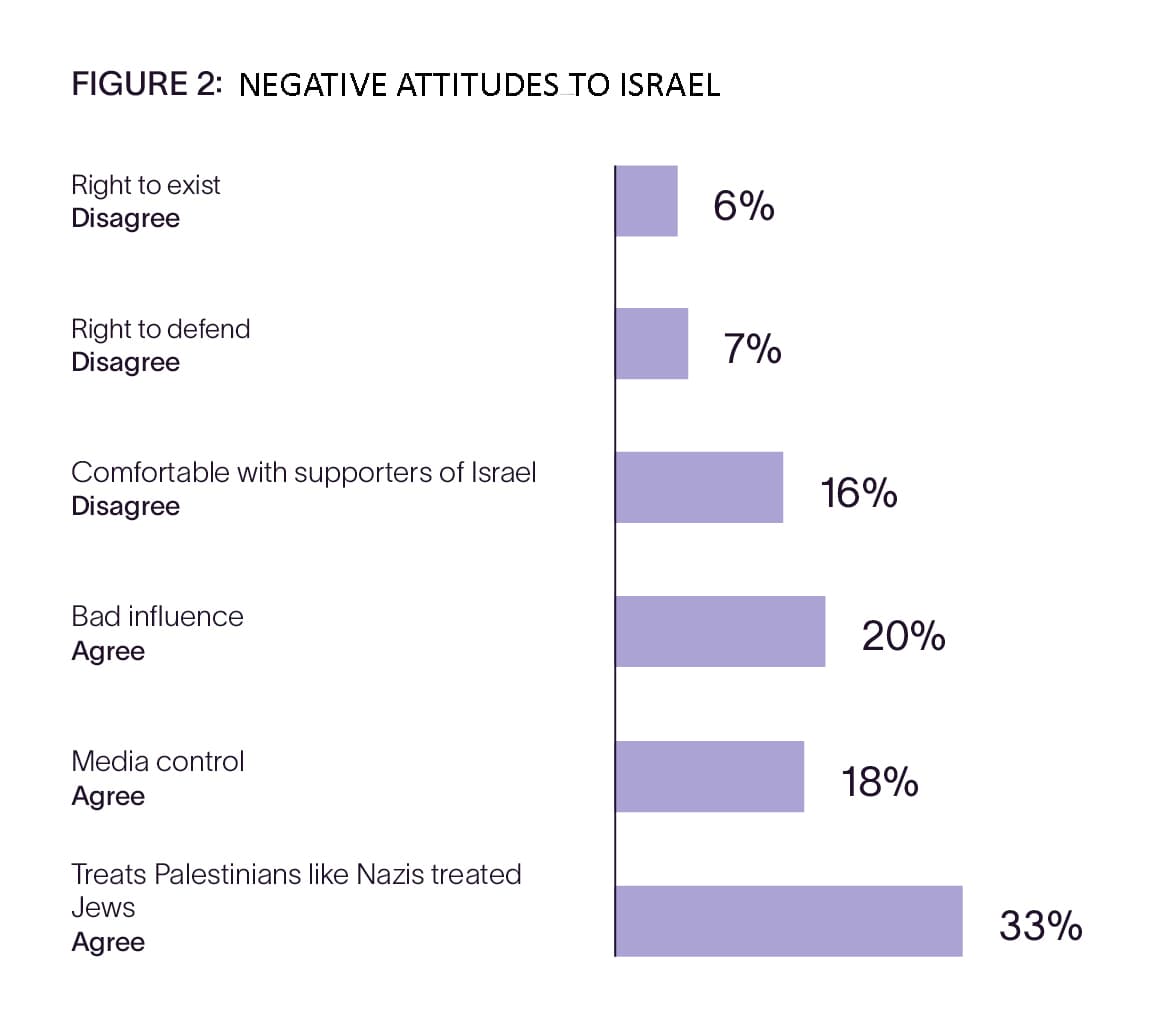
The Crossroads25 survey of Australian attitudes to Jews, Israel and antisemitism also found that the general population clearly distinguishes between Israel’s conduct of the war in Gaza and the state of Israel. While many Australians condemn the way Israel treats Palestininans, 60% or more support Israel’s right to exist and defend itself.

But both sympathy with Palestinians and hostility to Israel is much higher among younger Australians, with more than half of 18-24 year olds believing "Israel treats the Palestinians the way the Nazis treated the Jews", a statement Australia's official definition of antisemitism, the IHRA definition, defines as antisemitic.

The survey comes in the context of widespread community concern about antisemitism. Attacks including arson, assaults, vandalism and intimidation tripled in the year after the Hamas attack on Israel on October 7, 2023 and online antisemitism increased five-fold. Reflecting the high levels of hostility among young people, two thirds of Jewish staff and students say they feel unsafe on campus.
Crossroads25, commissioned by The Jewish Independent, provides methodologically sound data on Australian attitudes, including longitudinal comparison with the Crossroads21 survey. The survey was designed by Emeritus Professor Andrew Markus and conducted during August by the polling company YouGov across a sample size of 2270 Australians.

Violent acts do not reflect broader attitudes  

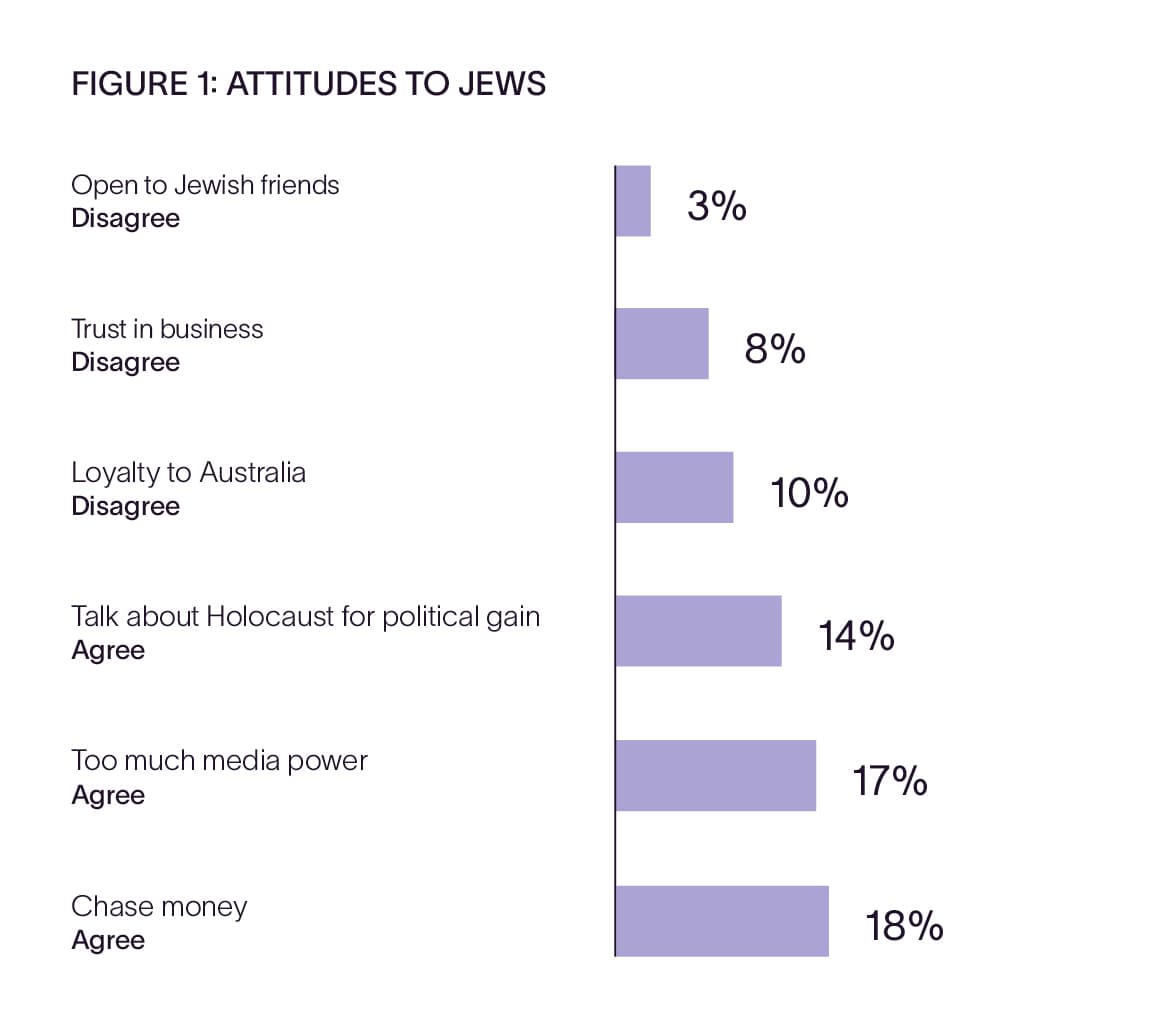
Just under 12% of those interviewed had a negative response to six questions asking about Judeophobic attitudes and sterotypes including friendship with a Jewish person, trust, loyalty to Australia, weaponisation of the Holocaust, media power, and pursuit of wealth. This response was consistent with a similar set of questions asked during the Crossroads21.

The Jewish Independent

Professor Markus said the results made it clear that the increasing number of violent antisemitic acts recorded in Australia over the past two years do not reflect the attitudes of most Australians.

“People are focused on incidents like demonstrations, graffiti, burning of synagogue, burning of cars, which are very frightening for people,” Professor Markus said.

But the survey shows negative attitudes only exist in a small minority in the population and are largely confined to limited demographic groups. “It's quite specific, and it does not indicate Australian opinion.”

Professor Markus said the low level of antisemitic sentiment was significant not only for the distinction it makes between the actions of a few and the view of the majority, but also because it shows attitudes to the war in Gaza have not translated into widespread antisemitism.

Ignorance rather than antipathy

The survey also debunks the idea that Australians are strongly polarised or opinionated about Israel and Palestine. In fact, almost half on average responded “don’t know” or “neither agree nor disagree” to Israel-related questions and 45% were not at all interested, or only a little interested, in the Israeli-Palestinian conflict.

Asked where their sympathies lay in the Middle East, 20% of respondents said with Palestinians, 16% said Israelis, 38% said equally, and 21% said they didn’t know.

Ignorance of October 7

The survey revealed many Australians don't know or believe in the October 7 Hamas attack, which means they do not understand what started the Gaza war.

Professor Markus said the most surprising result was the extent to which people were unable to agree with the fact that “Hamas killed around 1,200 Israelis in the attacks on October 7, 2023”.

Less than half, only 48%, said this statement was "broadly true", 5% said it was "broadly untrue", and 44% said they were not sure, with 3% preferring not to answer.

Support for Israel but not its treatment of Palestinians

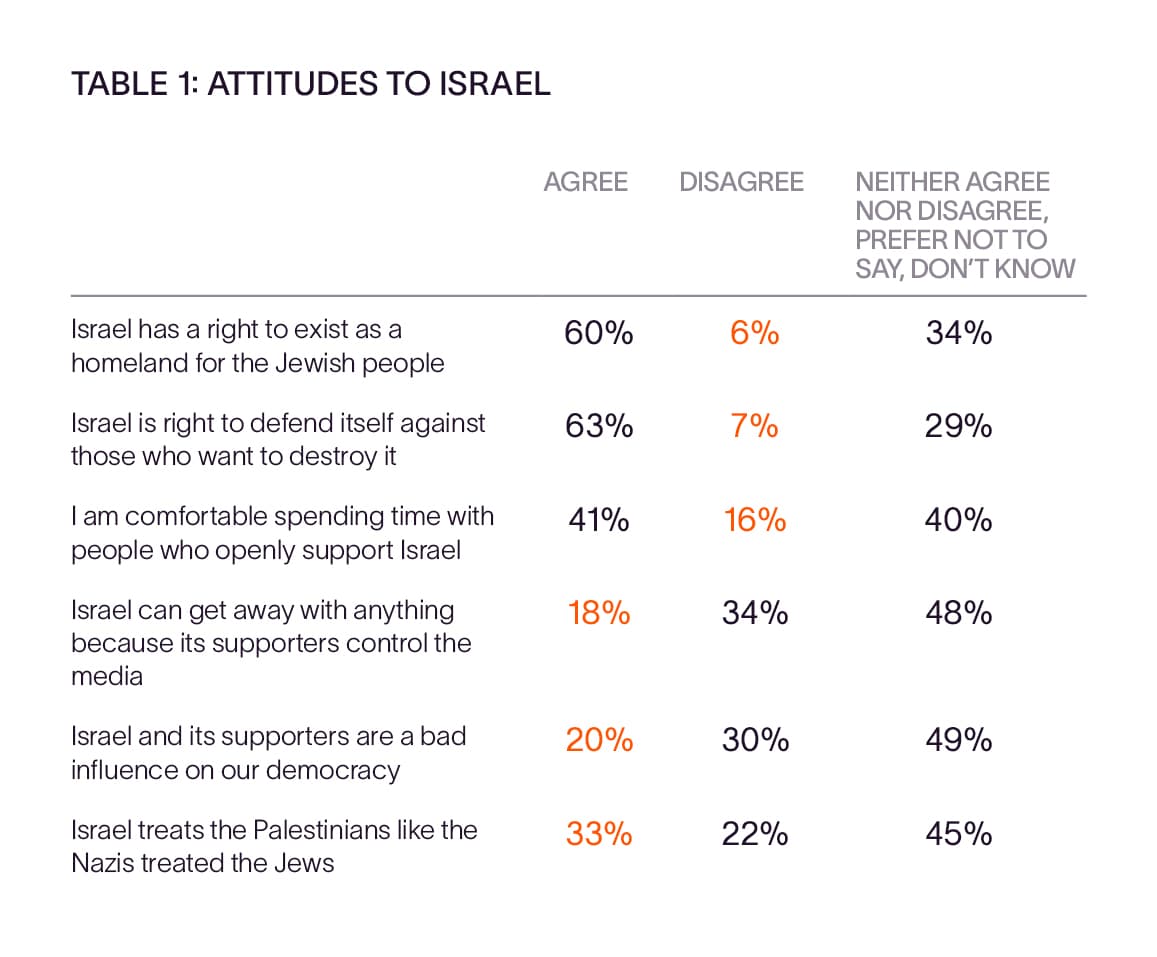
Respondents were asked eight questions to gauge their attitudes to Israel. These included Israel’s right to exist, its right to defend itself, andhow it treats Palestinians. The responses to baseline questions about Israel’s right to exist and defend itself indicated strong support. Just 6% disagreed with Israel’s right to exist as a homeland for the Jewish people, and 7% disagreed with its right to defend itself.

The Jewish Independent

However, there was a sharp contrast when respondents were asked their thoughts on the proposition that “Israel treats the Palestinians like the Nazis treated the Jews”: 33% agreed, 22% disagreed, and 43% were neutral or uncertain. (This question was not asked in Crossroads21.)

Professor Markus said this question yielded the most problematic response in the survey. The association of Israelis with Nazis is deeply offensive to Jews, particularly in Australia where so much of the community are descended from Holocaust survivors. "What the Nazis did to the Jews was the systematic annihilation of an unarmed population. That's very different from what happened in Gaza. The fact that so many people do not see that is a real issue."

He said he was surprised that negative attitudes to Israel's treatment of Palestinians did not mean broader antipathy to Israel or Jews.

“I would have expected that this negative view would then carry over to other issues such as the legitimacy of the State of Israel, and more fundamentally, the way that the Jewish community is viewed.

The Jewish Independent

“But there is a clear distinction in the minds of many people who are concerned about what's happening in Gaza between the conflict, Israel’s right to exist, and antisemitism. The war has not led to a change in attitudes to Israel, and Jews, across the board.

“The survey indicates that the negative response is specific and has to do with the Gaza war and the degree of sympathy with Gaza's civilian population.”

Many young people sympathise with Palestinians

While the overall results were reassuring for now, hostility to Israel looks set to increase. Younger Australians are much more likely to sympathise strongly with Palestinians while older Australians were more sympathetic to Israel.

More than half of 18-24 year old (54%) agreed that "Israel treats Palestinians like the Nazis treated the Jews"; 44% sympathised with Palestinians, and did not believe "Israel is right to defend itself against those who want to destroy it ."

Implications for policy and advocacy

The major findings in Crossroads25 raise important questions for Jewish communal advocates and Australian political leaders.

The claim that Australia has seen a widespread breakdown in social cohesion is challenged by the results of this survey.

But the high levels of hostility to Israel among young people, the antisemitic conflation of Nazis and Israelis, and the extent of community ignorance about October 7 provide evidence of the need for increased education, as the government’s antisemitism envoy Jillian Segal recommended in her recent report.

The results require policies that balance control of a violent, prejudiced minority with allowing freedom of expression for the more reasonable mainstream.

The survey makes it clear that recent attacks on Jews do not reflect broader Australian attitudes but the fear these attacks have unleashed within the Jewish community is widespread and ongoing.

"The toxic material on social media, the experiences of university students and staff, that's real, that's not just anxiety," said Professor Markus.

“I think the survey actually empowers [communal and political leaders] because it makes clear the distinction, unlike other surveys which have confused the actions of the small minority and the views of mainstream Australian opinion,” Professor Markus said.

“People say things like ‘it's never been this bad in Australia’. But they're not clarifying what they mean by ‘this bad’. The lack of clarity gives more power to the protesters, because it basically makes them look stronger than they actually are.”

Over the next few weeks The Jewish Independent will bring you deep dives into Crossroads25, including breakdowns according to age, gender and political affiliations; details on attitudes to Israel; and comparisons with where we were four years ago.

READ MORE

Crossroads25: Full reports (The Jewish Independent)

You might also like
  • Confronting Richard Flanagan and the myth of the Israel lobby
    Mary Garden
  • Facing a new year with the knowledge life can be better
    The Jewish Independent
  • UK’s dramatic policy change on Israel-Palestine
    Colin Shindler
logomark.67a07ee3
We believe in the free flow of information

Republish our articles for free, online or in print, by using our Creative Commons licence

You might also like

    Commissioner Virginia Bell
    Royal CommissionAnalysisAustralia

    Now is the time for the Royal Commission to deliver, not be politicised

    Dean Sherr 2
    funding handouts
    NewsAustralia

    Who will get the money from the Cranbourne windfall?

    Gideon Cohen
    Generation Change: Rachel Moshel
    Generation ChangeInterviewArts & Culture

    Rachel Moshel: Creating a space for Jewish art and joy

    Gideon Cohen

About the author

Michael Visontay

Michael Visontay

Michael Visontay is Commissioning Editor of TJI and was Editor-in-Chief from 2017-22. Michael is a former Assistant Editor of The Sydney Morning Herald and columnist with The Australian Jewish News. He has written six books, including Who Gave You Permission? with Manny Waks, and Welcome to Wanderland: Western Sydney Wanderers and the Pride of the West. His most recent book is Noble Fragments: the Maverick who broke up the world's greatest book (Scribe, 2024).

More from the author

ReflectionWorld

My memory of Gloria Steinem

NewsAustralia

No action to stop Hezbollah ally beaming antisemitic and anti-Israel content into Australia

NewsAustralia

Beinart takes a wrecking ball to Israel

AnalysisAustralia

Prime minister’s absence exposes weakness in Royal Commission hearings

Comments4

  • Avatar of Rachel Sussman

    Rachel Sussman30 October at 04:25 am

    Thank you for the results of the survey.
    A research is always interesting although much depends on the study group chosen.
    One can feel ‘reassured’ with some of the results but I will say this: my life has personally changed since 7/10. It has been shocking to me that people I considered friends became abusive and de-friended me; that I was ‘forced out’ from organisations and groups I have been involved with for many years and people I still consider as essentially good people,; it has been shocking to me to see my daughters distressed; it has been shocking for me to hear my grandkids say they will not go to Uni here but now plan to leave… and this to name just a few.
    I am not naiive, already in 2020 I was acutely aware of anti Israel attitudes especially in certain circles, but there was a difference…
    Also if you permit me to say, I am surprised at the wording of some statements in the survey especially the statement that Israel treats the Palestinians the way the Nazis treated the Jews… Seems to me that such is sugestive and somehow re- enforces anti Israel propagnda and false narratives.

  • Avatar of Harold Zwier

    Harold Zwier28 October at 11:06 pm

    It appears from the article that the Crossroads25 survey included the proposition, “Israel treats the Palestinians like the Nazis treated the Jews”. That proposition invites survey participants to consider an association that may not have been in their minds to begin with. It would be interesting to hear the steps taken by the people who drafted the survey, to avoid “push polling”.

  • Avatar of Vic Alhadeff OAM

    Vic Alhadeff OAM28 October at 10:19 am

    Congrats to Professor Andrew Markus and The Jewish Independent on this groundbreaking initiative. It dispels many of the concerns which have been preoccupying the community, while at the same time shining a light on where work needs to be done.

  • Avatar of Rebecca Forgasz

    Rebecca Forgasz28 October at 07:15 am

    Thank you Andrew for this important work and for your nuanced commentary on the findings. And thanks TJI for commissioning and sharing this work. It’s important for us to have this perspective and reassurance that, despite the very real fear and negativity that many of us have experienced over the past 2 years, the Australia we live in is largely unchanged with respect to antisemitism, and the vast majority of Australians are fair-minded and reasonable on matters related to the Israel/Palestine conflict.