Aa
  • Read, Watch, Listen
  • TJI Series
  • Community Action
  • Events
  • Zedi
Follow us and continue the conversation
  • LinkedIn
  • Instagram
  • FaceBook
  • X
  • YouTube
Test yourself with the TJI Quiz!

Adjust size of text

Aa

Follow us and continue the conversation

  • LinkedIn
  • Instagram
  • FaceBook
  • X
  • YouTube

Your saved articles

You haven't saved any articles

What are you looking for?

Original reporting, insightful analysis and diverse views, delivered straight to your inbox

  • LinkedIn
  • Instagram
  • FaceBook
  • X
  • YouTube
Your support fuels our mission to inform, entertain and inspire.

The Jewish Independent is bound by the Standards of Practice of the Australian Press Council. If you believe the Standards may have been breached, you may approach The Jewish Independent or make a complaint to the Australian Press Council in writing at www.presscouncil.org.au. The Council may also be contacted on 1800 025 712.

  • Our Story
  • Contact us
  • Our Team
  • Support us
  • Guidelines
  • Pitch your idea
  • Republishing us
  • Community Action
  • Our Awards
  • LinkedIn
  • Instagram
  • FaceBook
  • X
  • YouTube
Aboriginal FlagTorres Strait Islanders Flag

The Jewish Independent acknowledges Aboriginal and Torres Strait Islander peoples as the Traditional Owners and Custodians of Country throughout Australia. We pay our respects to Elders past and present, and strive to honour their rich history of storytelling in our work and mission.

© The Jewish Independent 2026All Rights Reserved
Website design and development by Your Creative, MelbourneTerms & ConditionsPrivacy Policy
HomeRead, Watch, ListenIsrael
AnalysisIsrael

A quarter of Israeli Jews are considering leaving: survey

Cost of living and concern for their children's future are prompting a third of Israel's Arabs and a quarter of the country's Jews to consider emigration.
Shahar Burla
Print this
ben-gurion-airport-shabbat

Published: 3 December 2025

Last updated: 3 December 2025

Thousands of Israelis queued on Friday at Cinema City in Glilot after the Portuguese embassy opened a special “Back to the Past” operation, allowing people to line up without an appointment for passport and ID services. The line quickly became enormous, with many turning back once they saw its length.

The scene unfolded just days after the Israel Democracy Institute (IDI) published a new survey conducted in April 2025 titled Leave or stay? A map of Israelis' considerations and attitudes regarding moving abroad, which finds that about a quarter of Jews and a third of Arabs are considering leaving Israel.

The Jewish Independent

Who is most likely to consider leaving?

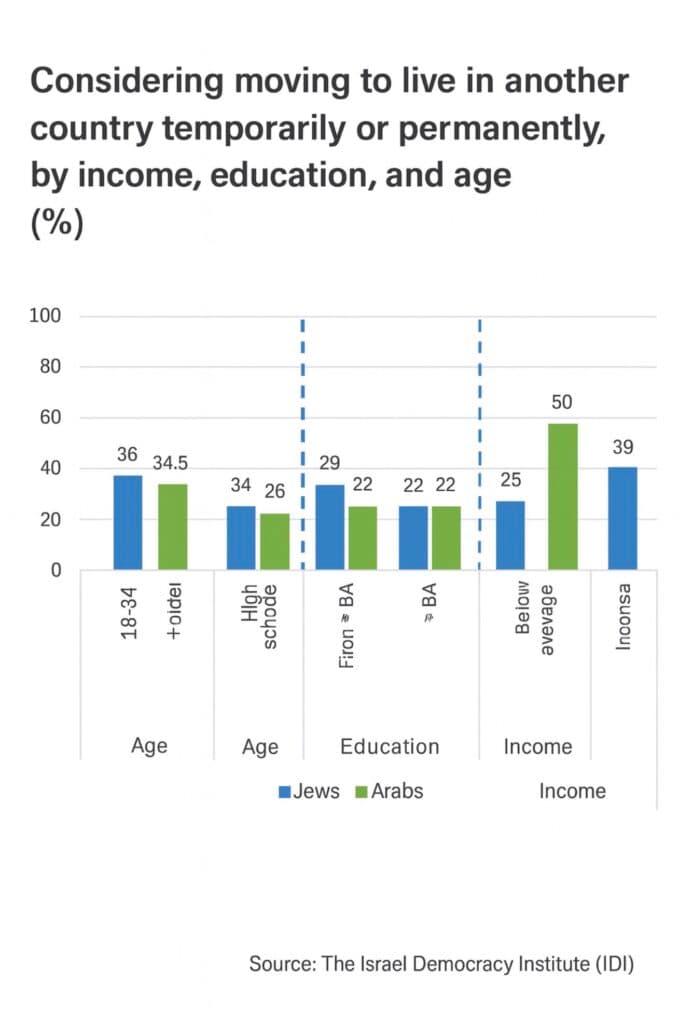
The demographic patterns make the findings even more dramatic, raising serious concerns for the future of Israeli academia, science and political culture. Among Jews, the level of religiosity has the strongest influence on intentions to leave: an especially high proportion of secular Jews are considering leaving – 39% (traditional non-religious – 24%, traditional religious – 19%, religious – 14%, Haredi – 3%). Age is the second key factor: 36% of young people aged 18–34 are considering leaving (aged 35–54 – 26%, aged 55 and over – 16%). Both Jews and Arabs with high incomes and professions with high global mobility are more likely to consider leaving.

The Jewish Independent

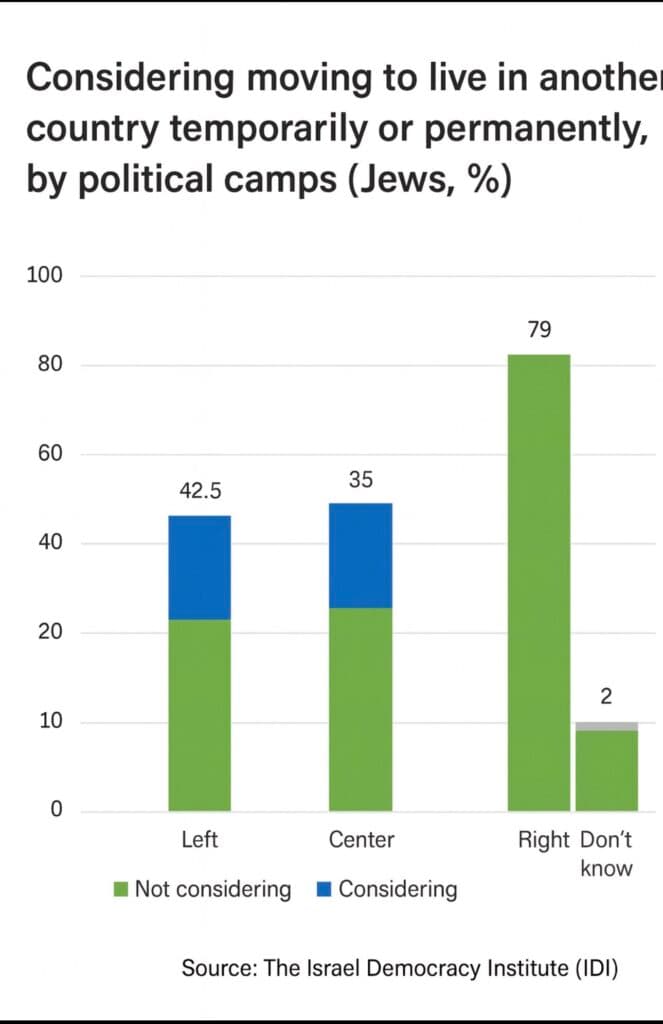
Advanced statistical analysis reveals that the probability that a young secular Jew will consider leaving is higher than 60%, and if he has a high income and foreign citizenship, the probability reaches about 80%. The implications are also clear for Israel’s political landscape: over 40% on the left and 35% in the centre are considering leaving, compared with only 19% on the right.
The Jewish Independent

The strongest push factors

The survey finds that the strongest push factors among those considering leaving are the high cost of living and the lack of a good future for their children. The most significant factor for remaining in the country across all populations and subgroups is the desire to stay close to family.

Forty two per cent of Jews who assess the situation in Israel as “bad” are considering leaving, compared with 8% of those who assess the situation as “good”. Among Arabs, the findings are 33% and 15% respectively.

Segmentation by political camp among Jews who are not currently considering leaving shows which “explosive” push factors could change their minds. For those on the left and centre, the key triggers are the political situation, quality of government, the judicial overhaul, and concerns about their children’s future. For those on the right, the main triggers are the high cost of living and worries about their children’s future.

Among Jews who are considering leaving, the strongest reasons for staying are security and cultural-national factors, including physical safety, the desire to raise children as Israelis, a sense of belonging to Israeli culture and mentality, and fear of antisemitism abroad.

Preferred destinations

A significant majority of those considering leaving among Jews (69%) and Arabs (62.5%) do not have a specific destination in mind; the main thing is simply to leave Israel. Fourteen per cent of Jews and 20% of Arabs are considering relocation for work purposes.

The most important considerations in choosing a destination country are the quality of public services, the economic situation in the destination country, and the level of antisemitism/anti-Arabism. The least important considerations are geographical distance from Israel and the weather.

Europe is preferred over North America and 43% of those considering leaving prefer countries in the European Union, compared with 27% who prefer the US or Canada.

Public attitudes

There has been a shift in how Israelis view emigrants. From a derogatory label that stigmatised emigrants as Yordim (going down) in contrast to Olim (going up), and Prime Minister Yitzhak Rabin’s description of emigrants as “the fallen among the weaklings”, in 1976, the survey finds that the public is now far more tolerant of leaving Israel. The most legitimate reasons cited are academic studies and family reunification (82% for both). The least legitimate reasons are lack of trust in the political system (57%) and fear of the security situation (65%). Differences between Jews and Arabs are minor.

The Jewish Independent

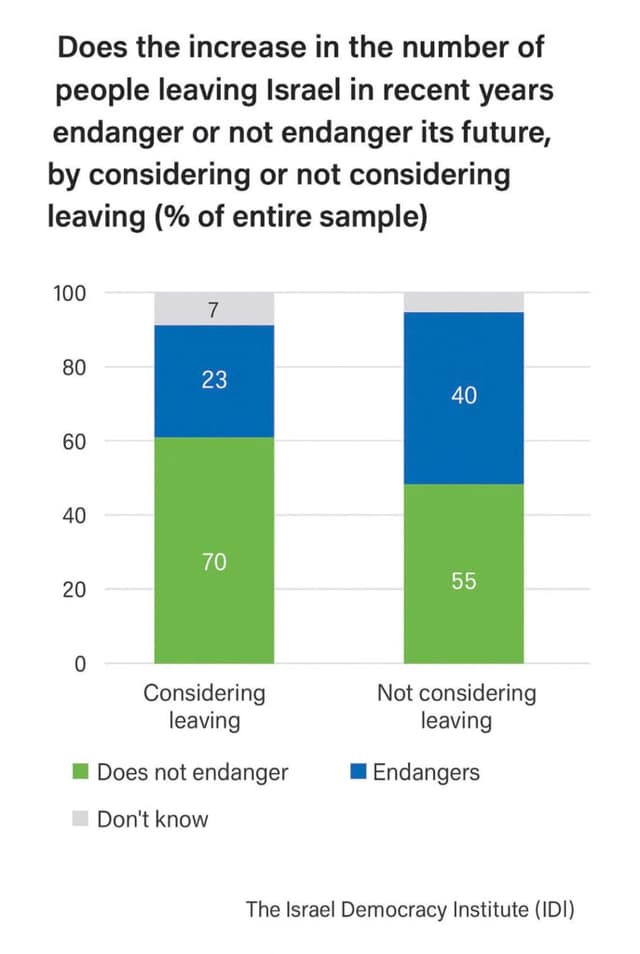
The majority of the public (Jews – 58%, Arabs – 64%) see the increase in the number of people leaving as a danger to the country’s future, and the departure of members of educated and established groups, a “brain drain”,  as an even greater danger (Jews – 64%, Arabs – 73%).

Overall, the findings raise serious questions about the long term health of Israel’s democracy. Those most likely to consider leaving, young, educated, secular and politically moderate Israeli are central to maintaining a dynamic civil society, a strong academic sector and a balanced political culture. If these groups continue to drift away, Israel risks a deeper political imbalance and the gradual erosion of the social and institutional foundations that sustain a robust democratic system.

You might also like
  • ‘Israel is systemically eliminating Palestinian collective life’:  B’Tselem
    Deborah Stone
  • Tame apologises – but with little grace
    Deborah Stone
  • Confronting Richard Flanagan and the myth of the Israel lobby
    Mary Garden
logomark.67a07ee3
We believe in the free flow of information

Republish our articles for free, online or in print, by using our Creative Commons licence

You might also like

    Arab Israeli Palestinian election vote
    Israel Votes 2026FeatureIsrael

    Fear of Netanyahu victory may drive big surge in Palestinian voter turnout

    Ben Lynfield
    altalena
    Israel Votes 2026OpinionIsrael

    The Altalena should be a warning, not a political weapon

    Shahar Burla 1
    Netanyahu
    Israel Hamas WarFeatureIsrael

    New evidence Netanyahu was warned about October 7

    Shahar Burla 2

About the author

Shahar Burla

Shahar Burla

Dr Shahar Burla is a Sydney-based researcher, lecturer and Contributing Editor of TJI. Shahar holds a Master’s degree in political science from Hebrew University and a PhD in political science from Bar-Ilan University. He is the author of Political Imagination in the Diaspora: The Construction of a Pro-Israeli Narrative (2013) and co-editor of Australia and Israel: A Diasporic, Cultural and Political Relationship (2015).

More from the author

FeatureIsrael

New evidence Netanyahu was warned about October 7

OpinionIsrael

The Altalena should be a warning, not a political weapon

AnalysisIsrael

Who is Ofer Winter and could he upset Netanyahu’s election?

AnalysisIsrael

Bennett’s balancing act: can he win over the right without losing the centre?

Comments

No comments on this article yet. Be the first to add your thoughts.