Aa
  • Read, Watch, Listen
  • TJI Series
  • Community Action
  • Events
  • Zedi
Follow us and continue the conversation
  • LinkedIn
  • Instagram
  • FaceBook
  • X
  • YouTube
Test yourself with the TJI Quiz!

Adjust size of text

Aa

Follow us and continue the conversation

  • LinkedIn
  • Instagram
  • FaceBook
  • X
  • YouTube

Your saved articles

You haven't saved any articles

What are you looking for?

Original reporting, insightful analysis and diverse views, delivered straight to your inbox

  • LinkedIn
  • Instagram
  • FaceBook
  • X
  • YouTube
Your support fuels our mission to inform, entertain and inspire.

The Jewish Independent is bound by the Standards of Practice of the Australian Press Council. If you believe the Standards may have been breached, you may approach The Jewish Independent or make a complaint to the Australian Press Council in writing at www.presscouncil.org.au. The Council may also be contacted on 1800 025 712.

  • Our Story
  • Contact us
  • Our Team
  • Support us
  • Guidelines
  • Pitch your idea
  • Republishing us
  • Community Action
  • Our Awards
  • LinkedIn
  • Instagram
  • FaceBook
  • X
  • YouTube
Aboriginal FlagTorres Strait Islanders Flag

The Jewish Independent acknowledges Aboriginal and Torres Strait Islander peoples as the Traditional Owners and Custodians of Country throughout Australia. We pay our respects to Elders past and present, and strive to honour their rich history of storytelling in our work and mission.

© The Jewish Independent 2026All Rights Reserved
Website design and development by Your Creative, MelbourneTerms & ConditionsPrivacy Policy
HomeRead, Watch, ListenIsrael
FeatureIsrael

While the world looks at Gaza, demolitions in East Jerusalem intensify

The village of Walaja has been hit hard. Some residents put it down to revenge, others attribute it to the influence of far-right ministers.
Ben Lynfield
Print this
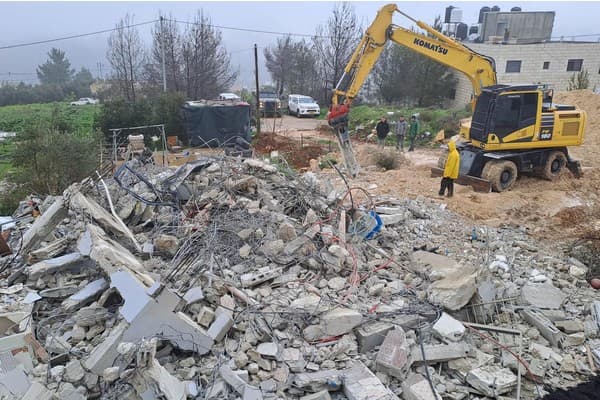
Walaja demolition Bimkom Feb 20 2024

House demolition in Walaja, February 20 (Bimkom Facebook)

Published: 8 April 2024

Last updated: 5 April 2024

With media attention focused on the Gaza war, Israel is intensifying demolitions of Palestinian homes in East Jerusalem.

One area particularly hard hit is Walaja, just across a valley from the settlement neighbourhood of Gilo. During three weeks in February, bulldozers destroyed ten houses there on the grounds that they were built without permits, which are impossible to obtain because authorities never drew up a building plan for the area.

Part of Walaja, including a third of the village’s 3000 residents, is in territory annexed to Jerusalem after the 1967 war. But as residents note wryly, the only service the municipality provided them with was demolitions, which drove some families into the nearby Bethlehem area in the West Bank.

It is very difficult to get building permits in the crowded Arab areas of East Jerusalem and most residents don't vote in municipal elections so their areas tend to be ignored by the municipality.

“We want to preserve our families here,” says Hasan Abu Tin, who serves on a committee advancing an independent building plan that villagers and left-wing Israeli allies hope will at long last gain official recognition. To their dismay, however, demolitions are only increasing in the meantime.

“The existence of the village is threatened,” says Abu Tin, himself a building contractor whose house is opposite the concrete West Bank separation barrier.

“I build for the Israelis and they come here and demolish,” he says.
The wave of destruction in Walaja is part of an uptick in demolitions in East Jerusalem since Hamas’s massacre in southern Israeli communities on October 7 triggered the devastating Gaza war. Some residents attribute the escalation in Walaja a desire for revenge, others to the extremism of far-right ministers Itamar Ben Gvir and Bezalel Smotrich.

Whatever the case, the demolitions seem harsh, even by the standards of Walaja’s own history in legal limbo that over the years made it the target for frequent demolitions.

According to the committee, 75 homes have been demolished there since 2016 for being built without permits, in contrast to the establishment and expansion of Jewish neighbourhoods built after 1967.

Reinforcing bitterness among residents is their panorama of the construction cranes on the neighbouring hilltop that are building a new area of Gilo for Israelis on land that used to belong to the village.

Each demolition has its own story and consequences. “They had a room for playing and a closet for their clothes and now they have nothing,” said Mohammed Abu Khiyara, referring to his four-year- old son and six-year-old daughter. “The kids are asking about their clothes lost in the rubble.”

Their home was bulldozed on February 19. “I, my wife and children are in depression. My boy asks me, ‘when will we have a new house?’ My wife says, ‘what will we do?’ We have lost everything.” Abu Khiyara said it was the second time his house had been razed since 2016. Each time he had built on land which his father had inherited from his grandfather.

“I built on land my father gave me so I could raise my family,” Abu Khiyara said. “If there was a way of getting a license, I would have applied for one and paid the fee just like I did for a driving license.”

Also in February, while the international community was focused on the spiralling Palestinian death toll and worsening humanitarian crisis in Gaza from the war, the Jerusalem municipality ratcheted up the demolitions policy by bulldozing the home of leading anti-demolition activist Fakhri Abu Diyab in the Bustan area of East Jerusalem.

City officials consider all Bustan homes to be illegal and have plans to build a biblically themed park, King David’s garden, where the houses now stand.

City officials have plans to build a biblically themed park, King David’s garden, where the houses now stand.

The municipality declined to comment on the reason for the wave of demolitions in Walaja, saying it had no connection to them even though they were carried out inside its borders. The demolitions were carried out by a national government body, the Authority to Combat Building and Planning Violations.

Its officials could not be reached for comment for this article, nor have they responded to repeated queries by Laura Wharton, a liberal city councilor, who condemned the Walaja demolitions as “outrageous”.

“It is very painful to see these people, many of them Jerusalem residents, being chased away by what is supposedly law enforcement,” she said. The demolitions come at a time when residents seemed to have made progress in longstanding efforts towards approval of a building plan they and independent Israeli planners have been fighting for in the courts, she added.

“Residents have made significant progress in getting the plan approved and are getting near the point where they could get it passed, which would mean many buildings would be recognised as legal. They could get permission to build and build in the future,” Wharton said.

Abu Tin said that many residents of the Jerusalem municipality area of Walaja who have had their homes destroyed over the years moved to the West Bank.

“Although we made a plan, demolitions continue. They just want to harm people,” Abu Tin said.

Arieh King, a deputy mayor allied with Itamar Ben-Gvir, the Israeli National Security Minister who favours large-scale demolitions in East Jerusalem, declined to be interviewed for this article.

But Naomi Kahn, spokeswoman for the right-wing Regavim organisation, which promotes “Zionist: land policies, said it was right to demolish the homes. “It’s not a cruel thing to uphold the law. If there are complaints, there are channels for them. Israeli law has all kinds of methods for legal construction.”

“It’s certainly justified to enforce the law all the time,” she said, apparently not concerned that Israel’s annexation and settlement of East Jerusalem are themselves violations of international law.

While bracing for more demolitions, Walaja residents have one consolation. They have Israeli supporters.  “There’s no question here. There are no two sides. There is no dilemma. It’s really a just cause,” says Mia Caplan, who is among a group of Israeli activists backing the village’s struggle to survive and to push forward the building plan.

Israeli supporters do what they can but the problem is the state doesn’t listen to them.

Abu Khiyara, demolition victim

She and Walaja residents credit the group’s founder, Aviv Tatarsky, a senior staffer at the left-wing NGO Ir Amim, with spearheading the solidarity drive. “This is not because of his work. It is because he and his friends have something in their heart for Walaja,” Abu Tin said.

Israeli activists and American supporters have been instrumental in raising funds for the building plan, he said.

But at this point, no one, it seems can stop the bulldozers. “[Israeli supporters] do what they can but the problem is the state doesn’t listen to them,” Abu Khiyara, the demolition victim, said.

You might also like
  • Fear of Netanyahu victory may drive big surge in Palestinian voter turnout
    Ben Lynfield
  • Israel is cementing its control over the West Bank and East Jerusalem while the world is distracted
    Martin Kear
  • Diaspora leadership must be candid about its disillusion with Netanyahu
    Colin Shindler
logomark.67a07ee3
We believe in the free flow of information

Republish our articles for free, online or in print, by using our Creative Commons licence

You might also like

    Woman with land and houses behind her
    NewsAustralia

    Australia to increase sanctions against West Bank settlements

    Deborah Stone 2
    Knesset divided
    Israel Votes 2026ExplainerIsrael

    Israel election explainer: the main parties

    Shahar Burla 1
    haredi street guitar
    Photo EssayArts & Culture

    Jerusalemites through the lens

    Sharon Gabay

About the author

Ben Lynfield

Ben Lynfield

Ben Lynfield covered Israeli and Palestinian politics for The Independent and served as Middle Eastern affairs correspondent at The Jerusalem Post. He writes for publications in the region and has contributed to the Christian Science Monitor, Foreign Policy and the New Statesman.

More from the author

FeatureIsrael

Fear of Netanyahu victory may drive big surge in Palestinian voter turnout

NewsIsrael

Abuse by IDF soldiers humiliates Muslim Palestinians

OpinionIsrael

Qusra siege exposes shared agenda of IDF and settler extremists

AnalysisIsrael

IDF ordered to evict West Bank camp in election show of strength

Comments

No comments on this article yet. Be the first to add your thoughts.