Aa
  • Read, Watch, Listen
  • TJI Series
  • Community Action
  • Events
  • Zedi
Follow us and continue the conversation
  • LinkedIn
  • Instagram
  • FaceBook
  • X
  • YouTube
Test yourself with the TJI Quiz!

Adjust size of text

Aa

Follow us and continue the conversation

  • LinkedIn
  • Instagram
  • FaceBook
  • X
  • YouTube

Your saved articles

You haven't saved any articles

What are you looking for?

Original reporting, insightful analysis and diverse views, delivered straight to your inbox

  • LinkedIn
  • Instagram
  • FaceBook
  • X
  • YouTube
Your support fuels our mission to inform, entertain and inspire.

The Jewish Independent is bound by the Standards of Practice of the Australian Press Council. If you believe the Standards may have been breached, you may approach The Jewish Independent or make a complaint to the Australian Press Council in writing at www.presscouncil.org.au. The Council may also be contacted on 1800 025 712.

  • Our Story
  • Contact us
  • Our Team
  • Support us
  • Guidelines
  • Pitch your idea
  • Republishing us
  • Community Action
  • Our Awards
  • LinkedIn
  • Instagram
  • FaceBook
  • X
  • YouTube
Aboriginal FlagTorres Strait Islanders Flag

The Jewish Independent acknowledges Aboriginal and Torres Strait Islander peoples as the Traditional Owners and Custodians of Country throughout Australia. We pay our respects to Elders past and present, and strive to honour their rich history of storytelling in our work and mission.

© The Jewish Independent 2026All Rights Reserved
Website design and development by Your Creative, MelbourneTerms & ConditionsPrivacy Policy
HomeRead, Watch, ListenIsrael
NewsIsrael

Arab women topple politician accused of sexual harassment in landmark case

Sexual harassment has been tolerated among Palestinian Israelis, but the case of Jafar Farah has turned the tide
Ben Lynfield
Print this
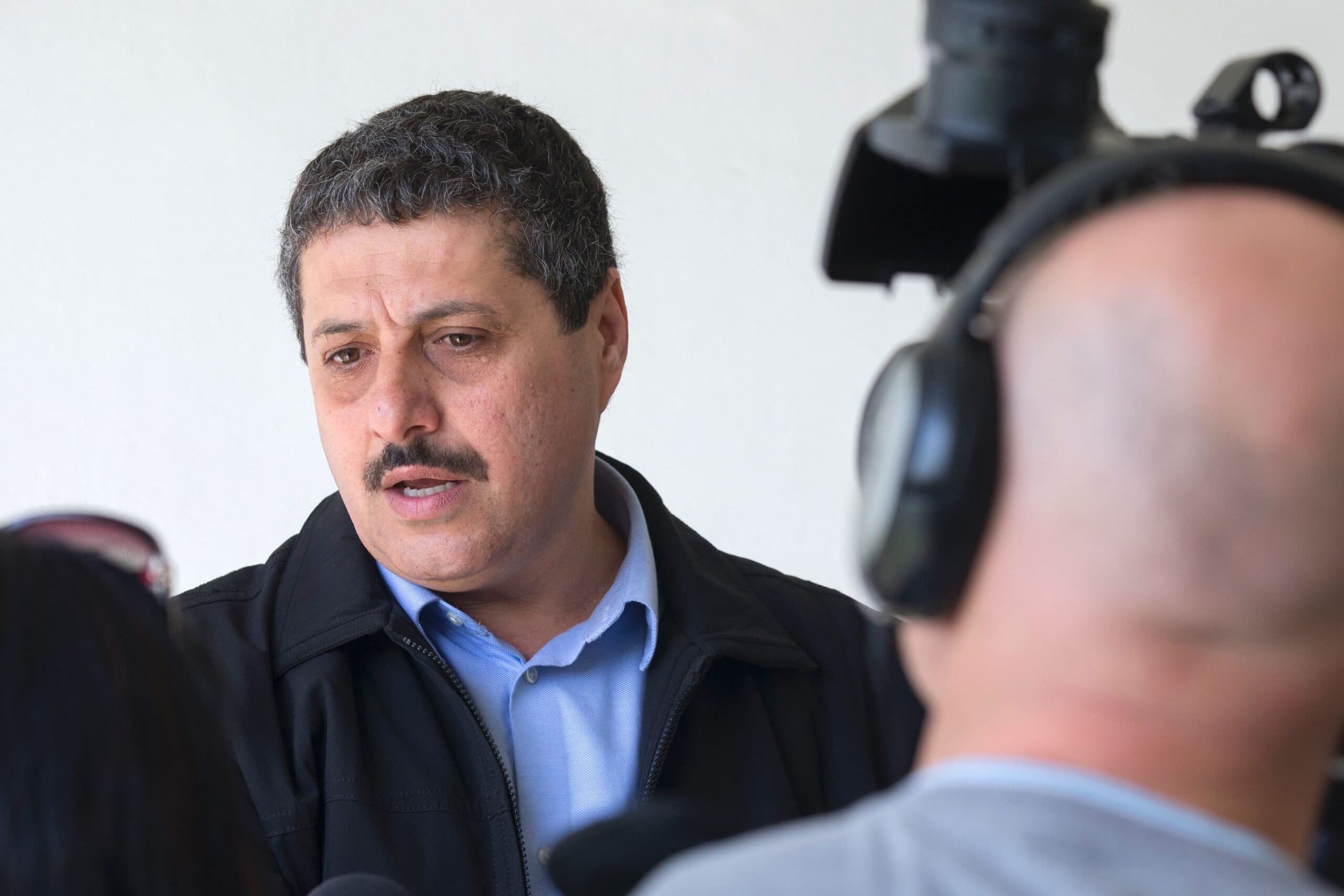
Jafar Farah

Jafar Farah attends a press conference in February, 2016 in Tel Aviv. (Photo credit: Jack Guez/AFP via Getty Images)

Published: 28 September 2026

Last updated: 28 September 2026

For years, Arab society in Israel has rebuffed women’s rights activists by claiming that all energies need to be devoted to the national struggle and to combatting racism. 

But now, two women’s groups—Haifa based As-Siwar and Nazareth-based Women Against Violence have dented the patriarchal norms by managing to topple the candidacy for the Knesset of an influential leader, Jafar Farah, on grounds of suspected sexual harassment. Farah, 60, denies the allegations. 

Although Farah’s supporters argued that a crucial election campaign to oust an extremist government was no time to be divided by other issues, the women’s groups countered that their voices must be heard urgently. 

They launched a social media campaign under the heading “Abuser, Resign!” and lobbied officials in Farah’s Hadash party, presenting them with multiple women giving testimonies against him. They prevailed against a tide of hostility including charges that they were serving political rivals of Farah, interfering in the democratic choice of the party, reflecting foreign interests and helping the Israeli right. 

There have been eight testimonies making allegations against Farah, the earliest dating back to 2017, according to a report in Haaretz.  

Farah, who was number two on the Hadash party list with a guaranteed seat to enter the Knesset before he was ousted, told TJI  that no complaint has ever been filed against him with police and he has faced no legal proceedings in labour court nor has he been investigated or convicted in connection with the allegations. 
A turning point? 

Arab women hope the case will mark a turning point against a heavily patriarchal society. While Palestinian Israeli women have made gains for Arab women, who have advanced n education and employment they still face a combination of sexism within Arab society and racism against Arab citizens from Jewish Israelis. 

“This was a historic step-the first time the feminist movement succeeded in bringing about the resignation of a representative of the public who had a cloud of suspicions of sexual harassments hanging over him,” said Meisa Irshaid, a leading feminist and lawyer. 

It was a breakthrough in terms of setting the agenda, she said. “For months the public discussion in society was about sexual harassment. “There was discussion about the victims. There was discussion about how we shape the face of society. There was a very serious struggle, genuine, popular, social and political.” 

Irshaid said it was not possible to predict the long term effect of the case on sexual harassment in Arab society “but we do know that in societal change there can be a domino effect”. 

However, Irshaid stresses that Palestinian women in Israel face a particularly arduous struggle that is two tiered: against what she terms “nationalist, racist, apartheid oppression” by the Israeli state on the one hand and patriarchalism in Arab and Jewish societies on the other. 

“We as freedom fighters will have to engage in struggles in every place we are and pay a psychological, physical, health and economic price,” she said. 

Despite such determination, many Arab women remain apathetic or averse about gaining political representation. Shahira Shalabi, executive co-director of the Abraham Initiatives, which promotes equality between Arabs and Jews, cited a survey showing that only  37 percent of Arab women participated in the last national elections. “Women think politics belongs to men and we need to change that,” she told The Jewish Independent. 

There are currently three Arab women in the Knesset but due to the failure to place women high on electoral lists, the number of women elected from Arab parties might fall to one in the upcoming election. There are no women heads of Arab local councils and very few councilors. 

Shalabi, a former member of the Haifa city council, predicted, however that the discussion ignited in Arab society by the campaign against Farah’s candidacy “is going to create other arguments about equality, our role, how to be included and how not to be invisible again”. 

Sexual abuse in Arab society 

The numbers of women turning to As-Siwar with complaints against abuses of “authority relations” in the workplace and elsewhere has increased dramatically following the Farah case. 

 “I’m very glad that we succeeded to put things on the table as feminist groups,” said Lamia Naamneh, Director of As-Siwar. 

“What we faced was very aggressive, but as head of a feminist organisation, my responsibility is to talk about the sexual injury. It doesn’t interest me that the society wants to speak about removing [Itamar} Ben-Gvir at any price. I too want to bring down this rightist government but that doesn’t contradict the fact that there are testimonies against him [Farah] that he sexually harmed women.” 

Naamneh said that a major difficulty in countering sexual abuse is that victims do not trust the police, which is widely seen as hostile among the Arab minority. It is therefore incumbent on civil society “to build mechanisms that check complaints, even outside the police and courts”. 

“There is a responsibility of the police and courts in terms of how they treat [sexual abuse] but there is also the responsibility of the society, of how many believe and how many don’t believe and what prices the victim pays. 

“As organizations we too have thought about the prices we are willing to pay and we are not afraid,” she said.” We are willing to pay every price for the sake of justice so that those who spoke up won’t see the one who harmed them [continue]in the same position of control and so that he won’t be able to transform to such a position in another place.” 

You might also like
  • Netanyahu’s lightning UN visit reveals his growing isolation
    Shahar Burla
  • The leadership a wounded society needs
    Esther Takac
  • Fauda and the illusion of vengeance
    Ittay Flescher
logomark.67a07ee3
We believe in the free flow of information

Republish our articles for free, online or in print, by using our Creative Commons licence

You might also like

    haredi street guitar
    Photo EssayArts & Culture

    Jerusalemites through the lens

    Sharon Gabay
    Netanyahu
    Israel Hamas WarFeatureIsrael

    New evidence Netanyahu was warned about October 7

    Shahar Burla 2
    Arab Israeli Palestinian election vote
    Israel Votes 2026FeatureIsrael

    Fear of Netanyahu victory may drive big surge in Palestinian voter turnout

    Ben Lynfield

Comments

No comments on this article yet. Be the first to add your thoughts.

About the author

Ben Lynfield

Ben Lynfield

Ben Lynfield covered Israeli and Palestinian politics for The Independent and served as Middle Eastern affairs correspondent at The Jerusalem Post. He writes for publications in the region and has contributed to the Christian Science Monitor, Foreign Policy and the New Statesman.

More from the author

FeatureIsrael

Fear of Netanyahu victory may drive big surge in Palestinian voter turnout

NewsIsrael

Abuse by IDF soldiers humiliates Muslim Palestinians

OpinionIsrael

Qusra siege exposes shared agenda of IDF and settler extremists