Aa
  • Read, Watch, Listen
  • TJI Series
  • Community Action
  • Events
  • Zedi
Follow us and continue the conversation
  • LinkedIn
  • Instagram
  • FaceBook
  • X
  • YouTube
Test yourself with the TJI Quiz!

Adjust size of text

Aa

Follow us and continue the conversation

  • LinkedIn
  • Instagram
  • FaceBook
  • X
  • YouTube

Your saved articles

You haven't saved any articles

What are you looking for?

Original reporting, insightful analysis and diverse views, delivered straight to your inbox

  • LinkedIn
  • Instagram
  • FaceBook
  • X
  • YouTube
Your support fuels our mission to inform, entertain and inspire.

The Jewish Independent is bound by the Standards of Practice of the Australian Press Council. If you believe the Standards may have been breached, you may approach The Jewish Independent or make a complaint to the Australian Press Council in writing at www.presscouncil.org.au. The Council may also be contacted on 1800 025 712.

  • Our Story
  • Contact us
  • Our Team
  • Support us
  • Guidelines
  • Pitch your idea
  • Republishing us
  • Community Action
  • Our Awards
  • LinkedIn
  • Instagram
  • FaceBook
  • X
  • YouTube
Aboriginal FlagTorres Strait Islanders Flag

The Jewish Independent acknowledges Aboriginal and Torres Strait Islander peoples as the Traditional Owners and Custodians of Country throughout Australia. We pay our respects to Elders past and present, and strive to honour their rich history of storytelling in our work and mission.

© The Jewish Independent 2026All Rights Reserved
Website design and development by Your Creative, MelbourneTerms & ConditionsPrivacy Policy
HomeRead, Watch, ListenAustralia
AnalysisAustraliaIsrael

More than three quarters of Australians have an unfavourable view of Israel

Of 36 countries, only six have a more negative view of Israel in a major new population survey
Shahar Burla
Print this
harbour bridge palestine protest

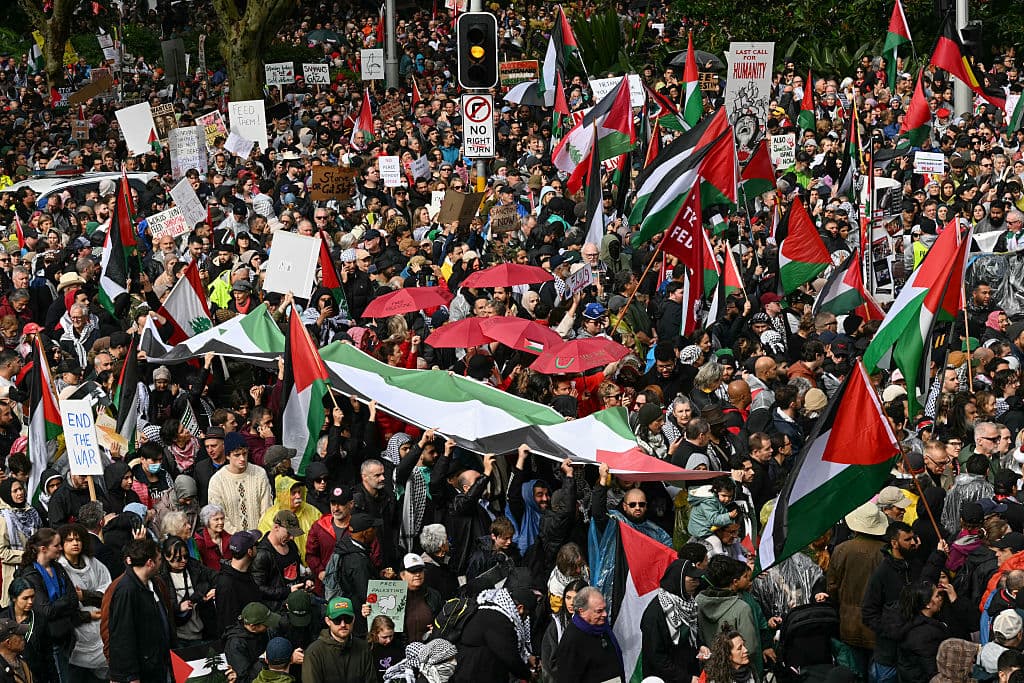
Pro-Palestine protesters rally against Israel’s actions in Gaza Strip in Sydney on August 3, 2025 (SAEED KHAN/AFP via Getty Images)

Published: 16 June 2026

Last updated: 16 June 2026

Australians rank among the world's most critical populations when it comes to views of Israel and Israeli Prime Minister Benjamin Netanyahu, according to a major new survey by the Pew Research Center.

The findings form part of a broader global trend. Across the 36 countries surveyed, majorities in most nations expressed an unfavourable view of Israel and little or no confidence in Netanyahu.

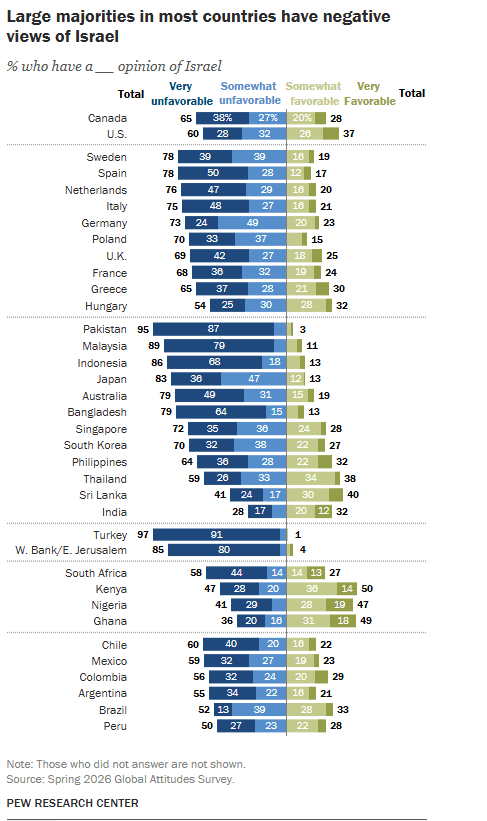
Australia sits towards the most critical end of the spectrum with 79 per cent of respondents expressing an unfavourable view. Only six countries – Indonesia, Pakistan, Turkey, Malaysia and the West Bank – had a lower level of support for Israel, with another four – Bangladesh, the Netherlands, Spain and Sweden – recording similarly high levels of unfavourability. Australia stands out among Anglo-Western democracies, posting more negative views than the US, Canada and Britain.

The findings, drawn from Pew's Spring 2026 Global Attitudes Survey, suggest attitudes have become even more negative over the past year. 

Overall, 79 per cent of Australians now hold an unfavourable view of Israel, including 49 per cent who describe their opinion as "very unfavourable". Just 19 per cent express a favourable view.
The Jewish Independent

The figures represent a further deterioration from 2025, when 74 per cent of Australians held an unfavourable view of Israel and 25 per cent viewed the country favourably. The five-point increase in negative sentiment is among the more significant year-on-year shifts recorded by Pew.
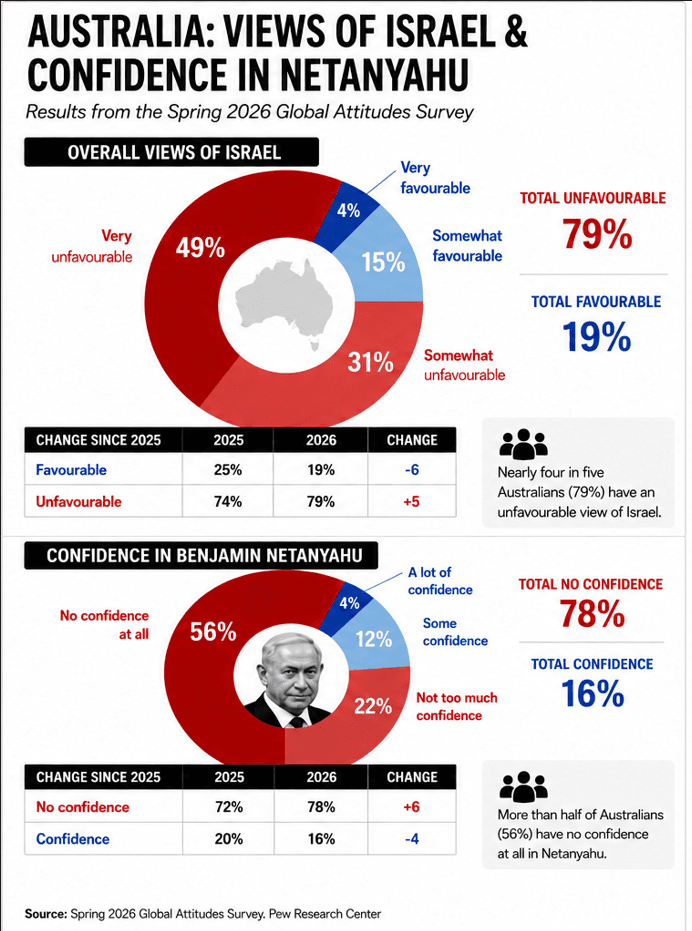
The trend is mirrored in attitudes towards Netanyahu. Some 78 per cent of Australians say they have little or no confidence in the Israeli Prime Minister to do the right thing regarding world affairs, including 56 per cent who report having no confidence at all. Only 16 per cent express confidence in Netanyahu.

Compared with 2025, the share of Australians lacking confidence in Netanyahu has increased by six percentage points, while confidence has fallen from 20 per cent to 16 per cent.

A widening generational divide

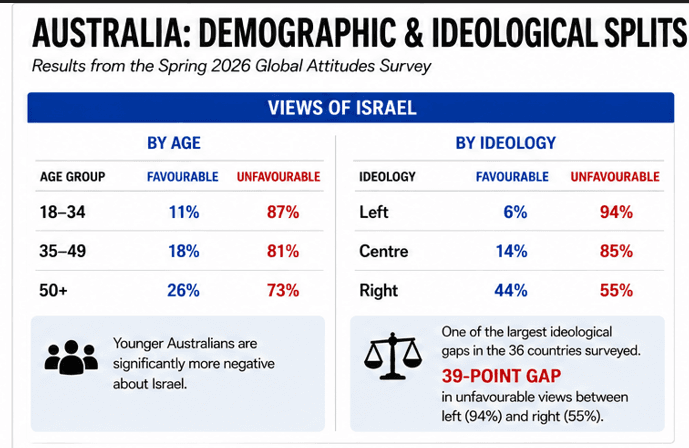
The most significant finding in the Australian data is the extent to which younger Australians are driving these results. Among Australians aged 18 to 34, an overwhelming 87 per cent hold an unfavourable view of Israel. Only 11 per cent express a favourable opinion.

By comparison, among Australians aged 50 and over, 73 per cent hold an unfavourable view and 26 per cent express a favourable opinion.

The Jewish Independent

The pattern is similar when it comes to Netanyahu. Just 6 per cent of Australians aged 18 to 34 say they have confidence in the Israeli leader, while 82 per cent report little or no confidence.

Among Australians aged 50 and above, confidence rises to 24 per cent, although a substantial 74 per cent still express little or no confidence.

The findings suggest attitudes towards Israel have become increasingly generational. While older Australians remain largely critical, younger Australians are considerably more negative, creating one of the clearest age divides recorded in the survey.

This trend mirrors broader developments across many Western countries, where younger voters have become more critical of Israel in recent years, particularly following the Gaza war and the wider regional conflict that has dominated international headlines since October 2023.

Politics matters too

Among Australians who identify on the political left, 94 per cent hold an unfavourable view of Israel. Among those on the political right, the figure falls to 55 per cent, although even a majority of right-leaning respondents still express a negative opinion.

Australians on the political left are among the most critical of Israel anywhere in the survey. With 94 per cent expressing an unfavourable view, Australia's left ranks alongside the most negative left-leaning constituencies across the 36 countries surveyed, while the 39-point gap between left and right is one of the largest ideological divides recorded by Pew. Pew also found that Australians on the left are substantially more likely than those on the right to express no confidence in Netanyahu.

The Jewish Independent

The findings highlight how views of Israel have become increasingly intertwined with broader political identities and debates. While criticism of Israeli governments has long existed across the political spectrum, the scale of the ideological divide suggests that attitudes towards Israel are now becoming part of wider cultural and political fault lines.

More than a reaction to current events?

For Australia's Jewish community and supporters of Israel, the survey is likely to reinforce concerns that negative perceptions are becoming increasingly entrenched, particularly among younger generations.

The data suggests the challenge may extend beyond reactions to current events. The age divide points to a broader shift in how younger Australians understand Israel, the Israeli-Palestinian conflict and the country's role in global affairs.

Equally notable is the degree to which views of Israel and views of Netanyahu now appear closely aligned. Previous surveys often revealed a distinction between attitudes towards Israel as a country and attitudes towards its political leadership. The latest results suggest that, for many Australians, that distinction is becoming less pronounced.

Whether these attitudes soften if the regional conflict subsides or if Israel experiences a change of leadership remains to be seen. For now, however, the Pew data points in one direction: Australians are increasingly critical of Israel, and nowhere is that trend more pronounced than among younger Australians.

Methodology

The findings are based on the Pew Research Center's Spring 2026 Global Attitudes Survey, conducted across 36 countries. In Australia, interviews were carried out with a nationally representative sample of adults using Pew's established survey methodology. Respondents were asked about their views of Israel and their confidence in Israeli Prime Minister Benjamin Netanyahu to do the right thing regarding world affairs. The Australian results were weighted to reflect national demographic characteristics and are comparable with surveys conducted in previous years, allowing for year-on-year trend analysis.

You might also like
  • Abuse by IDF soldiers humiliates Muslim Palestinians
    Ben Lynfield
  • Beinart takes a wrecking ball to Israel
    Michael Visontay
  • Diaspora leadership must be candid about its disillusion with Netanyahu
    Colin Shindler
logomark.67a07ee3
We believe in the free flow of information

Republish our articles for free, online or in print, by using our Creative Commons licence

You might also like

    Albanese Bondi
    Royal CommissionAnalysisAustralia

    Prime minister’s absence exposes weakness in Royal Commission hearings

    Michael Visontay
    chanukah by the sea bondi
    Royal CommissionOpinionAustralia

    Safety not just security: the last word to the Royal Commission

    Yehoram Ulman 1
    PENNY WONG P
    Israel Hamas WarAnalysisAustralia

    Zomi investigation delivers new low in Australia-Israel relations

    Michael Visontay 7

Comments8

  • Avatar of JM

    JM4 July at 07:28 am

    To Susan Bures. If you go to the research you can find the detail of methodology. It’s all quite transparent.

  • Avatar of Rachel Sussman

    Rachel Sussman25 June at 03:39 am

    We all want to be loved and liked – it is a human condition. We also know that those who make choices to please and be liked, sell their Souls…
    Yes the anti-Israel/Zionist/antisemitic movement is growing around the world and not surprisingly, especially withing young people who are exposed to one sided misinformation, education, and often false narratives.
    Blaming Bib, or policies may make us feel good, but is really ‘blood leibel’.
    Of course many do not like Bibi and object current government policies and actions – that is ok. But many do not like the leaders, policies and actions of Russia, China, Iran, USA, etc. yet no ‘movement’ is calling to exterminate these countries/ people. Yes, they are criticised but people still visit them, buy their products, there is no call for intifada against the.
    So I suggest that we wake up and call a spade a spade, stop looking for ‘something to blame’, fight to educate so that the same that is afforded to other countries/people is afforded to us and Israel.
    Sure, we can criticise Israelis policies and leaders, speak up, but please let us not fall into this ‘blame’; remember they hated us before Israel!

  • Avatar of Deborah Stone

    Deborah Stone22 June at 01:39 pm

    Please follow the link to the full report for an explanation of the data.

  • Avatar of Kati haworth

    Kati haworth22 June at 01:43 am

    How do I interpret results that don’t add to 100? There is one country that only adds to 60 when totalling the nay and the yay. What do the percentages mean when there is such a gap? Please explain as I think it skews the interpretation.

About the author

Shahar Burla

Shahar Burla

Dr Shahar Burla is a Sydney-based researcher, lecturer and Contributing Editor of TJI. Shahar holds a Master’s degree in political science from Hebrew University and a PhD in political science from Bar-Ilan University. He is the author of Political Imagination in the Diaspora: The Construction of a Pro-Israeli Narrative (2013) and co-editor of Australia and Israel: A Diasporic, Cultural and Political Relationship (2015).

More from the author

AnalysisIsrael

Bennett’s balancing act: can he win over the right without losing the centre?

OpinionIsrael

Flying to vote is an act of love, not impudence

AnalysisIsrael

Palestinians disillusioned with Hamas and armed struggle: new survey

AnalysisIsrael

Netanyahu rejects Trump’s Gaza plan, testing US influence in the region

  • Avatar of Mark Ian

    Mark Ian19 June at 01:47 am

    This is predominantly related to humanitarian reactions to the tough Israel counterattack after the Hamas Massacres with Heinous Atrocities .
    Israelis so personally affective could not empathise with the Gaza situation as much distant peoples .
    The Western press was too scared to show images of wild celebrations in Gaza over the massacres and atrocities for fear of causing violent cycles revenge .
    Also many news outlet wanted coverage rights in Gaza and pictures out of Gaza of killed and injured Hamas fighters would mean expulsion or assassination.
    Images of civilian deaths and injuries had to be predominant to ensure rights to cover the War .
    The narrative that only senior Hamas families like the Sinwar family were permitted refuge in the deep tunnels could not be safely expressed .
    This is not to say that a more humane Israel ought to have offered refuge to children and their maternal carers In the
    Negev or Palestinian Cities as suggested by Jarrod Kushner is not worthy of honest questioning.

  • Avatar of Michael Jaku

    Michael Jaku19 June at 12:17 am

    Since when is the West Bank a country? Must have missed something!

  • Avatar of Susan Bures

    Susan Bures18 June at 09:43 pm

    I’m very curious to know how many people in Australia were interviewed

  • Avatar of Ian Bowie

    Ian Bowie18 June at 07:20 am

    The survey results reported here should make for very uncomfortable for all Australians, especially politicians. Entitlement and exceptionalism do not play out any better in Australia than victimhood. Religious Jewry in Australia should reflect on this. In particular, all Australians need to be helped to understand that there is no necessary association between religious Jewry and the behaviour of the State of Israel – just as there is no necessary association say between Anglicanism and the behaviour of the Kingdom of England, or between say Islam and the behaviour of the Kingdom of Saudi Arabia. Religion and politics do not mix well.