Aa
  • Read, Watch, Listen
  • TJI Series
  • Community Action
  • Events
  • Zedi
Follow us and continue the conversation
  • LinkedIn
  • Instagram
  • FaceBook
  • X
  • YouTube
Test yourself with the TJI Quiz!

Adjust size of text

Aa

Follow us and continue the conversation

  • LinkedIn
  • Instagram
  • FaceBook
  • X
  • YouTube

Your saved articles

You haven't saved any articles

What are you looking for?

Original reporting, insightful analysis and diverse views, delivered straight to your inbox

  • LinkedIn
  • Instagram
  • FaceBook
  • X
  • YouTube
Your support fuels our mission to inform, entertain and inspire.

The Jewish Independent is bound by the Standards of Practice of the Australian Press Council. If you believe the Standards may have been breached, you may approach The Jewish Independent or make a complaint to the Australian Press Council in writing at www.presscouncil.org.au. The Council may also be contacted on 1800 025 712.

  • Our Story
  • Contact us
  • Our Team
  • Support us
  • Guidelines
  • Pitch your idea
  • Republishing us
  • Community Action
  • Our Awards
  • LinkedIn
  • Instagram
  • FaceBook
  • X
  • YouTube
Aboriginal FlagTorres Strait Islanders Flag

The Jewish Independent acknowledges Aboriginal and Torres Strait Islander peoples as the Traditional Owners and Custodians of Country throughout Australia. We pay our respects to Elders past and present, and strive to honour their rich history of storytelling in our work and mission.

© The Jewish Independent 2026All Rights Reserved
Website design and development by Your Creative, MelbourneTerms & ConditionsPrivacy Policy
HomeRead, Watch, ListenAustralia
ReflectionAustralia

Bondi memorials expose politics of Jewish symbols

Using a chanukiah to commemorate Bondi victims is expressing solidarity with the Jewish community without having to use a symbol strongly associated with Israel.
Michael Visontay
Print this
Sydney Celebrates New Years Eve 2026

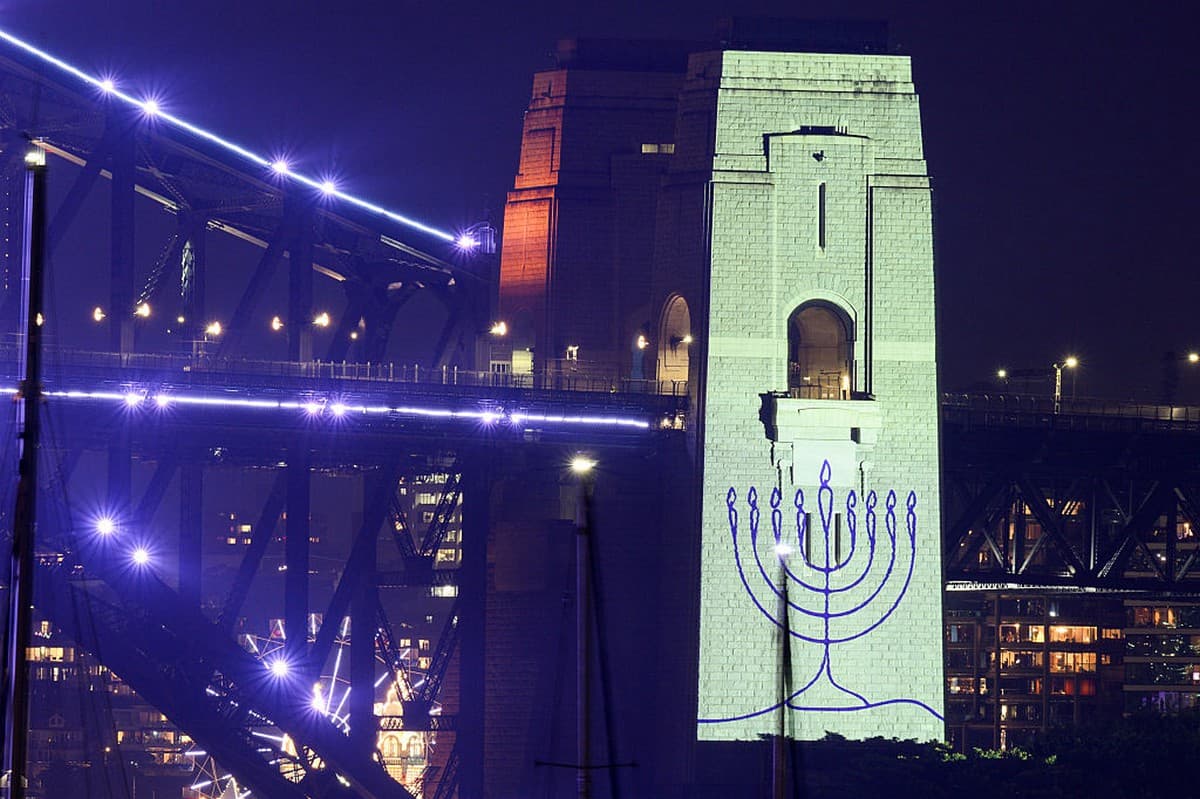
Chanukiah projected onto the Sydney Harbour Bridge pylon, December 31, 2025 (Getty)

Published: 22 January 2026

Last updated: 22 January 2026

For close to two millennia, the six-pointed Magen David (Star of David) has been the recognised symbol of the Jews. It is found in synagogues built in 3rd- 4th century CE; appears in mystical texts from the 13th century; was adopted by the First Zionist Congress in 1897; and was enshrined as the centrepiece of the Israeli flag in 1948.

There has been no other symbol so readily identifiable as Jewish – until now.

The massacre of Jews celebrating Chanukah at Bondi Beach on December 14 has elevated to public consciousness a different symbol: the nine-branch candelabra, known as a chanukiah or Chanukah menorah. It has been transformed from a symbol known mainly by Jews to one understood in the broader community. It will be cemented further in the national psyche after today’s National Day of Mourning.

In the aftermath of the terror attack that left 15 dead and 40 others wounded, the chanukiah has appeared in memorials and vigils all over the world in honour of those who lost their lives.

From the pylon of the Sydney Harbour Bridge to London and Berlin, the chanukiah has been chosen by civil authorities and community groups, over the Magen David, to commemorate the loss of Jewish life. While the star has been present, the chanukiah has been dominant.
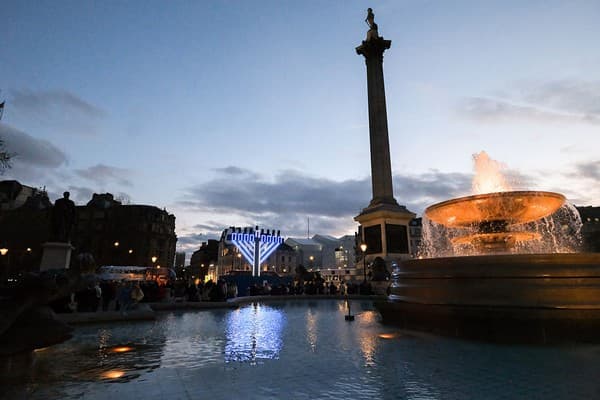

Chanukiah on Trafalgar Square following the Bondi Beach attack (Matthew Chattle/Future Publishing via Getty Images)

In one sense this is unremarkable, since the attack targeted a communal festival, whose centrepiece was a large chanukiah. The Chabad community, whose event was the target of the shooters and who sustained heavy losses, has a strong tradition of public Chanukah events and a preference for anything that evokes religious observance.

Chanukiah's political message

Yet the emergence of the chanukiah as the symbol of choice also carries a subtle political significance. The Magen David speaks to both Israeli and Jewish identity. Although Jews often use it as jewellery or to decorate religious items, the form in which non-Jews most often see a Magen David is in the national flag of Israel. To the wider community, the Magen David is as much a national as a religious or cultural symbol.

Conversely, the candelabra, in its nine-branch form, is strictly a religious symbol, used on Chanukah. It evokes, but is distinct from, the seven-branch menorah, which is drawn directly from ancient Jewish history, appears in the Bible and was a centrepiece of the ancient Temple.

The symbols of Judaism and Israel cannot be disentangled. The menorah is Israel’s official emblem, and appears on its coat of arms, early stamps, and in a large statue outside the Knesset. Yet the non-Jewish public does not associate it as strongly with the modern state of Israel.

The chanukiah presents Jews as people deserving of sympathy rather than being intertwined with Israel

For many Jews, the difference will go almost unnoticed. They have grown up with both the Magen David and menorah as cultural furniture and most Jewish homes have a chanukiah. Some within the broader community might also see the difference as irrelevant to their sympathies.

But in the context of widespread protests against Israel, the absence of the Magen David is no coincidence. Using a chanukiah as a Jewish motif offers a way of expressing solidarity with the Jewish community without having to use a symbol strongly associated with Israel, or wrestle with the invisible baggage of the Middle East conflict.

Put simply, the chanukiah presents Jews as people deserving of sympathy rather than being intertwined with Israel or tainted by the occupation of the Palestinian territories.

As political debates about antisemitism and the royal commission play out in the months ahead, the recurring images of the chanukiah will imprint the symbol more heavily on our collective memories.

Whether its profile endures in the longer term is uncertain. But for now, while it acts as a reminder of the Bondi Beach massacre, it will continue to send subtle messages about the nuances of modern Jewish identity.

You might also like
  • How to write an effective submission to the Royal Commission
    Judith Levitan
  • Commissioner begins antisemitism inquiry by ensuring shooter trial uncompromised
    Michael Visontay
  • Michal Herzog on antisemitism, education and sexual violence as a weapon of war
    Michael Visontay
logomark.67a07ee3
We believe in the free flow of information

Republish our articles for free, online or in print, by using our Creative Commons licence

You might also like

    Generation change Template
    Generation ChangeInterviewAustralia

    Ash Densham: Building community through Humanistic Judaism

    Gideon Cohen
    tame kostakidis west
    AnalysisAustralia

    How not to apologise

    Zac Klugman
    Article Image
    OpinionAustralia

    Mind the mentality: not every rejection is antisemitism

    Nomi Kaltmann

About the author

Michael Visontay

Michael Visontay

Michael Visontay is Commissioning Editor of TJI and was Editor-in-Chief from 2017-22. Michael is a former Assistant Editor of The Sydney Morning Herald and columnist with The Australian Jewish News. He has written six books, including Who Gave You Permission? with Manny Waks, and Welcome to Wanderland: Western Sydney Wanderers and the Pride of the West. His most recent book is Noble Fragments: the Maverick who broke up the world's greatest book (Scribe, 2024).

More from the author

ReflectionWorld

My memory of Gloria Steinem

NewsAustralia

No action to stop Hezbollah ally beaming antisemitic and anti-Israel content into Australia

NewsAustralia

Beinart takes a wrecking ball to Israel

AnalysisAustralia

Prime minister’s absence exposes weakness in Royal Commission hearings

Comments

No comments on this article yet. Be the first to add your thoughts.