Aa
  • Read, Watch, Listen
  • TJI Series
  • Community Action
  • Events
  • Zedi
Follow us and continue the conversation
  • LinkedIn
  • Instagram
  • FaceBook
  • X
  • YouTube
Test yourself with the TJI Quiz!

Adjust size of text

Aa

Follow us and continue the conversation

  • LinkedIn
  • Instagram
  • FaceBook
  • X
  • YouTube

Your saved articles

You haven't saved any articles

What are you looking for?

Original reporting, insightful analysis and diverse views, delivered straight to your inbox

  • LinkedIn
  • Instagram
  • FaceBook
  • X
  • YouTube
Your support fuels our mission to inform, entertain and inspire.

The Jewish Independent is bound by the Standards of Practice of the Australian Press Council. If you believe the Standards may have been breached, you may approach The Jewish Independent or make a complaint to the Australian Press Council in writing at www.presscouncil.org.au. The Council may also be contacted on 1800 025 712.

  • Our Story
  • Contact us
  • Our Team
  • Support us
  • Guidelines
  • Pitch your idea
  • Republishing us
  • Community Action
  • Our Awards
  • LinkedIn
  • Instagram
  • FaceBook
  • X
  • YouTube
Aboriginal FlagTorres Strait Islanders Flag

The Jewish Independent acknowledges Aboriginal and Torres Strait Islander peoples as the Traditional Owners and Custodians of Country throughout Australia. We pay our respects to Elders past and present, and strive to honour their rich history of storytelling in our work and mission.

© The Jewish Independent 2026All Rights Reserved
Website design and development by Your Creative, MelbourneTerms & ConditionsPrivacy Policy
HomeRead, Watch, ListenIsrael
Israel Hamas WarExplainerIsrael

Famine officially declared in Gaza: IPC report, Israel’s rebuttal

The UN’s food security body has declared a famine in Gaza for the first time. Israel dismissed the determination as biased and false. Here’s what you need to know.
TJI Wrap
Print this
A crowd of women holding out empty bowls.

Palestinians wait for food aid in Gaza City, where the IPC has declared hunger has reached famine levels (Khames Alrefi/Anadolu via Getty Images)

Published: 26 August 2025

Last updated: 26 August 2025

The UN’s food security body has declared a famine in Gaza for the first time, warning of mass starvation across the area.

The Integrated Food Security Phase Classification (IPC) — the globally recognised index for assessing hunger — has declared the areas around and including Gaza City at the highest level of food insecurity, while other parts of Gaza are suffering from significant but less severe food crisis.

“Over half a million people in the Gaza Strip are facing catastrophic conditions characterised by starvation, destitution and death,” the IPC report found.

Israel has restricted the entry of most food and other essential aid into the enclave since the war began nearly two years ago.

How bad is Gaza's food crisis?

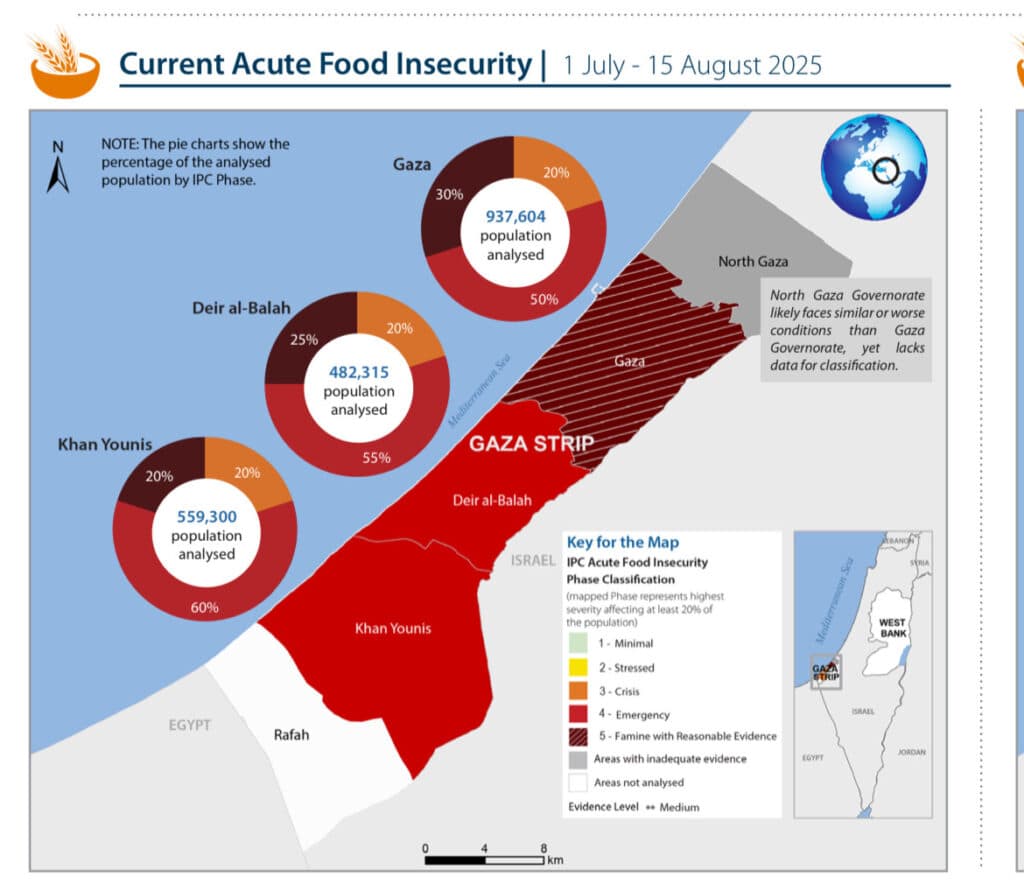
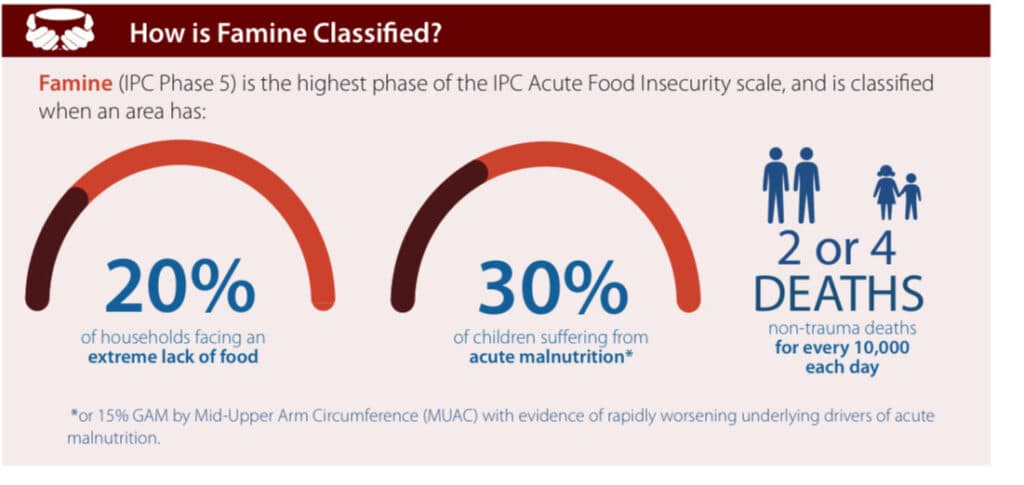
Just under a third of Gaza's population (32%) are in Famine (Phase 5), the highest level of the IPC classification. For Famine classification, an area needs to have extreme critical levels of acute malnutrition and mortality. Starvation, death, destitution and extremely critical acute malnutrition levels must be evident.

A further 1.07 million people (54%) are in Emergency (Phase 4), and 396,000 (20%) are in Crisis (Phase 3).

The Food Review Committee (FRC) noted this is the fifth review of Gaza’s food security, with conditions worsening despite repeated warnings. It confirmed famine in Gaza Governorate, projected imminent famine in Deir al-Balah and Khan Younis, and warned that conditions in North Gaza may be worse.
Source: <em>IPC special snapshot on the Gaza Strip</em>
Source: IPC special snapshot on the Gaza Strip

According to the report, famine is projected to spread to Deir al-Balah and Khan Younis by late September, with 641,000 people — almost a third of the population — facing catastrophic conditions. Acute malnutrition among children under five is expected to double to 132,000 cases by mid-2026, including 41,000 severe cases at high risk of death. Around 55,500 pregnant and breastfeeding women urgently require nutritional support.

Conditions in North Gaza are believed to be equally severe, but a lack of data prevents formal classification.

What does the IPC scale mean?

The IPC is a set of tools and procedures used to classify the severity and characteristics of acute food and nutrition crises based on international standards. It comprises four interlinked functions, each with specific protocols, focusing on consensus-building, evidence convergence, accountability, transparency and comparability. IPC analyses are designed to inform emergency responses as well as medium- and long-term food security and nutrition policies.

Source: <em>IPC special snapshot on the Gaza Strip</em>
Source: IPC special snapshot on the Gaza Strip

The IPC defines five phases of acute food insecurity:

  • Phase 1: Households can meet essential food and non-food needs without engaging in atypical or unsustainable strategies to access food and income.
  • Phase 2: Households have minimally adequate food consumption but cannot afford some essential non-food expenses without resorting to stress-coping strategies.
  • Phase 3: Households have food consumption gaps reflected by high or above-usual acute malnutrition, or they meet minimum food needs only by depleting essential livelihood assets or through crisis-coping strategies.
  • Phase 4: Households face large food consumption gaps, with very high acute malnutrition and excess mortality, or mitigate large gaps only through emergency livelihood strategies and asset liquidation.
  • Phase 5: Households face an extreme lack of food and/or are unable to meet other basic needs even after exhausting all coping strategies. Starvation, death, destitution and critically high acute malnutrition are evident.

What are the drivers of the crisis?

According to the IPC report the key issues are:

  • Escalating violence: Fighting has increased since March 2025, peaking in July with 3,700 killed and 14,000 injured, displacing 800,000 people.
  • Food supply collapse: There was a complete halt of aid in March–April, and minimal deliveries since. Of the UN aid trucks that enter Gaza, 87% have been intercepted.
  • Public health collapse: Destroyed healthcare, water, sanitation, and nutrition systems, rising disease, and underreported non-trauma deaths.

What are the recommendations?

  • Immediate, large-scale, multi-sector humanitarian action is essential — food aid alone is insufficient without healthcare, water, sanitation, shelter and fuel.
  • A sustained ceasefire is critical to allow aid to reach civilians and prevent exponential increases in mortality.
  • Delays — even by days — will cause a devastating escalation in deaths.
  • The FRC urges governments, donors, and international actors to act decisively, end the conflict, ensure unhindered humanitarian access, and restore basic services. The report concludes that inaction will result in an avoidable humanitarian catastrophe of unprecedented scale.

How did Israel respond?

Israel swiftly denied the report, claiming that the IPC relies on Hamas sources and accusing it of having “twisted its own rules” in declaring a famine. In a statement on Friday, the Prime Minister’s Office (PMO) called the IPC declaration an “outright lie” and a “modern blood libel.”

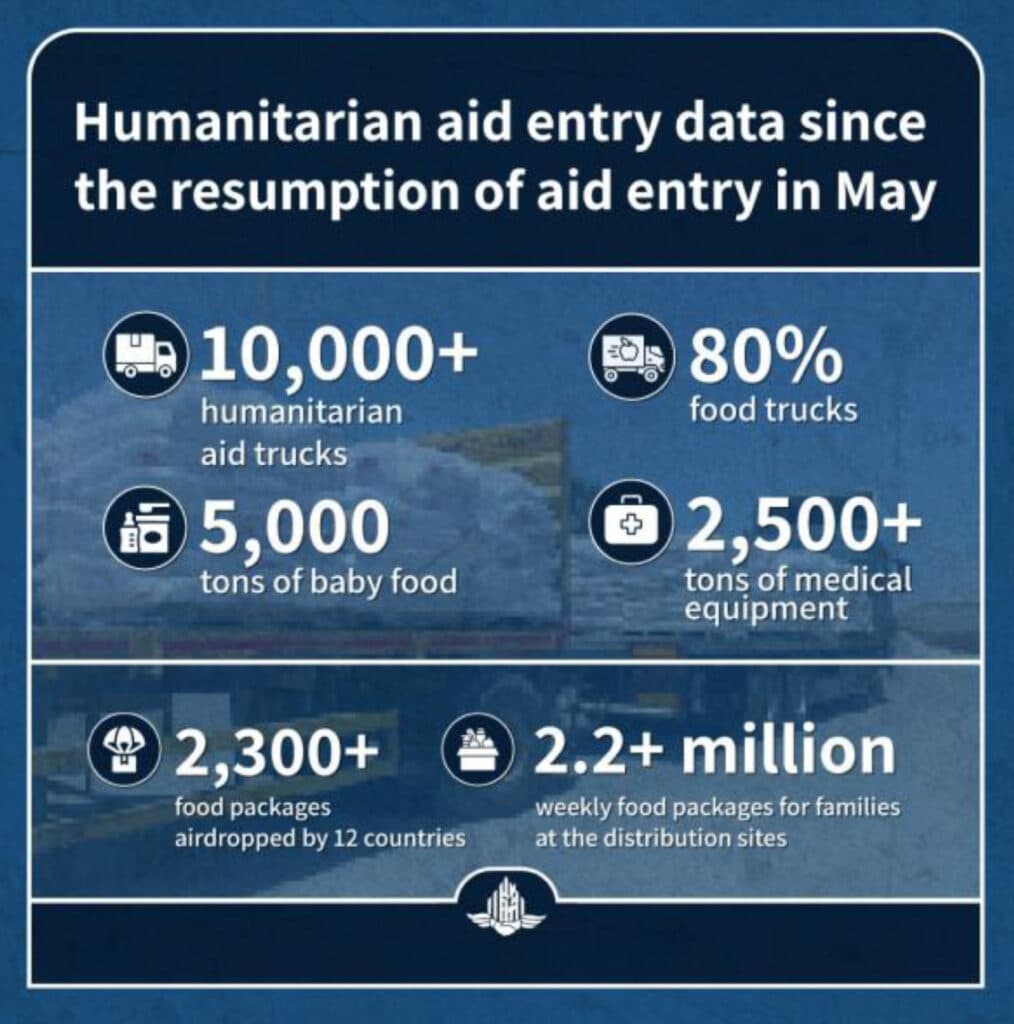
The PMO cited data from the Coordination of Government Activities in the Territories (COGAT) and the Defence Ministry, highlighting that two million tonnes of aid have entered Gaza since 7 October 2023 — equivalent to one tonne per capita. It stated: “Like all previous IPC reports, this one ignores Israel’s humanitarian efforts and Hamas’s systematic theft … Hamas steals aid to finance its war machine. These were the causes of temporary shortages, which Israel overcame with airdrops, maritime deliveries, safe transport routes, and GHF distribution points manned by American companies.”

Source: <em>COGAT humanitarian efforts in the Gaza strip – response to recent IPC publication/August 2025</em>
Source: COGAT humanitarian efforts in the Gaza strip – response to recent IPC publication/August 2025

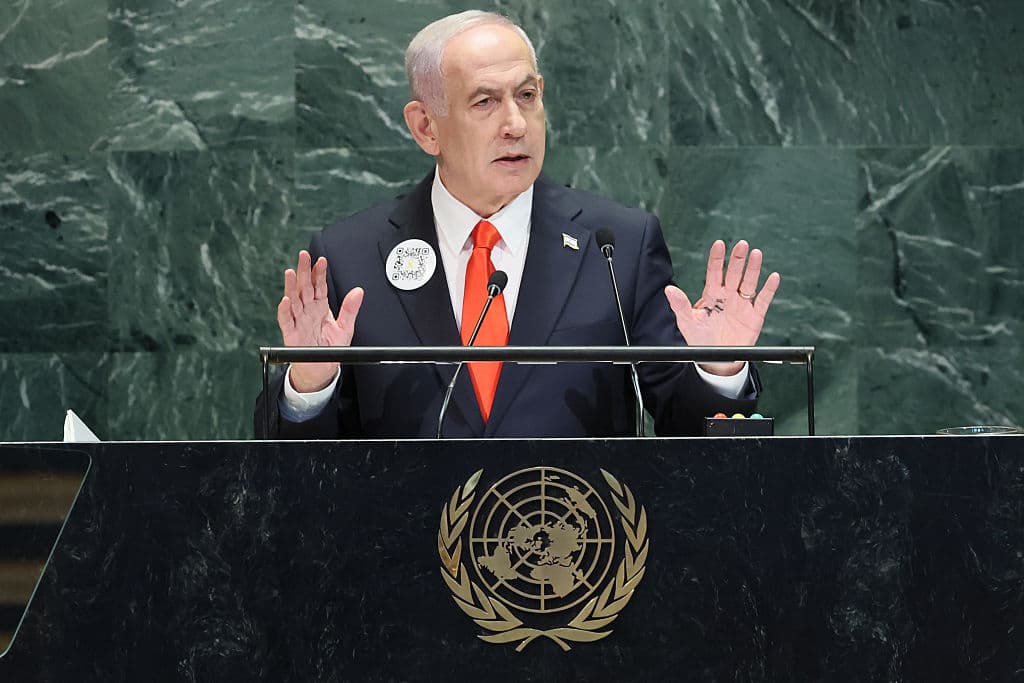
Prime Minister Netanyahu said, “Israel has enabled two million tonnes of aid to enter the Gaza Strip since the start of the war, and prices have plunged because of Israel’s surge in humanitarian aid in Gaza.”

In a detailed document the COGAT rejected the IPC’s findings, saying “Previous IPC assessments have repeatedly proven inaccurate and fail to reflect reality on the ground. This one-sided approach disregards the extensive humanitarian efforts undertaken in Gaza. It is illogical to suggest conditions will worsen when improvements are already evident.”

According to COGAT, internal Israeli security data shows sharp declines in the prices of basic goods in Gaza following a “massive influx of humanitarian aid” in recent weeks:

  • Flour dropped from NIS 80–100 per kg three weeks ago to NIS 18.
  • Sugar dropped from NIS 300 per kg to NIS 50.
  • Pasta dropped from NIS 100 per kg to NIS 10.

COGAT concluded that Israel has improved logistical coordination and enhanced targeted deliveries to the most vulnerable, even under active security threats. It accused the IPC of “lowering the bar” for famine classification and questioned its “integrity and professionalism.”

The Israeli Foreign Ministry also denounced the report as “a tailor-made fabricated report to fit Hamas’s fake campaign”, alleging that the IPC changed its global standard (lowering the 30% threshold to 15%) and ignored death rate criteria solely to target Israel.

“The laws of supply and demand don’t lie — the IPC does. Every forecast the IPC has made regarding Gaza during the war has proven baseless and completely false. This assessment, too, will be thrown into the despicable trash bin of political documents,” the PMO said, labelling the report a “modern blood libel” and warning that “history will judge those who peddle it.”

Sources told Haaretz that the report has caused unease in Jerusalem, with military and government officials meeting earlier this week to discuss the issue of starvation in Gaza.

In The Guardian, Peter Beaumont argued that Israel’s claims are contradicted by the IPC’s ruling and by independent evidence: “Aid agencies large and small — including Médecins Sans Frontières’ clinics — have been collecting their own data showing rising acute malnutrition. Palestinian doctors, journalists and ordinary people have described going without food for days, suffering dramatic weight loss and exhaustion. The most vulnerable — young children, the elderly, and those with pre-existing medical conditions — have begun dying as expected in an unfolding famine.”

Beaumont also noted that while Israel blocks foreign media access to Gaza, it has brought in sympathetic social media “influencers” to amplify its denials and continues to blame Hamas and UN agencies, including UNRWA, which it has banned from operating in Israel.

READ MORE

IPC special snapshot on the Gaza Strip

COGAT humanitarian efforts in the Gaza strip – response to recent IPC publication/August 2025

Outrage after Israel kills five journalists in ‘double-tap’ attack on Gaza hospital (CNN)

Declaration of famine in Gaza lays bare Israel’s disregard for humanitarian duty (Peter Beaumont, The Guardian)

Famine in Gaza confirmed by hunger monitor for first time since war started (Bark Ravid, Axios)

'Starvation Is everywhere': virtual tours of Gaza clinics expose the scale of the horror (Haaretz)

 In first, UN says over half a million Gazans suffering from famine; Netanyahu: 'outright lie' (Haaretz)

Gaza’s biggest city is in chaos ahead of an imminent Israeli assault (CNN)

You might also like
  • ‘Israel is systemically eliminating Palestinian collective life’:  B’Tselem
    Deborah Stone
  • Tame apologises – but with little grace
    Deborah Stone
  • Confronting Richard Flanagan and the myth of the Israel lobby
    Mary Garden
logomark.67a07ee3
We believe in the free flow of information

Republish our articles for free, online or in print, by using our Creative Commons licence

You might also like

    Arab Israeli Palestinian election vote
    Israel Votes 2026FeatureIsrael

    Fear of Netanyahu victory may drive big surge in Palestinian voter turnout

    Ben Lynfield
    Yoav Segalovitz Mansour Abbas
    Israel Votes 2026OpinionIsrael

    Because of my Zionist values, I’m joining an Arab party

    Yoav Segalovitz 1
    Segalovitz Abbas
    Israel Votes 2026AnalysisIsrael

    Segalovitz decision to join Arab party is a paradigm change for Israel

    Eetta Prince-Gibson

About the author

TJI Wrap

TJI Wrap

TJI wraps consolidate essential news and analysis from multiple sources into digestable summaries.

More from the author

NewsAustralia

War crimes allegations against Australian IDF soldier

NewsWorld

Wave of attacks on Jewish sites sparks international alarm

AnalysisIsrael

Gaza, Lebanon, Syria, Iran: Israel’s tense security landscape

AnalysisIsrael

Middle East on edge as Iran and Israel inch closer to another war

Comments

No comments on this article yet. Be the first to add your thoughts.