Aa
  • Read, Watch, Listen
  • TJI Series
  • Community Action
  • Events
  • Zedi
Follow us and continue the conversation
  • LinkedIn
  • Instagram
  • FaceBook
  • X
  • YouTube
Test yourself with the TJI Quiz!

Adjust size of text

Aa

Follow us and continue the conversation

  • LinkedIn
  • Instagram
  • FaceBook
  • X
  • YouTube

Your saved articles

You haven't saved any articles

What are you looking for?

Original reporting, insightful analysis and diverse views, delivered straight to your inbox

  • LinkedIn
  • Instagram
  • FaceBook
  • X
  • YouTube
Your support fuels our mission to inform, entertain and inspire.

The Jewish Independent is bound by the Standards of Practice of the Australian Press Council. If you believe the Standards may have been breached, you may approach The Jewish Independent or make a complaint to the Australian Press Council in writing at www.presscouncil.org.au. The Council may also be contacted on 1800 025 712.

  • Our Story
  • Contact us
  • Our Team
  • Support us
  • Guidelines
  • Pitch your idea
  • Republishing us
  • Community Action
  • Our Awards
  • LinkedIn
  • Instagram
  • FaceBook
  • X
  • YouTube
Aboriginal FlagTorres Strait Islanders Flag

The Jewish Independent acknowledges Aboriginal and Torres Strait Islander peoples as the Traditional Owners and Custodians of Country throughout Australia. We pay our respects to Elders past and present, and strive to honour their rich history of storytelling in our work and mission.

© The Jewish Independent 2026All Rights Reserved
Website design and development by Your Creative, MelbourneTerms & ConditionsPrivacy Policy
HomeRead, Watch, ListenIsrael
Israel

Netanyahu’s options range from bad to worst

Dror Doron
Print this
72640-4

Published: 9 October 2023

Last updated: 5 March 2024

Hamas wants more conflict. Its attack was designed to show that an armed struggle is far more effective than the failed political path chosen by the PA.

Fifty years to the day after the 1973 Yom Kippur war, Israel’s enemies were once again able to surprise the IDF and carry out a large-scale coordinated attack without any warning. The total lack of preliminary intelligence and the low readiness of the Israeli forces during a national holiday has contributed to a devastating outcome.

The main distinction between today and 1973 is that on this Saturday, many of the victims were not soldiers, but innocent civilians who found themselves facing hundreds of armed and well-trained aggressors. The photos and videos circulating on different social media platforms are shocking.

Men, women and children were slaughtered inside their homes or taken as prisoners and hostages and led into the Hamas-controlled Gaza strip as bargaining chips for future negotiations designated for the release of thousands of Palestinians terrorists from Israeli jails.

These unprecedented events of brutally massacred civilians in villages and settlements along the Gaza-strip border were of a kind no-one in Israel had ever conceived possible, and resembled incidents occurring only once before in secluded settlements during the 1948 war of independence.

The limited IDF forces in the area during the Shabbat and the Sukkot holiday were overwhelmed by the staggering number of Hamas militants who stormed the border barrier and crossed into Israel. This well-orchestrated attack, that no doubt took months of planning and training, was carried out in a few short hours, using a large salvo of rockets fired into central Israel at sunrise as a diversion.

Using motorcycles, motorised paragliders and light boats, the militants crossed the few kilometres separating Gaza and the Israeli civilian communities in a matter of hours. Today, more than 700 Israelis are dead, 1800 wounded and more than a hundred taken hostage.


The IDF failed in its most basic mission – defending the civilian population. Then followed an almost undisturbed massacre.

The IDF failed in its most basic mission – defending the civilian population. What followed was an almost undisturbed massacre and it took Israel too many hours to gain control over the situation.

The declarations by Prime Minister Benjamin Netanyahu have left no room for confusion. Israel is at war and the government promises the response will be different from any in the past. Tens of thousands of reserve soldiers were called up for duty, schools are closed, and most international airlines cancelled their flights to Ben Gurion airport.

Concurrently, first signs of the potential widening of the military confrontation into the West Bank and Lebanon is already evident. Israel foiled a few small-scale terror attempts and arrested prominent Hamas members in the West Bank, while Hezbollah has already fired mortars into northern Israel.

Hamas has called on all Arab governments and the general Arab public to join the confrontation against Israel. The formal reason is to stop Israeli aggression in general and specifically the heightened Jewish activity around holy sites in Jerusalem under the right-wing Israeli government.

It was Hezbollah that openly shed light on the more strategic goal of Hamas's unprecedented attack: initiating a military escalation to disturb, and hopefully derail, the ongoing peace negotiations between Saudi Arabia and Israel. That deal is meant to include concessions of economic and political gain for the Palestinian Authority (PA) and set the ground for future peace negotiations between Israel and the Palestinian leadership.

The concept of a peaceful Middle East, with Israel accepted as a legitimate partner, is a nightmare for Hamas and other radical Islamists in the region. A scenario of a stronger PA in the West Bank, which enjoys massive economic support from Saudi Arabia and would offer new hope for political solution of the Israeli-Palestinian conflict, does not serve Hamas’s interests.

Hamas, along with Iran and Hezbollah, needs an ongoing confrontation with Israel as part of a religious war to maintain its political logic and organisational identity. Without an external enemy in the form of the Jewish state, a major part of the reason for its existence will be missing. What is the meaning of a “resistance organisation” if there is a peaceful political solution and no enemy to resist?

Saturday’s attack was not meant to destroy Israel. It was mainly aimed to portray Hamas as the true representative of Palestinian goals and to illustrate that the concept of an armed struggle is far more effective than the failed political course of action represented by the PA. The negotiations to release Palestinian prisoners jailed in Israel in exchange for hostages taken during the raid will boost its image on the Palestinian street.

The negotiations to release prisoners in Israel in exchange for hostages will boost its image on the Palestinian street.

The potential for further escalation in the West Bank, which would destabilise the PA, would be another victory for Hamas, which holds a longstanding ambition to take over the West Bank and become the sole representative of the Palestinian cause.

Time will tell whether Hamas’s attack was a well-calculated military move that will lead to future political gains, or whether it was a step too far in pushing Israel to try end Hamas's rule in Gaza.

The ball is now in the hands of the Israeli government, but it seems Netanyahu will have to choose from a range of bad to worst options. The calls from the right-wing ministers in the government for the IDF to retake Gaza and destroy Hamas altogether represent their lack of military experience and understanding.

A ground invasion of the IDF into Gaza, one of the most densely populated areas in the world, would take weeks and most probably lead to a huge number of casualties on both sides. It is doubtful that the IDF generals will recommend this course of action.

The calls from the right-wing ministers for the IDF to retake Gaza and destroy Hamas represent their lack of military experience.

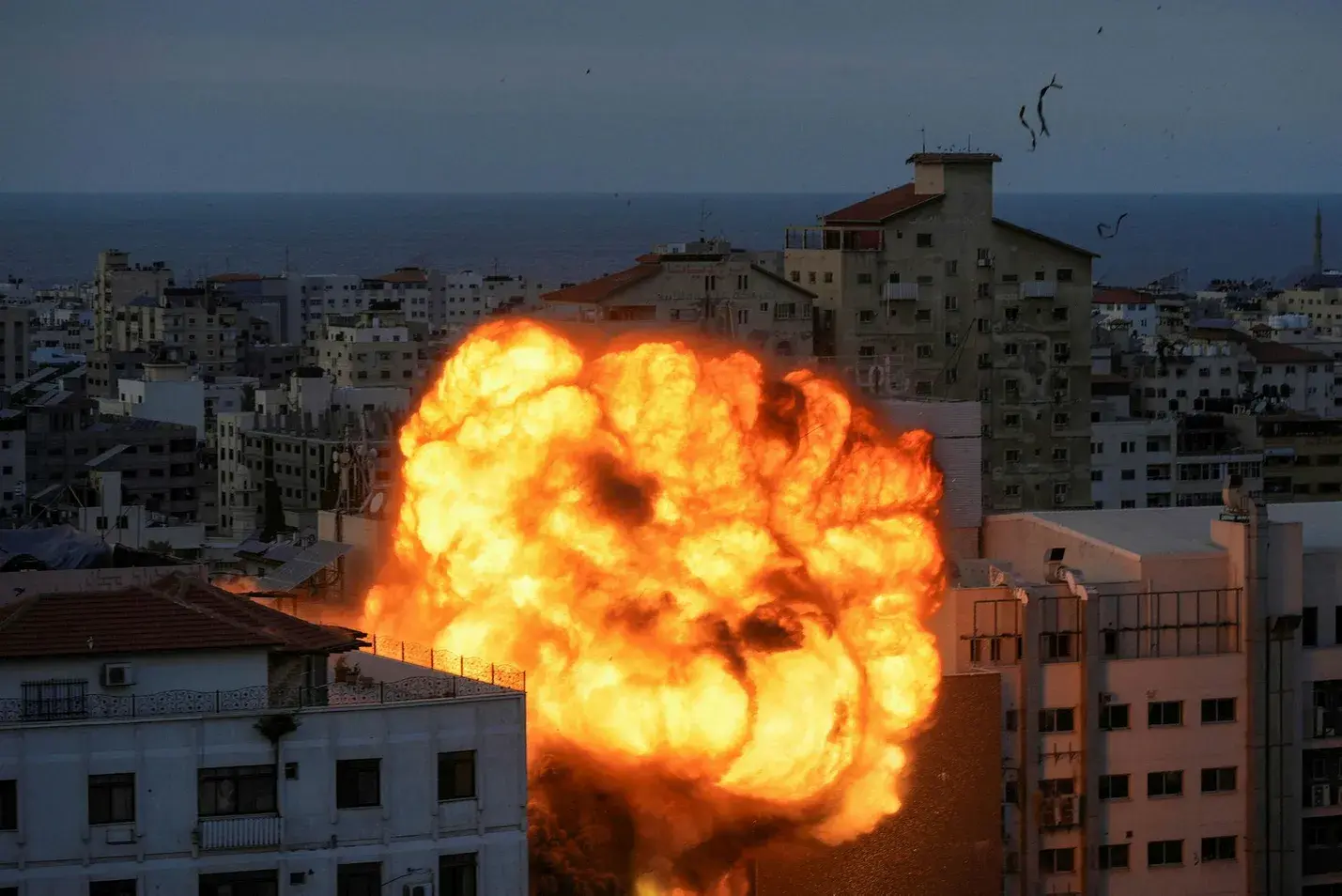
Large-scale aerial bombardments of Hamas targets in Gaza are already taking place and the rising number of dead civilians will curb the international legitimacy to continue those attacks. By now they hold limited operational logic, as all of the Hamas leadership and military operatives are well protected by civilian infrastructures such as hospitals, mosques and schools they use for hiding.

The frustration and anger among Israeli public and decision-makers due to the humiliating situation, horrifying images and limited military retaliation options is a dangerous combination. We can only hope that the calls for revenge will not prevent rational and calculated decisions. Otherwise, a very bad situation could get much worse.

Photo: Fire and smoke engulf a building in Gaza as Israel launches retaliatory strikes (Hatem Moussa/AP)

You might also like
  • The Altalena should be a warning, not a political weapon
    Shahar Burla
  • Turkey emerges as military threat to Israel
    Dror Doron
  • Because of my Zionist values, I’m joining an Arab party
    Yoav Segalovitz
logomark.67a07ee3
We believe in the free flow of information

Republish our articles for free, online or in print, by using our Creative Commons licence

You might also like

    Segalovitz Abbas
    Israel Votes 2026AnalysisIsrael

    Segalovitz decision to join Arab party is a paradigm change for Israel

    Eetta Prince-Gibson
    ISRAEL-TRANSPORT-AVIATION-STRIKE
    Israel Votes 2026AnalysisIsrael

    Bennett’s balancing act: can he win over the right without losing the centre?

    Shahar Burla 1
    fly to vote
    Israel Votes 2026OpinionIsrael

    Flying to vote is an act of love, not impudence

    Shahar Burla

About the author

Dror Doron

Dror Doron

Dror Doron is a senior political analyst specialising in the Middle East, and is a senior adviser at United Against Nuclear Iran (UANI) focusing on Hezbollah and Lebanon.

More from the author

AnalysisIsrael

Turkey emerges as military threat to Israel

AnalysisWorld

New Saudi-Pakistan-Turkey alliance driven by failure of US to subdue Iran

AnalysisIsrael

Trump’s Hamas disarmament deal a mirage that’s quickly faded

AnalysisIsrael

Syria reimagined: From military threat to geostrategic competitor