Aa
  • Read, Watch, Listen
  • TJI Series
  • Community Action
  • Events
  • Zedi
Follow us and continue the conversation
  • LinkedIn
  • Instagram
  • FaceBook
  • X
  • YouTube
Test yourself with the TJI Quiz!

Adjust size of text

Aa

Follow us and continue the conversation

  • LinkedIn
  • Instagram
  • FaceBook
  • X
  • YouTube

Your saved articles

You haven't saved any articles

What are you looking for?

Original reporting, insightful analysis and diverse views, delivered straight to your inbox

  • LinkedIn
  • Instagram
  • FaceBook
  • X
  • YouTube
Your support fuels our mission to inform, entertain and inspire.

The Jewish Independent is bound by the Standards of Practice of the Australian Press Council. If you believe the Standards may have been breached, you may approach The Jewish Independent or make a complaint to the Australian Press Council in writing at www.presscouncil.org.au. The Council may also be contacted on 1800 025 712.

  • Our Story
  • Contact us
  • Our Team
  • Support us
  • Guidelines
  • Pitch your idea
  • Republishing us
  • Community Action
  • Our Awards
  • LinkedIn
  • Instagram
  • FaceBook
  • X
  • YouTube
Aboriginal FlagTorres Strait Islanders Flag

The Jewish Independent acknowledges Aboriginal and Torres Strait Islander peoples as the Traditional Owners and Custodians of Country throughout Australia. We pay our respects to Elders past and present, and strive to honour their rich history of storytelling in our work and mission.

© The Jewish Independent 2026All Rights Reserved
Website design and development by Your Creative, MelbourneTerms & ConditionsPrivacy Policy
HomeRead, Watch, ListenIsrael
AnalysisIsrael

Hamas consolidates control in Gaza while Mid-East is distracted by Iran war

Hamas is using the current regional tensions to consolidate its position in Gaza, while engaging in indirect talks with the US and managing its relationship with Iran.
Shahar Burla
Print this
Hamas fighters Gaza 2026

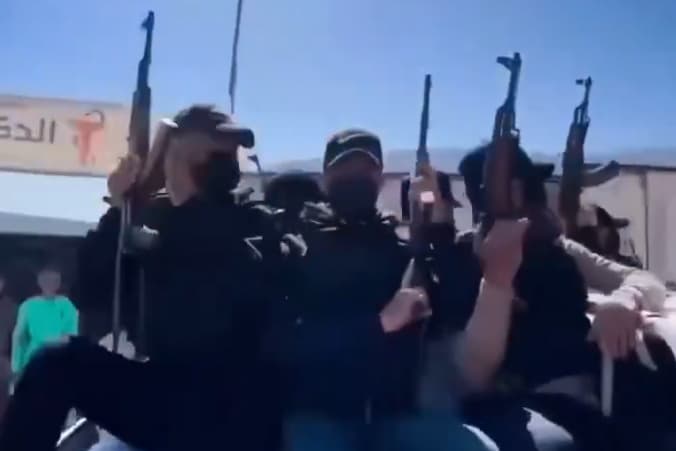
Masked Hamas fighters brandish weapons during a convoy in Gaza this week (X)

Published: 18 March 2026

Last updated: 18 March 2026

The Israeli and US strikes on Iran on 28 February have pushed the region towards a broader confrontation, with Tehran responding through missile and drone attacks across the Gulf and against Israel. Yet one arena has remained comparatively contained: Gaza.

Despite vocal support for Iran and sharp condemnation of Israel and the US, Hamas has so far avoided direct military involvement. That restraint is not only a product of weakness or constraint, it is also a strategic choice. With Israel’s attention increasingly absorbed by the Iran front, Hamas appears to be using the moment to consolidate its position at home.

As the war unfolds, the group is navigating multiple, sometimes competing priorities: reasserting control inside Gaza, engaging in indirect talks with Washington over the territory’s future, and managing its relationship with Iran, its long-time patron, while carefully preserving its own room to manoeuvre in a rapidly shifting regional landscape.

Reasserting control inside Gaza

In the aftermath of the October ceasefire, Gaza remains deeply fractured. Millions are displaced, infrastructure is devastated, and access to food, shelter and healthcare is limited. Within this environment, Hamas appears to be reasserting its authority.

Reports from Gaza, cited by Haaretz, point to a renewed visible presence of armed Hamas operatives in civilian areas, particularly in the densely populated coastal strip west of the so-called “Yellow Line”. This includes organised patrols, convoys, and an increased willingness to act against internal dissent.

Several incidents illustrate this pattern. Palestinian activists report cases of individuals detained, assaulted, or even killed after criticising Hamas publicly. In one widely circulated case, a Gaza resident who had condemned both Hamas and Iran online was abducted, severely beaten, and left outside a hospital. In another, a man was shot at a Hamas checkpoint under disputed circumstances.

This post, from former Israeli politician Major-General Yair Golan, captures a shows of strength by Hamas in Gaza this week.

These incidents have contributed to what observers describe as a growing climate of fear. According to Dr Asaf David, speaking to Haaretz, Gazans are increasingly cautious in their speech, often avoiding direct criticism and instead using indirect references.

At the same time, the picture is not entirely one-dimensional. Some residents reportedly see the return of Hamas policing as restoring a degree of order amid near-total institutional collapse. In a society where clan dynamics and local disputes can escalate quickly, the presence of an authority, even an unpopular one, can provide a measure of stability.

This dual reality captures Hamas’s current position: widely blamed for Gaza’s devastation, yet still functioning as its de facto governing authority.

Israeli-backed militias step up against Hamas in Gaza

Alongside Hamas’s efforts to consolidate control, a quieter but significant development is unfolding: the growing activity of Palestinian militias reportedly backed by Israel. These groups, including formations operating in Rafah and east of Khan Younis, have increased their operations in recent months. Their activities include raids, targeted killings, and attempts to infiltrate Hamas-controlled areas.

Though relatively small in number, these militias appear to have gained improved logistical support and operational capacity. Some have been deployed in Israeli-controlled zones, including at border crossings, while others have launched incursions deeper into Gaza.

Iran, which has provided Hamas with significant financial and military support over decades, now finds its ally engaging with Washington at a moment of direct confrontation.

Clashes between these groups and Hamas fighters have been reported in multiple regions, including Jabaliya and Gaza City. Hamas has responded with counter-operations, contributing to a rise in internal violence despite the broader ceasefire framework.

Quiet talks with Washington

Perhaps the most striking development is diplomatic rather than military. Even as the US participates in strikes against Iran, it is also engaged in indirect discussions with Hamas over Gaza’s future. Reports, including from Haaretz, indicate ongoing talks in Cairo involving Egypt and other mediators. These discussions focus on ceasefire implementation, governance arrangements, and the possibility of Hamas disarmament.

So far, there has been little concrete progress. But the very existence of such talks highlights the pragmatic dimension of Hamas’s current strategy.

For Hamas, the priorities are clear: preserving its position in Gaza, avoiding renewed large-scale war, and securing a role in any “day after” framework. For the US and regional actors, engagement, even indirect, reflects a recognition that Hamas remains a central player on the ground.

These talks have reportedly caused frustration in Tehran. Iran, which has provided Hamas with significant financial and military support over decades, now finds its ally engaging with Washington at a moment of direct confrontation.

Managing a strained relationship with Iran

Hamas’s relationship with Iran has always been strategic rather than purely ideological. As a Sunni movement backed by a Shiite power, the partnership has been shaped by shared opposition to Israel rather than deep alignment.

Since the beginning of the war, Hamas has publicly supported Iran’s right to respond to Israeli and US strikes, while also issuing an unusual call urging Tehran to avoid targeting neighbouring Gulf states. The message reflects Hamas’s delicate position: many of its senior leaders are based in Qatar, now itself exposed to potential Iranian retaliation.

There are also indications of disrupted communication channels between Hamas and Iranian officials, particularly within the Islamic Revolutionary Guard. According to regional reporting, contacts that were previously maintained even during past conflicts have gone silent.

Analysts cited by Al-Monitor suggest that Hamas sees direct involvement in the Iran war as both risky and impractical. Gaza remains devastated after nearly two years of war, and any escalation could trigger overwhelming Israeli retaliation.

“Hamas’s current priorities are to implement the ceasefire, prevent further war on Gaza, and oversee reconstruction,” political analyst Ibrahim al-Madhoun told Al-Monitor.

Historical tensions also linger. Hamas distanced itself from Iran during the Syrian civil war, later repairing ties. More recently, questions have been raised about the level of Iranian support during the October 2023 attacks and the subsequent war.

In the current conflict, Hamas has refrained from launching rockets at Israel, a notable departure from past patterns, even as other members of the so-called “Axis of Resistance”, including Hezbollah, have escalated their involvement.

Between consolidation and calculation

Hamas is operating under a complex mix of pressures,  but also, increasingly, opportunities.

Internally, it is tightening its grip over a shattered Gaza, reasserting authority, suppressing dissent, and restoring elements of day-to-day governance. Militarily, it continues to face challenges from Israeli operations and emerging rival militias. Diplomatically, it is engaging with actors it has long opposed, including the US.

Yet the regional moment is also working in its favour. With Israel’s attention and military resources heavily focused on the confrontation with Iran, Hamas appears to be regaining a degree of confidence on the ground. The relative reduction in sustained Israeli pressure, even if temporary, has created space for the group to reorganise, project control, and test its position.

At the same time, its relationship with Iran is being recalibrated. The broader “Axis of Resistance” is under strain following a series of setbacks, from leadership assassinations to shifting dynamics in Syria and Lebanon, and the current war is exposing new tensions within that alliance.

Hamas’s decision to stay out of direct confrontation with Israel, for now, reflects a calculated balance. Gaza remains too fragile to absorb another full-scale war, and escalation could jeopardise Hamas’s hold on power. But restraint does not necessarily signal weakness. Rather, it suggests a strategic pause, consolidating internally while watching how the regional picture evolves.

That calculation may not hold indefinitely. The outcome of the Iran war will shape Hamas’s strategic environment for years to come. A weakened Iran could leave Hamas more isolated; a resilient or resurgent Tehran could restore its strategic backing.

For now, Hamas is not simply reacting to events. It is using the moment, cautiously but deliberately, to strengthen its position, aware that the window created by Israel’s focus elsewhere may be limited.

READ MORE 

Hamas forcefully reasserts rule in Gaza under cover of Israel-Iran war (Haaretz) 

Hamas sits out Iran war as Gaza, Gulf interests take priority (Paywall, Al-Monitor) 

Hamas urges Iran to stop attacking Gulf states as Qatar pressures terror group to distance from Tehran (Ynetnws) 

Israeli-backed Palestinian militias step up operations against Hamas in Gaza (The Guardian) 

You might also like
  • Tame apologises – but with little grace
    Deborah Stone
  • Confronting Richard Flanagan and the myth of the Israel lobby
    Mary Garden
  • UK’s dramatic policy change on Israel-Palestine
    Colin Shindler
logomark.67a07ee3
We believe in the free flow of information

Republish our articles for free, online or in print, by using our Creative Commons licence

You might also like

    Yoav Segalovitz Mansour Abbas
    Israel Votes 2026OpinionIsrael

    Because of my Zionist values, I’m joining an Arab party

    Yoav Segalovitz 1
    Woman with land and houses behind her
    NewsAustralia

    Australia to increase sanctions against West Bank settlements

    Deborah Stone
    Netanyahu
    Israel Hamas WarFeatureIsrael

    New evidence Netanyahu was warned about October 7

    Shahar Burla 2

About the author

Shahar Burla

Shahar Burla

Dr Shahar Burla is a Sydney-based researcher, lecturer and Contributing Editor of TJI. Shahar holds a Master’s degree in political science from Hebrew University and a PhD in political science from Bar-Ilan University. He is the author of Political Imagination in the Diaspora: The Construction of a Pro-Israeli Narrative (2013) and co-editor of Australia and Israel: A Diasporic, Cultural and Political Relationship (2015).

More from the author

FeatureIsrael

New evidence Netanyahu was warned about October 7

OpinionIsrael

The Altalena should be a warning, not a political weapon

AnalysisIsrael

Who is Ofer Winter and could he upset Netanyahu’s election?

AnalysisIsrael

Bennett’s balancing act: can he win over the right without losing the centre?

Comments

No comments on this article yet. Be the first to add your thoughts.