Aa
  • Read, Watch, Listen
  • TJI Series
  • Community Action
  • Events
  • Zedi
Follow us and continue the conversation
  • LinkedIn
  • Instagram
  • FaceBook
  • X
  • YouTube
Test yourself with the TJI Quiz!

Adjust size of text

Aa

Follow us and continue the conversation

  • LinkedIn
  • Instagram
  • FaceBook
  • X
  • YouTube

Your saved articles

You haven't saved any articles

What are you looking for?

Original reporting, insightful analysis and diverse views, delivered straight to your inbox

  • LinkedIn
  • Instagram
  • FaceBook
  • X
  • YouTube
Your support fuels our mission to inform, entertain and inspire.

The Jewish Independent is bound by the Standards of Practice of the Australian Press Council. If you believe the Standards may have been breached, you may approach The Jewish Independent or make a complaint to the Australian Press Council in writing at www.presscouncil.org.au. The Council may also be contacted on 1800 025 712.

  • Our Story
  • Contact us
  • Our Team
  • Support us
  • Guidelines
  • Pitch your idea
  • Republishing us
  • Community Action
  • Our Awards
  • LinkedIn
  • Instagram
  • FaceBook
  • X
  • YouTube
Aboriginal FlagTorres Strait Islanders Flag

The Jewish Independent acknowledges Aboriginal and Torres Strait Islander peoples as the Traditional Owners and Custodians of Country throughout Australia. We pay our respects to Elders past and present, and strive to honour their rich history of storytelling in our work and mission.

© The Jewish Independent 2026All Rights Reserved
Website design and development by Your Creative, MelbourneTerms & ConditionsPrivacy Policy
HomeRead, Watch, ListenIsrael
AnalysisIsrael

Hezbollah disarmament has failed: what happens now?

Under the ceasefire agreement, Hezbollah should have been disarmed by now. But Lebanon's moves to peace with Israel have stumbled at this essential hurdle.
Dror Doron
Print this
Hezbollah Lebanon

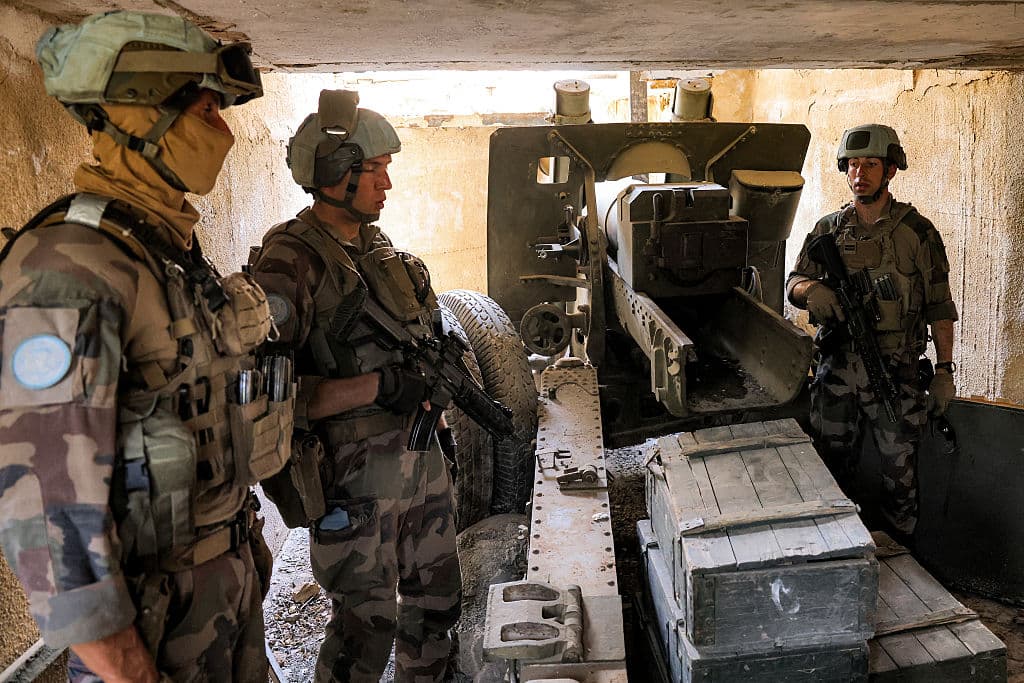
Peacekeepers of the United Nations Interim Force in Lebanon (UNIFIL) stand by an artillery gun at a fortified position formerly held Iran-backed Hezbollah in the Khraibeh Valley in el-Meri in south Lebanon on August 27, 2025. (ANWAR AMRO/AFP via Getty Images)

Published: 11 December 2025

Last updated: 11 December 2025

Dramatic changes occurred in Lebanon this year. A new Western-aligned president was elected, and a new government was sworn in. The notion of disarming Hezbollah, Iran’s crown jewel and most feared proxy terror organization, is openly debated as the government is officially committed to achieving a monopoly over the use of arms on Lebanon’s soil.

Lebanese politicians raised the possibility of peace with Israel publicly, and for the first time in decades, the government authorized a civilian official, and not a military man, to meet with an Israeli counterpart as part of the ceasefire oversight mechanism. The unprecedented interview of Israel’s ambassador in Washington by a Lebanese media outlet and the peaceful message ambassador Leiter sent to the Lebanese people were unthinkable just a year ago.

The Jewish Independent

Nevertheless, the possibility of a peace treaty with Lebanon is still far away. As Hezbollah is clinging to its arms and Tehran’s destructive shadow still looms over Beirut, Lebanon is unable to walk in the footsteps of the other Arab countries neighboring Israel. 

The harsh reality is that as weak as Hezbollah is, the organization's total rejection of the notion of peace with Israel and the fragility of the Lebanese domestic arena, lead to a stalemate that prevents any possibility of moving forward.

Without a strong central government, Lebanon’s ability to engage in any meaningful negotiations with Israel, the way Egypt and Jordan did in the past, and Syria does today, is unrealistic.

Under the current limitations, tactical agreements and local understandings are the most that can be achieved between the two countries.

Disarming Hezbollah is proving too hard

According to the ceasefire agreement signed last year and by the Lebanese government's own decision, by the end of 2025 Hezbollah should have been completely disarmed, first in southern Lebanon and then in the rest of the country. Recent polls indicate that the vast majority of Lebanese support the government's notion of the army being the only armed entity in the country.

As the end of the year approaches, the reality on the ground is very different. Hezbollah categorically refuses to surrender its arms and is actively promoting, with close Iranian assistance, the rebuilding of its military capabilities.

The Lebanese government is unwilling to order the army to forcefully disarm Hezbollah, as it committed to do, due to the fear that such a move will lead to civil war. Most of the estimated 1.5 million Shiite population in Lebanon supports Hezbollah and that some 30% of the soldiers in the army Shiites, so internal resistance is a clear risk.

The US special envoy to Lebanon, Ambassador Tom Barrack, recently expressed his doubts about the Lebanese army's ability to disarm Hezbollah. Some lawmakers in Washington are even promoting legislation conditioning any additional US aid to the Lebanese army on its active confrontation with Hezbollah.

Israel’s dilemma

From Israel’s perspective, the continuation of the current situation is unacceptable. Over the past year, the IDF has targeted hundreds of Hezbollah terrorists and struck dozens of the organization's military infrastructures all over Lebanon.

As it becomes clear that the Lebanese army will not carry out the mission of disarming Hezbollah, the voices in Israel calling for the IDF to launch another large-scale military campaign against Hezbollah by the end of the year are getting more traction.

Any effective Israeli military move to disarm Hezbollah would require a massive ground operation and gaining effective control over large parts of southern Lebanon, as the ability to disarm the remaining capabilities of Hezbollah from the air is limited.  A ground campaign is a costly option, which has has previously been implemented only on a limited scale during the war with Hezbollah, when IDF ground forces took over only areas adjacent to the Israeli border. It is doubtful if Israel would decide to carry out such a move now.

The Trump administration’s clear interest in resolving the situation in Lebanon through negotiations and preventing the eruption of another conflict in the Middle East will act as a restraining factor on any Israeli operative plans.

The likely outcome

It seems that the conflicting interests of the various actors influencing the Israeli-Lebanese relationship will lead to a “more of the same” outcome.

A new full-scale war is an unlikely scenario, but so are formal peace negotiations. While the tones are high and threats are being used by both Israel and Hezbollah, an incremental progress in the form of tactical military operations and limited diplomatic developments is the most likely projection for the upcoming months.

You might also like
  • Peacebuilding through the eyes of a sceptic
    Ron Finkel
  • The Altalena should be a warning, not a political weapon
    Shahar Burla
  • Turkey emerges as military threat to Israel
    Dror Doron
logomark.67a07ee3
We believe in the free flow of information

Republish our articles for free, online or in print, by using our Creative Commons licence

You might also like

    Ibrahim Khatatbe
    NewsIsrael

    Abuse by IDF soldiers humiliates Muslim Palestinians

    Ben Lynfield 3
    Activists attempt to deliver supplies to Palestinian families near Nablus
    OpinionIsrael

    Qusra siege exposes shared agenda of IDF and settler extremists

    Ben Lynfield
    Segalovitz Abbas
    Israel Votes 2026AnalysisIsrael

    Segalovitz decision to join Arab party is a paradigm change for Israel

    Eetta Prince-Gibson

About the author

Dror Doron

Dror Doron

Dror Doron is a senior political analyst specialising in the Middle East, and is a senior adviser at United Against Nuclear Iran (UANI) focusing on Hezbollah and Lebanon.

More from the author

AnalysisIsrael

Turkey emerges as military threat to Israel

AnalysisWorld

New Saudi-Pakistan-Turkey alliance driven by failure of US to subdue Iran

AnalysisIsrael

Trump’s Hamas disarmament deal a mirage that’s quickly faded

AnalysisIsrael

Syria reimagined: From military threat to geostrategic competitor

Comments1

  • Avatar of Wesley Parish

    Wesley Parish11 December at 06:29 am

    Since it’s Israel’s habit to reach for WW2 for precedent, Dror shouldn’t complain if I also do that. To wit: Hizbullah is a armed Resistance movement, which the IDF sparked into being by invading Lebanon in 1982, and not leaving. Did any of the armed Resistance movements in Occupied Europe the Allies supported during WW2 ever disarm before the disarming of the Wehrmacht? If not, then why should Hizbullah be treated any different?