Iran war: your questions answered
Why now? Are the strikes legal? What does Hezbollah's involvement mean? Will Russia or China get involved? What are the implications for the global economy?
Shahar Burla
Iranian flag with nuclear missiles (Getty)
Published: 3 March 2026
Last updated: 6 March 2026
The joint US–Israeli strikes on Iran have reshaped the Middle East landscape within days, militarily, politically and economically. What began as targeted operations has rapidly widened into a multi-front confrontation involving Iran, Israel, the United States, Hezbollah and regional actors — with ripple effects across global energy markets and world capitals.
Below is a guide to the official justifications, the legal debate, Iran’s leadership crisis, and the regional and global implications.
US President Donald Trump says the primary objective of the strikes is to “defend the American people by eliminating imminent threats from the Iranian regime.” Central to that claim is the failure of recent negotiations over Iran’s nuclear program. Trump argued that Tehran had rejected repeated opportunities to renounce its nuclear ambitions and insisted it had long been US policy that the Islamic Republic must never obtain a nuclear weapon.
The administration framed the strike as the culmination of months of escalating concern, despite its claims last year that Iran's nuclear program had been “totally” obliterated when the United States briefly joined Israel’s June war against Iran.
While US envoys were publicly engaged in talks with Tehran over a potential nuclear deal, including discussions about enriched uranium stockpiles, Washington was simultaneously building up military assets in the Middle East at levels not seen since the 2003 Iraq invasion.
US and Israeli intelligence agencies reportedly monitored the movements of Iran’s Supreme Leader, Ali Khamenei, for months. Trump also revived longstanding grievances, citing the 1979 hostage crisis and the 1983 Beirut embassy bombing, and repeated contested claims that Iran was developing ballistic missiles capable of reaching the US mainland, assertions some US intelligence assessments have treated as longer-term contingencies rather than imminent threats.
From Israel’s perspective, Prime Minister Benjamin Netanyahu has consistently described Iran as the country’s most dangerous adversary. Israeli officials argue that after the weakening of Iran-aligned forces in Syria and Lebanon, a strategic window opened to confront Tehran directly. Netanyahu reiterated that Israel would not permit the Islamic Republic to acquire a nuclear weapon, and the Israeli military linked the campaign to Iran’s backing of Hamas and the aftermath of the 7 October 2023 attack.
What have the strikes on Iran achieved?
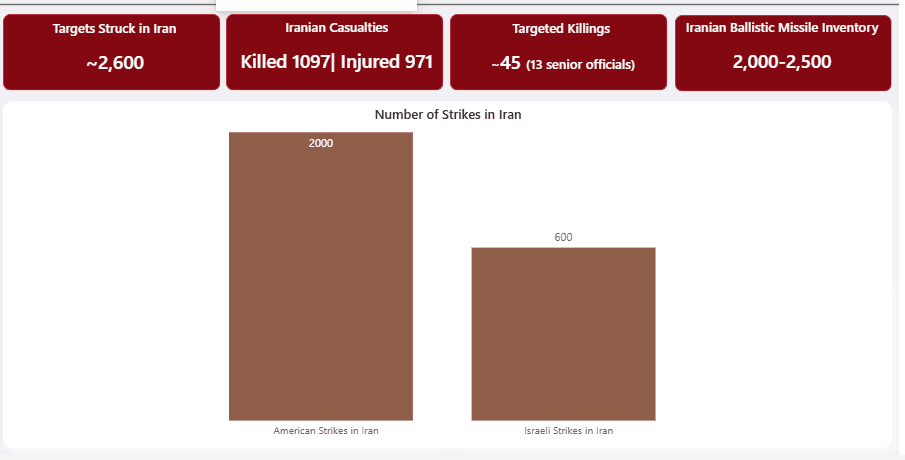
The most symbolic achievement of the war is the assasination of Supreme Leader Ali Khamenei but equally important is that targeted attacks on the leadership has decapitated the regime, taking out 45 leaders, including 13 senior figures.
Israeli and US forces say they have struck roughly 1,850 targets, including missile sites, command centres and Revolutionary Guards infrastructure.Military sources say between 2,000 and 2,500 Iranian ballistic missiles have been destroyed so far.
Iranian losses are estimated at 742 killed and 971 wounded.
Source: Institute for National Security Studies, Israel
How are Israelis being affected?
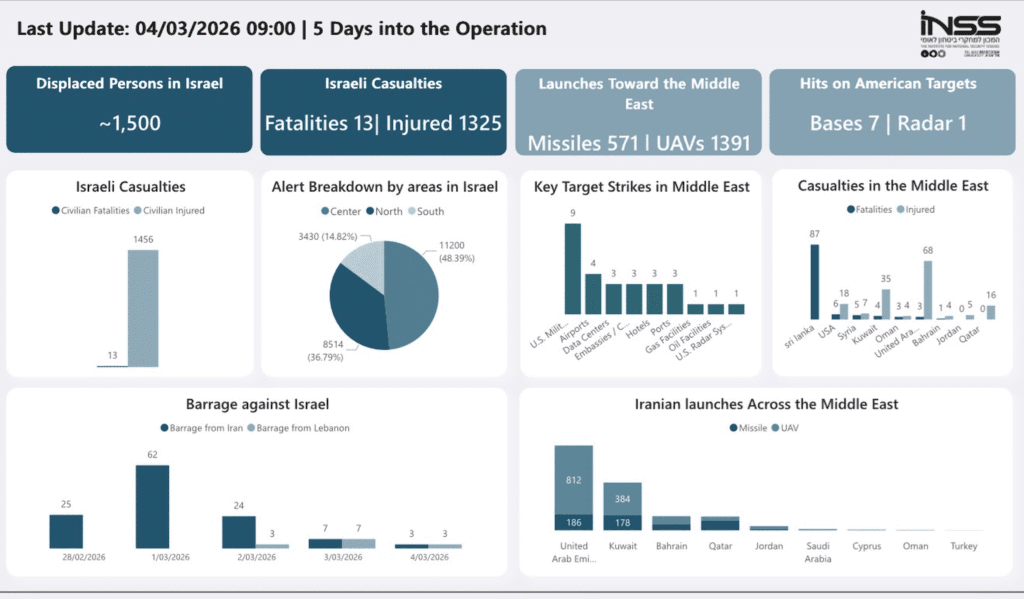
As of Wednesday, 4 March, the conflict has had a significant human and civilian impact across Israel. Iranian retaliation has triggered tens of thousands of air-raid alerts across Israel. According to data compiled by the Institute for National Security Studies (INSS), the Israeli Home Front Command has recorded 22,669 alerts so far: about 48.9% in central Israel, 36.1% in the north and 15% in the south. Israeli air-defence systems have been operating continuously to intercept incoming threats as the population moves repeatedly into shelters, often sheltering every hour and a half, day and night.
Source: Institute for National Security Studies, Israel
On the peak day so far, March 1, 62 volleys launched from Iran. Hezbollah has also entered the fighting, firing additional rockets from Lebanon.
As of March 5, the toll inside Israel stands at 13 dead and around 1,090 wounded, with damage concentrated in cities including Tel Aviv, Beit Shemesh and Beersheba. Property damage from missile strikes and interceptions is estimated at roughly 100 million shekels (AUD 46 million), with more than 3,600 compensation claims already filed.
While Iranian launches toward Israel appear to have dropped significantly since the first day of the war, the fighting is expected to continue for weeks as US and Israeli forces shift toward systematically targeting remaining military infrastructure.
Were the strikes permitted under international law?
In announcing what he called “major combat operations,” Trump did not seek a formal declaration of war from Congress. Under Article I of the US Constitution, the power to declare war rests with Congress, but successive presidents have relied on Article II commander-in-chief authority to initiate military action without explicit approval. This constitutional grey area has again become central in Washington.
Reaction on Capitol Hill has largely followed party lines. Republican leaders, including House Speaker Mike Johnson, said the administration briefed the bipartisan “Gang of Eight” and defended the president’s authority. Most Democrats accused Trump of launching a war without congressional authorisation and renewed calls for a War Powers Resolution to limit unilateral action. Similar measures have struggled to pass in the past.
The administration insists the strikes were justified as pre-emptive self-defence. Secretary of State Marco Rubio said there was “absolutely an imminent threat,” arguing the US anticipated Iranian retaliation against American forces following Israeli action and acted to prevent higher casualties.
Legal scholars remain divided: critics argue that without publicly presented evidence of an imminent threat, the strikes may fall short of constitutional and international legal standards, leaving the war’s legality in dispute. They also note that preventive war has no recognised basis under international law, and that the UN Security Council did not authorise military action, meaning the formal collective-security pathway was not pursued.
Who is governing Iran after the decapitation strikes?
Trump has claimed that 48 senior Iranian figures were killed in the opening hours of the air campaign, including Supreme Leader Ali Khamenei. For a system that has experienced only one leadership transition since 1979, the shock to Iran’s command structure could be profound. Iran’s foreign minister has acknowledged that some military units may be operating independently.
Under Iran’s constitution, the 88-member Assembly of Experts selects a new supreme leader. In the interim, authority transfers to a temporary council composed of the president, the head of the judiciary and a senior cleric from the Guardian Council. Iranian authorities say such a structure is in place, reportedly including President Masoud Pezeshkian, judiciary chief Gholam-Hossein Mohseni-Ejei and Ayatollah Alireza Arafi. However, none have featured prominently in public as strikes reportedly continue.
The uncertainty is compounded by the absence of an obvious successor. Former president Ebrahim Raisi, once seen as a contender, died in a helicopter crash in 2024. Mojtaba Khamenei, the late leader’s son, is frequently mentioned but would face clerical and political resistance. Without a clear heir and under sustained military pressure, the Islamic Republic’s governing structure appears unusually fragile.
What has changed since last year's war?
Since the previous 12-day war, Iran appears to have recalibrated its doctrine. Rather than launching massive salvos, more than 500 missiles were fired last time, Tehran is pursuing what Israeli officials describe as a “drizzle” strategy: smaller, more frequent waves from dispersed sites. The aim may be to exhaust expensive Israeli and American interceptor systems over time rather than overwhelm them at once.
Israeli officials say tactics now include more complex payloads. The IDF’s Home Front Command reported the use of a ballistic missile with a cluster-munition warhead, dispersing multiple smaller explosives. Meanwhile, US forces are focusing on southern Iran, protecting American personnel and assisting Israel’s air defence. Airspace congestion has required close coordination.
The strain is visible across the Gulf. Iran has targeted infrastructure and shipping lanes, widening the conflict’s footprint. Reporting suggests Qatar’s Patriot interceptor stocks could be depleted within days if attacks continue, while the UAE has reportedly sought additional air defence support. Both are said to be urging diplomatic efforts. Tehran may be betting that economic disruption and allied fatigue will generate pressure on Washington to de-escalate.
Hezbollah has entered the war — what does this mean for Israel and Lebanon?
Fighting has expanded to Israel’s northern front after Hezbollah launched missiles and drones, prompting Israeli strikes in Beirut and southern Lebanon. The IDF reported intercepting several projectiles, with limited damage in northern communities. Lebanese authorities reported casualties and evacuations in parts of the south and Beirut’s Dahiyeh district. Israel has reinforced the northern border.
Hezbollah framed its attacks as retaliation for Khamenei’s killing. Leader Naim Qassem pledged solidarity with Tehran and resistance against the US and Israel. Israeli officials warned that deeper Hezbollah engagement would trigger severe retaliation against the group and Lebanese infrastructure.
Lebanon’s state leadership has sought to contain escalation. Prime Minister Nawaf Salam criticised actions risking a wider war, while President Joseph Aoun reiterated that decisions of war and peace rest with the Lebanese state. With Hezbollah actively engaged, Lebanon risks becoming a central front.
Is Europe edging closer to direct involvement?
Europe’s major powers have largely aligned publicly with Washington and Jerusalem. Germany, France and the United Kingdom condemned Iran’s strikes and urged renewed negotiations. They stressed they did not participate in the initial attacks but remain closely engaged. EU leaders also called for restraint and adherence to international law.
After the last attacks in Cyprus the UK, France and Germany signalled they could consider targeting Iran’s missile and drone infrastructure if attacks continue hinting at a broader coalition. No formal decision has been announced.
Spain’s Prime Minister Pedro Sánchez opposed the strikes, warning of instability. European diplomats acknowledge tension between transatlantic unity and commitment to diplomacy. Europe appears to be balancing solidarity with Washington against concern that diplomacy is giving way to widening war.
What does a Strait of Hormuz closure mean for the global economy?
An Iranian Revolutionary Guards official declared the Strait of Hormuz closed, warning vessels attempting passage would be targeted. The statement followed earlier threats to shut the export route.
Markets reacted immediately. Brent crude surged about 10% above US$82 a barrel, and gas prices jumped. The strait carries roughly 20% of global oil and gas supply. Shipping has slowed dramatically, raising fears of sustained disruption. Analysts warn oil could exceed US$100 if closure persists.
The corridor connects major Gulf producers to global markets. For Australia, a US$10 rise in oil can add roughly 10 cents per litre at the petrol pump. Sustained disruption would feed into inflation and interest rate pressures globally.
How are Russia and China reacting?
While some Western leaders cautiously welcomed news of Khamenei’s reported death, Moscow and Beijing condemned the strikes but stopped short of signalling intervention. China described the killing as a violation of sovereignty and international law. Russia echoed criticism.
The condemnations followed reported contact between senior Russian and Chinese diplomats. Both have strategic ties to Tehran: Iran has supplied drones to Russia, while China purchases most of Iran’s oil exports and depends on Gulf shipping routes.
For now, their response appears limited to diplomatic protest. Russia lacks capacity to replenish Iran’s destroyed systems, and China is unlikely to jeopardise broader economic interests. Despite talk of a strategic axis, Tehran appears to be confronting the crisis largely alone.
About the author
Dr Shahar Burla is a Sydney-based researcher, lecturer and Contributing Editor of TJI. Shahar holds a Master’s degree in political science from Hebrew University and a PhD in political science from Bar-Ilan University. He is the author of Political Imagination in the Diaspora: The Construction of a Pro-Israeli Narrative (2013) and co-editor of Australia and Israel: A Diasporic, Cultural and Political Relationship (2015).