Aa
  • Read, Watch, Listen
  • TJI Series
  • Community Action
  • Events
  • Zedi
Follow us and continue the conversation
  • LinkedIn
  • Instagram
  • FaceBook
  • X
  • YouTube
Test yourself with the TJI Quiz!

Adjust size of text

Aa

Follow us and continue the conversation

  • LinkedIn
  • Instagram
  • FaceBook
  • X
  • YouTube

Your saved articles

You haven't saved any articles

What are you looking for?

Original reporting, insightful analysis and diverse views, delivered straight to your inbox

  • LinkedIn
  • Instagram
  • FaceBook
  • X
  • YouTube
Your support fuels our mission to inform, entertain and inspire.

The Jewish Independent is bound by the Standards of Practice of the Australian Press Council. If you believe the Standards may have been breached, you may approach The Jewish Independent or make a complaint to the Australian Press Council in writing at www.presscouncil.org.au. The Council may also be contacted on 1800 025 712.

  • Our Story
  • Contact us
  • Our Team
  • Support us
  • Guidelines
  • Pitch your idea
  • Republishing us
  • Community Action
  • Our Awards
  • LinkedIn
  • Instagram
  • FaceBook
  • X
  • YouTube
Aboriginal FlagTorres Strait Islanders Flag

The Jewish Independent acknowledges Aboriginal and Torres Strait Islander peoples as the Traditional Owners and Custodians of Country throughout Australia. We pay our respects to Elders past and present, and strive to honour their rich history of storytelling in our work and mission.

© The Jewish Independent 2026All Rights Reserved
Website design and development by Your Creative, MelbourneTerms & ConditionsPrivacy Policy
HomeRead, Watch, ListenArts & Culture
InterviewArts & CultureIsrael

Rising to take back Israel

A new Australian-made documentary explores the courage and resilience of Israel's democracy movement.
Peter Kohn
Print this
Oded, one of five protaganists, in the film Rising: Voices of Hope and Protest speaks into a public address system and raises his arm in protest.

Oded, one of five protaganists, in the film Rising: Voices of Hope and Protest about Israel’s democracy movement (supplied)

Published: 30 October 2025

Last updated: 30 October 2025

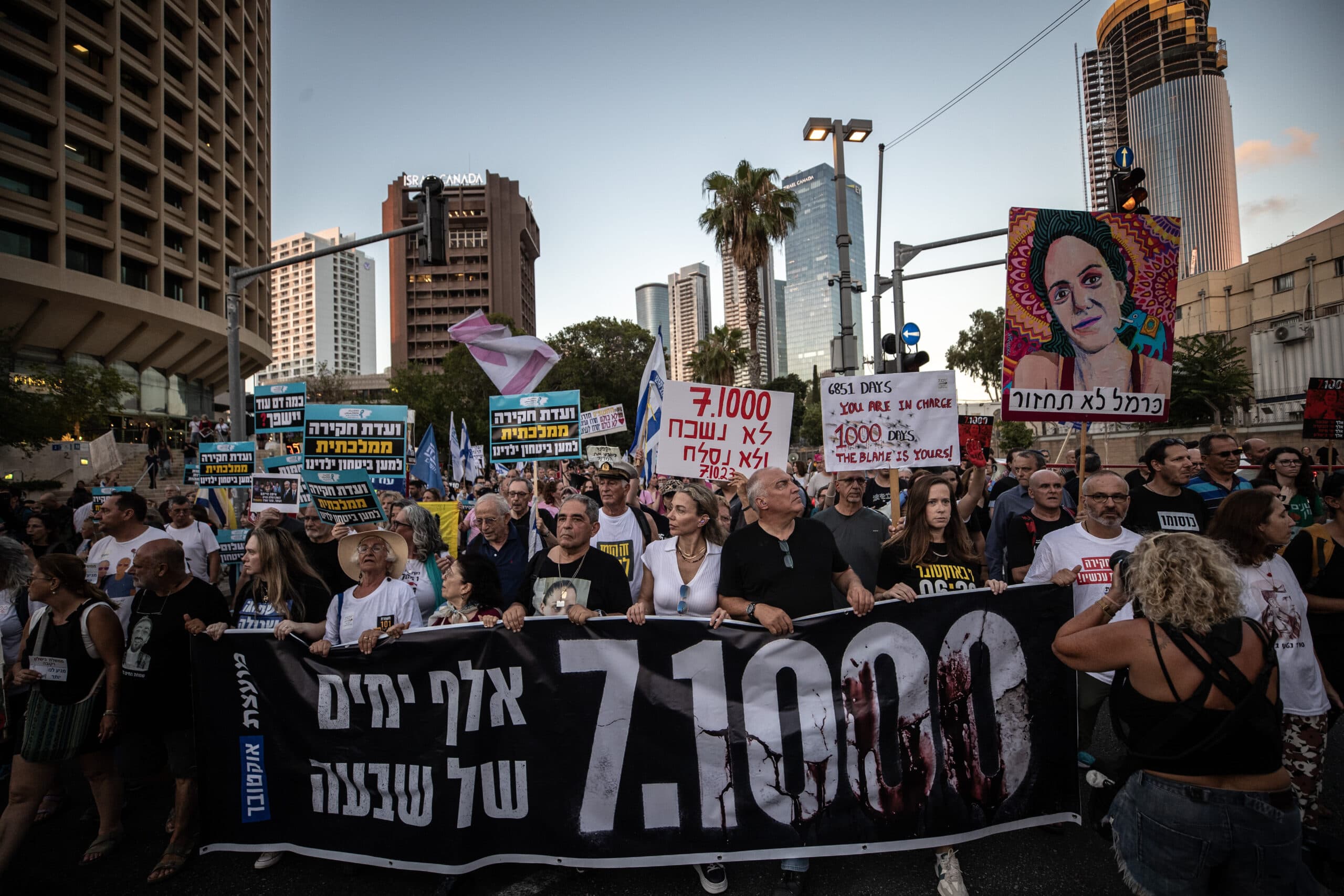
Israel is not its government. It’s a point emphatically expressed on Israeli protest placards. But the distinction is lost on tens of millions around the globe who have condemned the Jewish State over two years of war in Gaza.

In theory, a democratic government reflects a majority of society, but in reality that’s only as far as a lumbering political system allows.

Australian Jewish filmmaker Esther Takac’s latest project Rising: Voices of Hope and Protest portrays the outcry of a vibrant, passionate, dazed, wounded, brawling society intent on keeping the checks and balances, the norms and values of its democracy intact.

Rising takes the temperature of an angry public pouring into Israel’s streets; everyday Israelis who have been shoehorned in, under the most far-right government in the nation’s history. Takac portrays a government of stark certitudes, entrenched interests and transactionalism; that tried to muzzle an independent judiciary, shaking democracy to its core and fatally distracting the nation from sworn external foes.

The challenge was not to soften the criticism but to make sure the audience understands where it comes from: from love, not rejection; from hope, not despair

Filmmaker Esther Takac

Early in the film, Rising takes us to the Gaza envelope. When Hamas struck on October 7, 2023, its pogrom of death and abduction was the greatest Jewish bloodletting in a single day since the Holocaust. More than 1200 innocents were murdered that day alone.


The trauma of Hamas barbarity and the dysfunction of Israel’s first response haunts Takac’s film. So does the ensuing war, which lacerated Israel’s societal fabric, as prospects of recovering living hostages dwindled, and the IDF death toll grew.

And so too does the widespread killing on the other side of the fence. In the casual shorthand of Western media, Gaza’s calamity has been become Israel’s global brand.

The mob chanting “Fuck the Jews” at the Sydney Opera House two days after October 7, well before any Israeli intervention in Gaza, is graphically recalled in Rising.  These hardcore anti-Zionists didn’t need a figleaf for their antisemitism. But two years of war in Gaza have given a wider cohort of antisemites the cover they crave in order to be seen as ‘respectable’ anti-Zionists. And for the uncommitted, the nightly news videos consistently appal.

Demonstrators for democracy in the film Rising: Voices of Hope and Protest (supplied)

The film, which premieres at the Jewish International Film Festival (JIFF) this month, focuses on these seismic developments through the eyes of five individuals in Israel’s protest movement.

Eran is a grieving father whose daughter was murdered at the Nova festival. He became a protest leader. Yossi is a therapist who survived October 7 and immediately began treating others. Elana is a democracy activist whose son was killed saving his comrades. Oded is a choreographer turned crisis responder and a steadfast protest activist. Ayelet is a trauma psychologist.

Says Takac: “We made a choice - to tell the story not as a political account but through the eyes of five people who lived it. Their personal journeys became our window into the larger story. It’s through their voices that we could capture the emotion, the passion, and the heartbreak of a nation fighting for its soul,” she says.

Takac's award-winning 2022 documentary, The Narrow Bridge, followed the work of a grassroots group, the Israeli Palestinian Bereaved Families.

She and husband Robert – Hebrew-speaking psychologists specialising in trauma counselling -- flew to Israel after October 7 and spent months there helping. Takac began filming Rising. She became its writer, director and producer.

 “I saw the pain, trauma, and grief everywhere,” she recalls. “But I also saw something extraordinary: the resilience, the values, and the spirit of people rising from devastation. We ourselves were traumatised by October 7, and in the first six months of working on the film, both we and the film were dominated by it,” says Takac.

“I went to the protests and was overwhelmed by the care, passion, and determination of the people, by their desire to protect Israel and keep it true to its values. These people rose to defend what I am most proud of in Israeli society: its humanity, its sense of mutual responsibility. Kol Yisrael arevim zeh lazeh (All Jews are responsible for one another).”

At its core, Rising portrays a government, presumably aware of its flawed security policies before October 7, in fervent pursuit of a redemptive but undefined regional victory, and in that pursuit, sacrificing the lives of hostages and fracturing the Israeli bedrock of arevim zeh lazeh.

For Elana, the fragmenting of Israeli society before and after October 7 are not dissimilar. Interviewed in the film, the activist and grieving mother identifies this undercurrent which so embitters the protest movement. “Before that day, the government undermined democracy,” she says. “But since October 7, I think it’s been clear the betrayal goes way beyond that. The hostages have been abandoned.” (Ultimately, of 251 abducted, only 168 returned alive).

Adds Takac: “At a certain point, we understood that telling the truth, even when it is uncomfortable, is an act of love, and the distinction between much of Israeli society and their government became central to the film.

“The people we followed in the protest movement are Israel. They represent its conscience, its courage, and its moral backbone. So the challenge was not to soften the criticism but to make sure the audience understands where it comes from: from love, not rejection; from hope, not despair.”

That tough love fired a creative tension in the edit room, recalls Takac. She and acclaimed Melbourne film editor Uri Mizrahi “were constantly walking a fine line”, she says.

“Uri and I disagreed and argued as we strove to find this delicate balance, wanting to show the outrage but also the humanity, the anger but also the hope. We avoided sensationalism, because this story was never about noise or chaos, it was about moral clarity. Every image, every interview, every piece of music had to serve that purpose: to remind viewers that protest is not the opposite of patriotism, it is its purest form.”

Rising “aims to counter misinformation and antisemitism by showing the human face of Israel”, says Takac. “Too often, people judge Israel from the outside without really understanding its layers, its pain, or its humanity.”

Takac, Mizrahi and the production team have been under the pump, readying Rising for JIFF. “It would have been much easier to slow down and postpone,”  she admits, “but as the months passed, we felt more and more how important it was to have this film out there.”

And she notes that in these testing times for democracies, “this is not only an Israeli story”.

The Jewish Independent will host premiere Q&A screenings of Rising on 9 November in Melbourne and 16 November in Sydney. Details and tickets at RISING: Voices of Protest and Hope - Q&A Screenings - JIFF.

You might also like
  • ‘Israel is systemically eliminating Palestinian collective life’:  B’Tselem
    Deborah Stone
  • Tame apologises – but with little grace
    Deborah Stone
  • Confronting Richard Flanagan and the myth of the Israel lobby
    Mary Garden
logomark.67a07ee3
We believe in the free flow of information

Republish our articles for free, online or in print, by using our Creative Commons licence

You might also like

    Erdogan Turkey
    AnalysisIsrael

    Turkey emerges as military threat to Israel

    Dror Doron
    haredi street guitar
    Photo EssayArts & Culture

    Jerusalemites through the lens

    Sharon Gabay
    Arab Israeli Palestinian election vote
    Israel Votes 2026FeatureIsrael

    Fear of Netanyahu victory may drive big surge in Palestinian voter turnout

    Ben Lynfield

About the author

Peter Kohn

Peter Kohn

Peter Kohn is an Australian journalist who began his career at the Herald & Weekly Times. For 43 years, he was associated with The Australian Jewish News. For the past decade, he held the title of Senior Journalist at the newspaper. He is the author of two novels. Rachel’s Chance is the story of his family’s experiences as Jewish refugees in Shanghai during World War II, and View From A Sandcastle is based on his own story, growing up in Melbourne suburbia during the 1960s and 1970s.

More from the author

FeatureWorld

‘Your help is extremely needed’: Jewish aid group on the ground after Nepal flood

NewsAustralia

Strategies for cohesion final focus of Royal Commission hearings

NewsAustralia

Evidence of declining social cohesion and the efforts to turn it around

NewsAustralia

Hate preachers, polarised debate, counter-terrorism

Comments

No comments on this article yet. Be the first to add your thoughts.