Aa
  • Read, Watch, Listen
  • TJI Series
  • Community Action
  • Events
  • Zedi
Follow us and continue the conversation
  • LinkedIn
  • Instagram
  • FaceBook
  • X
  • YouTube
Test yourself with the TJI Quiz!

Adjust size of text

Aa

Follow us and continue the conversation

  • LinkedIn
  • Instagram
  • FaceBook
  • X
  • YouTube

Your saved articles

You haven't saved any articles

What are you looking for?

Original reporting, insightful analysis and diverse views, delivered straight to your inbox

  • LinkedIn
  • Instagram
  • FaceBook
  • X
  • YouTube
Your support fuels our mission to inform, entertain and inspire.

The Jewish Independent is bound by the Standards of Practice of the Australian Press Council. If you believe the Standards may have been breached, you may approach The Jewish Independent or make a complaint to the Australian Press Council in writing at www.presscouncil.org.au. The Council may also be contacted on 1800 025 712.

  • Our Story
  • Contact us
  • Our Team
  • Support us
  • Guidelines
  • Pitch your idea
  • Republishing us
  • Community Action
  • Our Awards
  • LinkedIn
  • Instagram
  • FaceBook
  • X
  • YouTube
Aboriginal FlagTorres Strait Islanders Flag

The Jewish Independent acknowledges Aboriginal and Torres Strait Islander peoples as the Traditional Owners and Custodians of Country throughout Australia. We pay our respects to Elders past and present, and strive to honour their rich history of storytelling in our work and mission.

© The Jewish Independent 2026All Rights Reserved
Website design and development by Your Creative, MelbourneTerms & ConditionsPrivacy Policy
HomeRead, Watch, ListenIsrael
Israel Hamas WarAnalysisIsrael

Trump faces tougher challenges in creating a lasting peace in Gaza

The US president has demonstrated his ability to coerce Netanyahu to do what he wants. The question now is whether he has the same influence over Hamas.
Dror Doron
Print this
President Trump Visits Israel And Egypt After Gaza Ceasefire Takes Effect

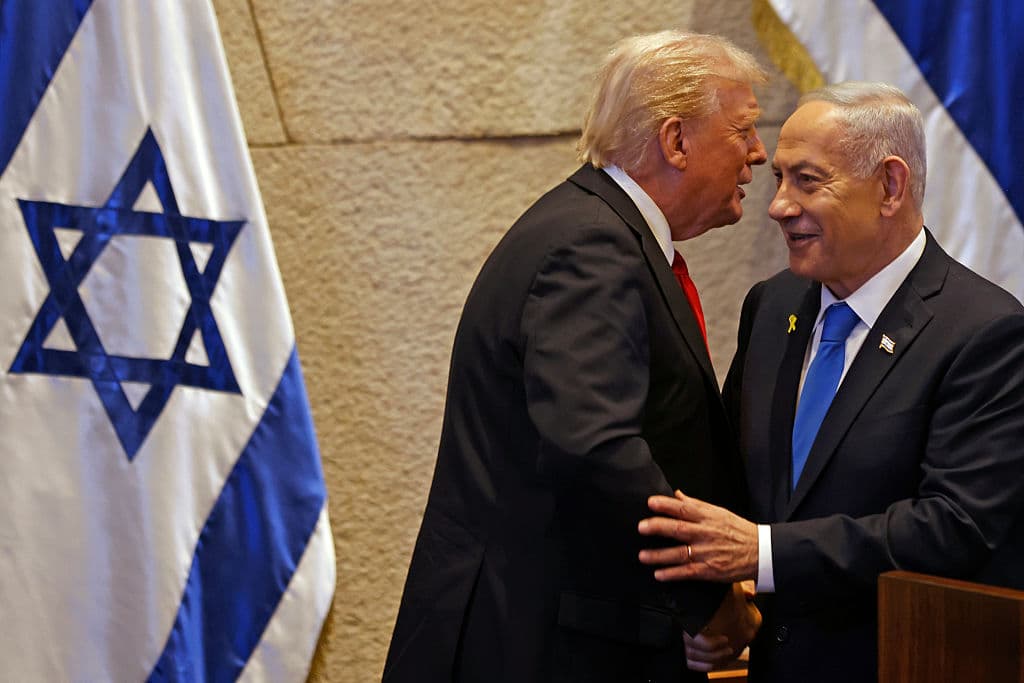
U.S. President Donald Trump speaks with Israel’s Prime Minister Benjamin Netanyahu in the Knesset, Israel’s parliament, on October 13, 2025 in Jerusalem. (Jalaa Marey – Pool/Getty Images)

Published: 14 October 2025

Last updated: 14 October 2025

After President Trump announced the end of the war in Gaza, Israel ceased its operations in Gaza and started to withdraw its forces as Hamas agreed to release the remaining hostages. These developments mark the first stage of the 20-point peace plan declared last week at the White House, and set the ground for further developments toward determining the future of Gaza and the Middle East.

Over the years the Middle East has witnessed many declarations and diplomatic plans that failed to materialise due to the conflicting interests of the parties involved in this centuries-long Israeli-Palestinian conflict. The resulting scepticism is well justified.

To assess the likelihood of this new peace vision succeeding, it would be best to start with figuring out what led both Israel and Hamas to abandon the positions they were entrenched in for the past two years: Israel’s refusal to stop the war until a “decisive victory” was achieved and Hamas's refusal to release the hostages which were used as an “insurance policy” to prevent Israel from occupying the entirety of the Gaza strip.

Under the current agreement, both sides have fallen short of achieving their declared goals. Israel did succeed in getting back its hostages but has failed to obliterate Hamas’s presence in Gaza. Hamas on the other hand, was able to survive the massive Israeli military campaign, but failed to ignite the coordinated regional war its instigators hoped would lead to Israel’s demise. The movement now faces the risk of losing its foothold in Gaza.

The critical role that President Trump played in bringing about the end of the Gaza war cannot be overstated. Trump used his full weight to force Israel and Hamas to compromise. This was a direct result of a combination of major factors. The tipping point was Israel’s unprecedented airstrike on Hamas negotiators in Qatar last month, which triggered Trump’s wrath towards Netanyahu’s tendency to sabotage every attempt to promote a peace deal.
Qatari panic

The Qatari panic that followed this strike emphasised the risk the ongoing war in Gaza poses toward US interests in the region. The emotional plea of large parts of the Israeli public calling him to personally intervene in order to release the hostages, and Trump’s personal ambition to receive the Nobel Peace Prize, played a significant role in orchestrating this deal.

Trump’s aggressive negotiation methods, and his strategy of leaving the details for later stages, were critical in getting Israel and Hamas to agree to this deal. The vague framework allows each side to interpret it according to their own narrative.

This pattern is clearly reflected by the White House leaking detailed reports regarding the way Trump forced Netanyahu to accept the deal, while using his personal connections to the leaders in Qatar and Turkey to pressure Hamas to accept the suggested framework.

The first stage of the deal was relatively the easiest one to implement, as both sides can claim victory: Israel will celebrate the release of the hostages and Hamas will hail the end of the war and the release of hundreds of Palestinian prisoners in return. 

Hamas arms hurdle

However, the next stages of Trump’s plan will be much more challenging, as they bring the conflicting goals of each side into a direct clash. Israel insists on Hamas’s disarmament and the demilitarisation of Gaza under the supervision of foreign forces. At the same time, Hamas refuses to surrender its arms and rejects the idea of any foreign intervention in the future governance of Gaza.

As it is highly likely that in the upcoming weeks Hamas will try to rebuild its military capabilities and Israel will use military force to foil those efforts, it will take meticulous American attention to prevent the renewal of hostilities. The US has already declared it will deploy a US Central Command (CENTCOM) force to monitor the implementation of the deal agreed by both sides.

From a wider perspective, Washington is trying to leverage its success to end the war in Gaza to launch a comprehensive initiative to stabilise the region, and Trump’s appearance at the international peace summit in the Red Sea resort city of Sharm el-Sheikh this week sends a clear message regarding his commitment to this vision.

The fact that Hamas won’t be part of this summit, and that Netanyahu was invited to take part in it only at the last minute, reflects Trump’s belief that he can coerce both Hamas’s leadership and Netanyahu’s extreme right-wing government to follow any decision coming from Washington.

Trump has already demonstrated his ability to do so when he ordered Netanyahu to turn back the fighter jets that were on their way to strike Tehran after the ceasefire between Israel and Iran was reached, and he did so again when he forced Netanyahu to apologise to the Qataris after the strike in Doha. 

The question is whether Trump has the same overwhelming influence over Hamas. This will be tested in the upcoming weeks, as the next stages of his Gaza plan require Hamas to disarm and turn over its power to a foreign governing body - two demands which Hamas categorically rejects.

We can only hope that the fact Trump did not receive this year’s Nobel Peace Prize will further ignite his motivation to continue the personal involvement he has shown towards negotiating peace in the Middle East.

After all, his willingness to use massive pressure and unconventional negotiation tactics to achieve his goals proved to be critical in bringing an end to the war in Gaza.

You might also like
  • Peacebuilding through the eyes of a sceptic
    Ron Finkel
  • The Altalena should be a warning, not a political weapon
    Shahar Burla
  • Turkey emerges as military threat to Israel
    Dror Doron
logomark.67a07ee3
We believe in the free flow of information

Republish our articles for free, online or in print, by using our Creative Commons licence

You might also like

    Ofer_Winter_2026
    Israel Votes 2026AnalysisIsrael

    Who is Ofer Winter and could he upset Netanyahu’s election?

    Shahar Burla
    settler outpost west bank
    NewsIsrael

    Israel is cementing its control over the West Bank and East Jerusalem while the world is distracted

    Martin Kear
    beautiful six hostages
    Israel Votes 2026OpinionIsrael

    The memory of the hostages should guide Israel’s choices for the future

    Nirit Eylon

About the author

Dror Doron

Dror Doron

Dror Doron is a senior political analyst specialising in the Middle East, and is a senior adviser at United Against Nuclear Iran (UANI) focusing on Hezbollah and Lebanon.

More from the author

AnalysisIsrael

Turkey emerges as military threat to Israel

AnalysisWorld

New Saudi-Pakistan-Turkey alliance driven by failure of US to subdue Iran

AnalysisIsrael

Trump’s Hamas disarmament deal a mirage that’s quickly faded

AnalysisIsrael

Syria reimagined: From military threat to geostrategic competitor

Comments

No comments on this article yet. Be the first to add your thoughts.