Aa
  • Read, Watch, Listen
  • TJI Series
  • Community Action
  • Events
  • Zedi
Follow us and continue the conversation
  • LinkedIn
  • Instagram
  • FaceBook
  • X
  • YouTube
Test yourself with the TJI Quiz!

Adjust size of text

Aa

Follow us and continue the conversation

  • LinkedIn
  • Instagram
  • FaceBook
  • X
  • YouTube

Your saved articles

You haven't saved any articles

What are you looking for?

Original reporting, insightful analysis and diverse views, delivered straight to your inbox

  • LinkedIn
  • Instagram
  • FaceBook
  • X
  • YouTube
Your support fuels our mission to inform, entertain and inspire.

The Jewish Independent is bound by the Standards of Practice of the Australian Press Council. If you believe the Standards may have been breached, you may approach The Jewish Independent or make a complaint to the Australian Press Council in writing at www.presscouncil.org.au. The Council may also be contacted on 1800 025 712.

  • Our Story
  • Contact us
  • Our Team
  • Support us
  • Guidelines
  • Pitch your idea
  • Republishing us
  • Community Action
  • Our Awards
  • LinkedIn
  • Instagram
  • FaceBook
  • X
  • YouTube
Aboriginal FlagTorres Strait Islanders Flag

The Jewish Independent acknowledges Aboriginal and Torres Strait Islander peoples as the Traditional Owners and Custodians of Country throughout Australia. We pay our respects to Elders past and present, and strive to honour their rich history of storytelling in our work and mission.

© The Jewish Independent 2026All Rights Reserved
Website design and development by Your Creative, MelbourneTerms & ConditionsPrivacy Policy
HomeRead, Watch, ListenIsrael
AnalysisIsrael

Netanyahu’s ‘Super-Sparta’: a flawed analogy with dangerous implications

By invoking Sparta, Netanyahu swaps Israel’s ethos of innovation for isolation — a sign of weakness from a leader cornered by his own policies.
Shahar Burla
Print this
Netanyahu

Israel’s Prime Minister Benjamin Netanyahu speaks during a joint press conference with the US Secretary of State in Jerusalem on September 15, 2025. (NATHAN HOWARD/POOL/AFP via Getty Images)

Published: 18 September 2025

Last updated: 18 September 2025

Hours before launching a ground offensive against Gaza City on Tuesday, Prime Minister Netanyahu shocked Israelis by warning that Israel may soon be forced to become a globally isolated “super-Sparta” with “autarkic features” — meaning little or no engagement with international trade.

“We will increasingly have to adapt to an economy with autarkic characteristics. It’s a word I hate. I’m a proponent of the free market. I worked to bring Israel a free market revolution, but we could find ourselves in a situation where our weapons industries are blocked. We will have to develop weapons industries here. We will have to be Athens and a super-Sparta.”

In his speech on Monday, at a Finance Ministry conference, Netanyahu blamed foreigners for Israel’s growing isolation, which he described as a siege organised by a few states. “One is China, and the other is Qatar. And they are organising an attack on Israel’s legitimacy in the social media of the Western world and the United States,” he said. To the west, he added, the threat was different but equally dangerous. “Western Europe has large Islamist minorities. They’re vocal. Many of them are politically motivated. They align with Hamas, they align with Iran,” Netanyahu declared.

“They pressure the governments of Western Europe, many of whom are kindly disposed to Israel, but they see they are being overtaken by campaigns of violent protest and constant intimidation,” he added, referring mainly to the UK and France.

The future the prime minister laid out for Israel — a more militarised society, a partial autarky with limited trade options, relying on homemade production — has stirred backlash among Israelis increasingly uneasy at the prospect of becoming a pariah state.
On the same day of the speech, the European Commission prepared to discuss suspending part of the Israel–EU trade agreement, while more countries pledged to recognise Palestine and others threatened to boycott the Eurovision Song Contest if Israel took part.

Pushback from the markets

Stocks on the Tel Aviv exchange dipped immediately after Netanyahu’s super-Sparta speech, and the shekel fell against the American dollar. Traders versed in ancient history noted the Spartans fought hard — but ultimately lost.

The Israel Business Forum, representing workers from 200 major companies, declared: “We are not Sparta,” warning Netanyahu’s policies were marching the country “toward a political, economic, and social abyss that will endanger our existence in Israel.” Histadrut union head Arnon Bar-David protested: “I don’t want to be Sparta… We deserve peace. Israeli society is exhausted, and our status in the world is very bad.”

Opposition Leader Yair Lapid demanded to know what Netanyahu meant by saying Israel was “becoming” isolated. “Did some higher power cause this? You caused this,” Lapid said in a speech at the International Institute for Counter-Terrorism.

On Tuesday morning, Netanyahu pushed back against the criticism, convening a “financial” press conference to project the opposite message. He insisted he had “full confidence” in Israel’s economy and that there had been a “misunderstanding that supposedly shook the stock market.” He clarified that his Monday comments concerned the defence industries, not the broader economy. “There is one area I referred to where indeed there could be restrictions — not economic ones, but political at their core — and that’s what’s happening in the defence industries. My remarks were on attempts to restrict the import of parts, components, weapons, or raw materials. That does not operate according to market economics, but political economics,” he asserted.

Autarkic defence industries

If, in fact, all the prime minister meant is that Israel will need to make more guns, bombs and artillery shells because imports are harder to secure, the statement amounts to little. A decision to expand the arms industry was made by the Defence Ministry in December 2023, well before any European state restricted exports, and the program has been underway since to produce aerial bombs.

But Israel’s defence industry has limits. As David Rosenberg noted in Haaretz: “Israeli firms can design, develop and manufacture cutting-edge drones and communications technology; but they don’t make all the tanks, armoured vehicles or even all the rifles Israel needs. They certainly can’t make fighter jets and submarines, except perhaps by producing an inferior product at enormous cost. Israel has no choice but to import major weapons platforms, like F-35s from America and submarines from Germany.”

A questionable and dangerous analogy

Netanyahu’s comparison drew attention to Sparta, the ancient Greek city-state remembered for its isolation and militarism. But historians warn the parallels are not so clear. Sparta, in southern Greece’s Peloponnese, was one of antiquity’s strongest powers, famed for its rigid military culture and austere way of life. Unlike Athens, with its democracy and trade, Sparta was ruled by kings, elders, and overseers who tightly controlled society.

Spartans deliberately avoided foreign influence. Historian Dr Lee Mordechai of the Hebrew University told Ynetnews: “They feared money and luxury would divide society. To prevent this, they banned gold and silver coins and used iron currency worthless outside Sparta. This limited their trade and contact with the wider Greek world.”

Sparta’s hierarchy placed citizen-warriors at the top, supported by non-citizens and a majority of helot serfs. Military training began in childhood to produce disciplined soldiers. Their reputation for toughness survives today in terms such as “Spartan education.”

Netanyahu’s analogy may have sought to portray resilience. Mordechai pointed to the Battle of Thermopylae (480 B.C.), where 300 Spartans resisted Persia and became symbols of bravery. But he stressed the limits: “Sparta’s isolation contributed to its decline. By the 4th century B.C. its dominance had faded.” Modern Israel, by contrast, relies on global trade and alliances. The comparison, he argued, is more rhetorical than real.

Dan Perry wrote in The Forward: “From the beginning, Israel saw itself as Athens rather than Sparta. It aspired to be a light unto the nations, and in many ways it succeeded. It made the desert bloom, gave the world desalination technology, created a start-up ecosystem admired worldwide, and turned scarcity into innovation.”

He continued: “This vision is a disaster that would erase the qualitative edge that has enabled Israel to be not only a refuge but a magnet — for immigrants, investors, trade, cultural exchange and tourism. A preview of the isolation it would bring was evident in today’s UN committee ruling that Israel is committing genocide in Gaza. Israel produced Nobel laureates, thinkers like Daniel Kahneman and Yuval Noah Harari, and a cultural canon in literature, cinema, music and the arts. GDP per capita surpassed $54,000, higher than Britain or France. Until Netanyahu began burning down the house, Jews came not just out of desperation but by choice, drawn by creativity and prosperity. Israel’s achievements weren’t only sources of pride — they were foundations of survival. They allowed Israel to deter the Arab world and to draw parts of it into alignment. If Israel follows Netanyahu’s call to become a “super-Sparta,” all of that will disappear.”

Social media response

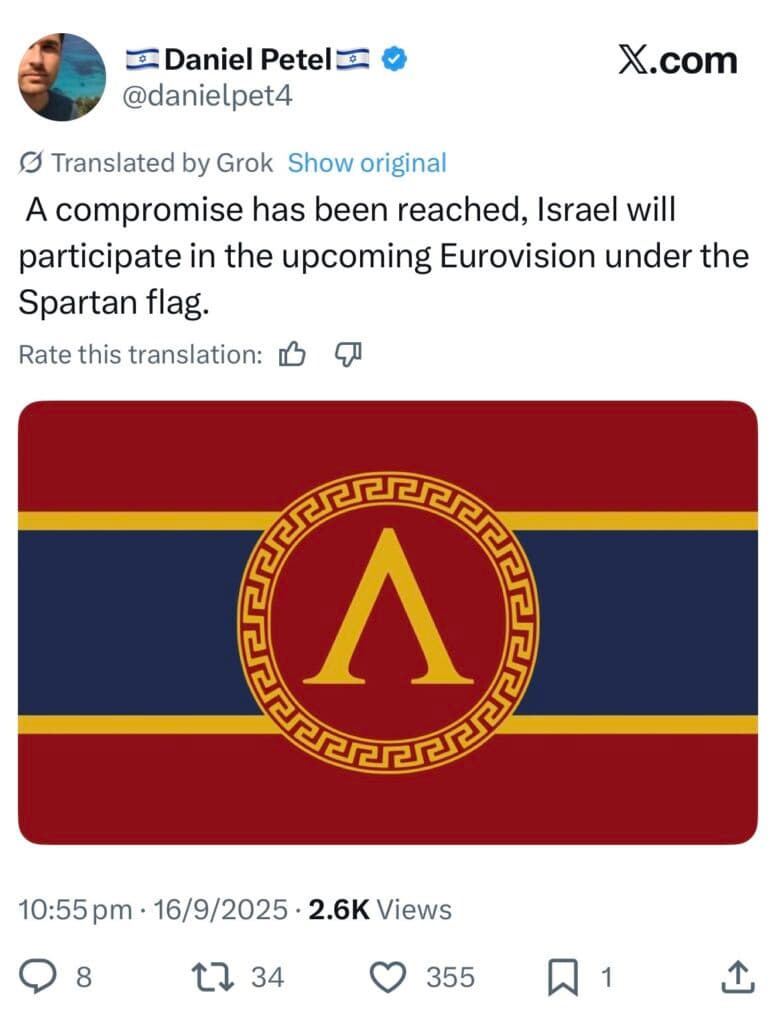
The Sparta analogy didn’t just spark debate — it delivered powerful social media moments that bolstered the position. Here are some of the standout posts on X:

The Jewish Independent

READ MORE

Netanyahu’s pitch for Israel as ‘super-Sparta’ is a dystopian death wish (Dan Perry, The Forward)

Netanyahu turns Start-up nation into Sparta nation – and indicts himself along the way (Yossi Verter, Haaretz)

Netanyahu’s ‘super-Sparta’ vision braces Israel for isolated economic future (The Guardian)

Netanyahu invokes 'Sparta' vision for Israel — but does history back the comparison? (Ynetnews)

It Didn't End Well for Sparta, and It Won't for Israel Either (David Rosenberg, Haaretz)

You might also like
  • ‘Israel is systemically eliminating Palestinian collective life’:  B’Tselem
    Deborah Stone
  • Tame apologises – but with little grace
    Deborah Stone
  • Confronting Richard Flanagan and the myth of the Israel lobby
    Mary Garden
logomark.67a07ee3
We believe in the free flow of information

Republish our articles for free, online or in print, by using our Creative Commons licence

You might also like

    Segalovitz Abbas
    Israel Votes 2026AnalysisIsrael

    Segalovitz decision to join Arab party is a paradigm change for Israel

    Eetta Prince-Gibson
    ISRAEL-LGBTQ-PRIDE-PARADE-PALESTINIAN-CONFLICT-HOSTAGES
    NewsIsrael

    LGBT asylum seekers caught between Palestinian violence and Israeli bureaucracy

    Jarod Rhine-Davis
    Yoav Segalovitz Mansour Abbas
    Israel Votes 2026OpinionIsrael

    Because of my Zionist values, I’m joining an Arab party

    Yoav Segalovitz 1

About the author

Shahar Burla

Shahar Burla

Dr Shahar Burla is a Sydney-based researcher, lecturer and Contributing Editor of TJI. Shahar holds a Master’s degree in political science from Hebrew University and a PhD in political science from Bar-Ilan University. He is the author of Political Imagination in the Diaspora: The Construction of a Pro-Israeli Narrative (2013) and co-editor of Australia and Israel: A Diasporic, Cultural and Political Relationship (2015).

More from the author

FeatureIsrael

New evidence Netanyahu was warned about October 7

OpinionIsrael

The Altalena should be a warning, not a political weapon

AnalysisIsrael

Who is Ofer Winter and could he upset Netanyahu’s election?

AnalysisIsrael

Bennett’s balancing act: can he win over the right without losing the centre?

Comments1

  • Avatar of Ian Light

    Ian Light25 September at 06:21 am

    SuperSparta will not be the model .
    But as great as possible manufacture of military defence including drones ballistic missiles iron beam laser a survivalist structure with deep underground shelters for public spaces are going to be necessary
    Sparta was too cruel and too depraved a primitive barbaric warrior society.
    With Iron Clan Security and Just Deterrence the Humane protocols have to be powerful .
    .