Understanding Israel’s electoral system and the power of small parties
Israel's Party-List Proportional Representation system provides broad political representation but grants small parties significant leverage in forming coalition governments
Shahar Burla
A young Arab Israeli woman votes during Israel’s parliamentary election at a polling station near Haifa in 2019 (Ahmad Gharabli/AFP via Getty Images)
Published: 22 July 2026
Last updated: 22 July 2026
With Israelis preparing to vote, understanding the country’s electoral system is essential to understanding not only how the next government will be formed, but why small parties can exercise such disproportionate influence over its policies.
Israel uses a Party-List Proportional Representation system inherited from the political institutions of the pre-state Yishuv. It was designed to provide the broadest possible representation in a society divided among different ideological, religious and political movements, and later transformed by successive waves of immigration. The system continues to ensure that Israel’s diverse communities can gain a voice in the Knesset. However, it also creates a fragmented parliament in which small sectoral parties frequently hold the balance of power.
Prime Minister Benjamin Netanyahu knows that without their support, he has no prospect of assembling another coalition after the election. With polls giving Likud only about 23 of the Knesset’s 120 seats, Netanyahu remains dependent on smaller parties to reach a parliamentary majority.
This explainer examines how Israel’s electoral system works, why it was adopted and how its greatest strength, broad political representation, also gives enormous leverage to small parties that can become the tipping point between rival political blocs.
What is Party-List Proportional Representation?
Israel’s electoral system is based primarily on the Basic Law: The Knesset and the Knesset Elections Law. Only registered political parties can submit lists of candidates and contest an election.
Rather than voting for an individual local representative, Israelis vote for a party list. The Knesset’s 120 seats are then distributed approximately in proportion to each list’s share of the national vote.
A party receiving about 10 per cent of the qualifying vote can therefore expect to receive roughly 12 seats. However, it must first cross the electoral threshold of 3.25 per cent. Votes cast for lists that fail to reach that threshold are excluded from the allocation of seats.
This differs from the majoritarian systems used in countries such as Australia, the UK, the US and Canada. In those systems, the country is divided into geographical electorates, with voters electing an individual representative for each district. In Australia, preferential voting is used to ensure the winning candidate receives an absolute majority after preferences are distributed. A party can consequently win substantial parliamentary representation without securing a majority of the national vote, while smaller parties whose supporters are spread across the country may receive few or no lower house seats.
Israel’s model makes it comparatively easier for small parties to enter parliament. That helps the Knesset reflect the country’s social and political diversity, but it also produces a fragmented parliament in which forming a government usually requires negotiations among several parties.
No single party has ever won more than half the Knesset’s seats.
Why did Israel adopt this system?
Israel inherited proportional representation from the institutions of the pre-state Yishuv, the organised Jewish community under the British Mandate.
The community was divided among competing Zionist movements, religious groupings and ideological parties, each determined to maintain its political independence. Proportional representation allowed those groups to participate in collective institutions without being absorbed by a dominant movement.
The combination of a single national electorate, closed lists, proportional representation and a relatively moderate threshold contributes to a highly fragmented parliament. Ten lists entered the Knesset after the 2022 election, and subsequent splits produced even more parliamentary factions
That approach also appeared appropriate for a new country experiencing rapid immigration and significant demographic change. The system was intended to provide the widest possible representation for Israel’s different communities and political traditions.
It continues to perform that function. Secular liberals, national-religious voters, ultra-Orthodox communities, Arab citizens, settlers, centrists and different currents of the Zionist left and right can all obtain parliamentary representation if their parties cross the threshold.
But representation comes at the cost of governability. Because the larger parties rarely approach the 61 seats needed to control the Knesset, small parties can become indispensable coalition partners.
What does Israel share with other parliamentary democracies?
Israel follows the central principles of parliamentary government. Voters elect the legislature rather than the executive, and the government must retain the confidence of parliament.
The prime minister is the head of government, while the president serves as head of state and performs mainly ceremonial duties, although the president has an important role following an election.
Most ministers are also Knesset members. Under the “Norwegian Law”, ministers may temporarily resign their parliamentary seats, allowing the next candidate on their party list to enter the Knesset. They can return if they leave the government.
The Knesset can also replace a government through a constructive vote of no confidence. This requires at least 61 members to support a specified alternative government, rather than merely voting to remove the incumbent one.
What makes the Israeli model unusual?
Israel is effectively one national electorate. A voter in Haifa chooses from the same party lists as a voter in Beersheba, Tel Aviv or Jerusalem. There are no locally elected Knesset representatives responsible for particular geographical constituencies.
Israel also uses closed lists. Voters select a party but cannot ordinarily change the order of its candidates at the ballot box. That order is determined before the election through party primaries, internal party institutions or decisions made by the party leadership.
Israel is therefore unusual among developed democracies in having neither a regional nor a personal component in its general election. An Israeli voter helps determine how many seats a party receives, but does not directly decide which of its candidates will occupy them.
The combination of a single national electorate, closed lists, proportional representation and a relatively moderate threshold contributes to a highly fragmented parliament. Ten lists entered the Knesset after the 2022 election, and subsequent splits produced even more parliamentary factions.
The Knesset is also comparatively small, with only 120 members serving a population of more than nine million. Members must often sit on several committees, limiting the time available to develop specialised expertise or scrutinise legislation.
Coalition negotiations compound the problem. To satisfy multiple partners, prime ministers frequently create additional ministries and ministerial positions. Israeli governments have consequently grown to more than 30 ministers, considerably larger than governments in many comparable democracies.
What happens when Israelis vote?
Israeli elections are conducted by secret ballot using paper slips. Behind a screen, the voter selects the slip representing one party list, places it in an envelope and deposits it in the ballot box. Votes are counted manually.
The slips display the list’s name and identifying letters, sometimes accompanied by the name of its leader. A list may represent one party or an alliance of several parties.
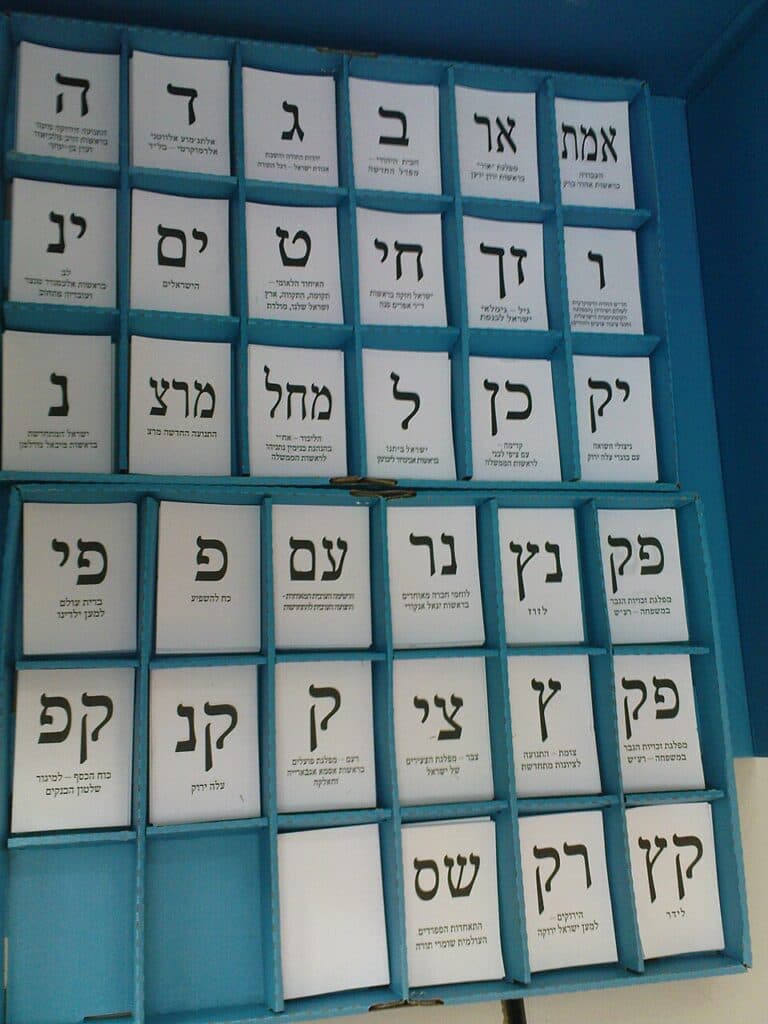
Ballot slips at a polling station in Israel, 18th Knesset elections (2009)
Election day is a public holiday for most workers, but voting is not compulsory. Most polling stations operate from 7am until 10pm.
Voters are generally assigned to a particular polling station according to their registered address. Israel does not provide general early, postal or online voting, and most citizens living or travelling overseas must return to Israel if they wish to participate.
Exceptions apply to diplomats and other authorised representatives abroad, soldiers, prisoners, hospital patients and some voters with limited mobility. Votes cast away from a person’s registered polling station are placed in “double envelopes” and checked centrally to prevent anyone voting twice.
Israeli citizens aged 18 and over can vote. Unlike systems requiring citizens to enrol separately, eligibility is generally derived from the population registry.
Arab citizens of Israel, including Muslim, Christian, Druze and other communities, have the same formal voting rights as Jewish citizens. Israeli citizens living in West Bank settlements also vote in national elections.
Palestinians who are not Israeli citizens, including most residents of the occupied West Bank and East Jerusalem, cannot vote in Knesset elections. Permanent residents of East Jerusalem may apply for Israeli citizenship, but relatively few have done so.
How are the 120 seats distributed?
Only parties crossing the 3.25 per cent threshold participate in the allocation of seats. Their qualifying votes are divided proportionally using the Bader-Ofer method, Israel’s version of the highest-averages formula used in several proportional democracies.
Because seats cannot be divided into fractions, parties are left with surplus votes. Two parties may sign a surplus-vote agreement before the election, allowing their remaining votes to be considered together when the final seats are allocated. If the agreement produces an additional seat, it goes to whichever party is entitled to it under the formula.
How will the next government be formed?
After the results are confirmed, the president consults representatives of every elected faction. Each faction recommends a Knesset member to form the government, although it is not required to endorse anyone.
The president then assigns the task to the member considered most likely to succeed. This is usually the leader of the largest party or bloc, but not necessarily. What matters is the ability to assemble sufficient parliamentary support.
The designated candidate initially receives 28 days to negotiate, with a possible extension of up to 14 days. If the attempt fails, the president may give another member an opportunity. The Knesset can later nominate a candidate supported by at least 61 members before another election becomes unavoidable.
All Israeli governments have been coalitions. Their component parties negotiate agreements covering government policy, legislation, budgets and the allocation of ministries.
This is where the leverage of small parties becomes most visible. A party holding only four seats may determine whether a prospective prime minister reaches 61. Its support can therefore be exchanged for major policy commitments, spending allocations or powerful ministries.
Israel’s electoral system succeeds in giving many communities a voice. However, in a closely divided country, representation and political power are not always proportional. The parties receiving the fewest seats may ultimately decide who becomes prime minister, and what price must be paid to put them there.
About the author
Dr Shahar Burla is a Sydney-based researcher, lecturer and Contributing Editor of TJI. Shahar holds a Master’s degree in political science from Hebrew University and a PhD in political science from Bar-Ilan University. He is the author of Political Imagination in the Diaspora: The Construction of a Pro-Israeli Narrative (2013) and co-editor of Australia and Israel: A Diasporic, Cultural and Political Relationship (2015).