Aa
  • Read, Watch, Listen
  • TJI Series
  • Community Action
  • Events
  • Zedi
Follow us and continue the conversation
  • LinkedIn
  • Instagram
  • FaceBook
  • X
  • YouTube
Test yourself with the TJI Quiz!

Adjust size of text

Aa

Follow us and continue the conversation

  • LinkedIn
  • Instagram
  • FaceBook
  • X
  • YouTube

Your saved articles

You haven't saved any articles

What are you looking for?

Original reporting, insightful analysis and diverse views, delivered straight to your inbox

  • LinkedIn
  • Instagram
  • FaceBook
  • X
  • YouTube
Your support fuels our mission to inform, entertain and inspire.

The Jewish Independent is bound by the Standards of Practice of the Australian Press Council. If you believe the Standards may have been breached, you may approach The Jewish Independent or make a complaint to the Australian Press Council in writing at www.presscouncil.org.au. The Council may also be contacted on 1800 025 712.

  • Our Story
  • Contact us
  • Our Team
  • Support us
  • Guidelines
  • Pitch your idea
  • Republishing us
  • Community Action
  • Our Awards
  • LinkedIn
  • Instagram
  • FaceBook
  • X
  • YouTube
Aboriginal FlagTorres Strait Islanders Flag

The Jewish Independent acknowledges Aboriginal and Torres Strait Islander peoples as the Traditional Owners and Custodians of Country throughout Australia. We pay our respects to Elders past and present, and strive to honour their rich history of storytelling in our work and mission.

© The Jewish Independent 2026All Rights Reserved
Website design and development by Your Creative, MelbourneTerms & ConditionsPrivacy Policy
HomeRead, Watch, ListenAustralia
FeatureAustraliaIsrael

Why Australian Jews should hear Gil and Hiba together 

This Israeli security analyst and Palestinian peacebuilder insist that the only sustainable future is one they build side by side
Ittay Flescher
Print this
Gil and Hiba

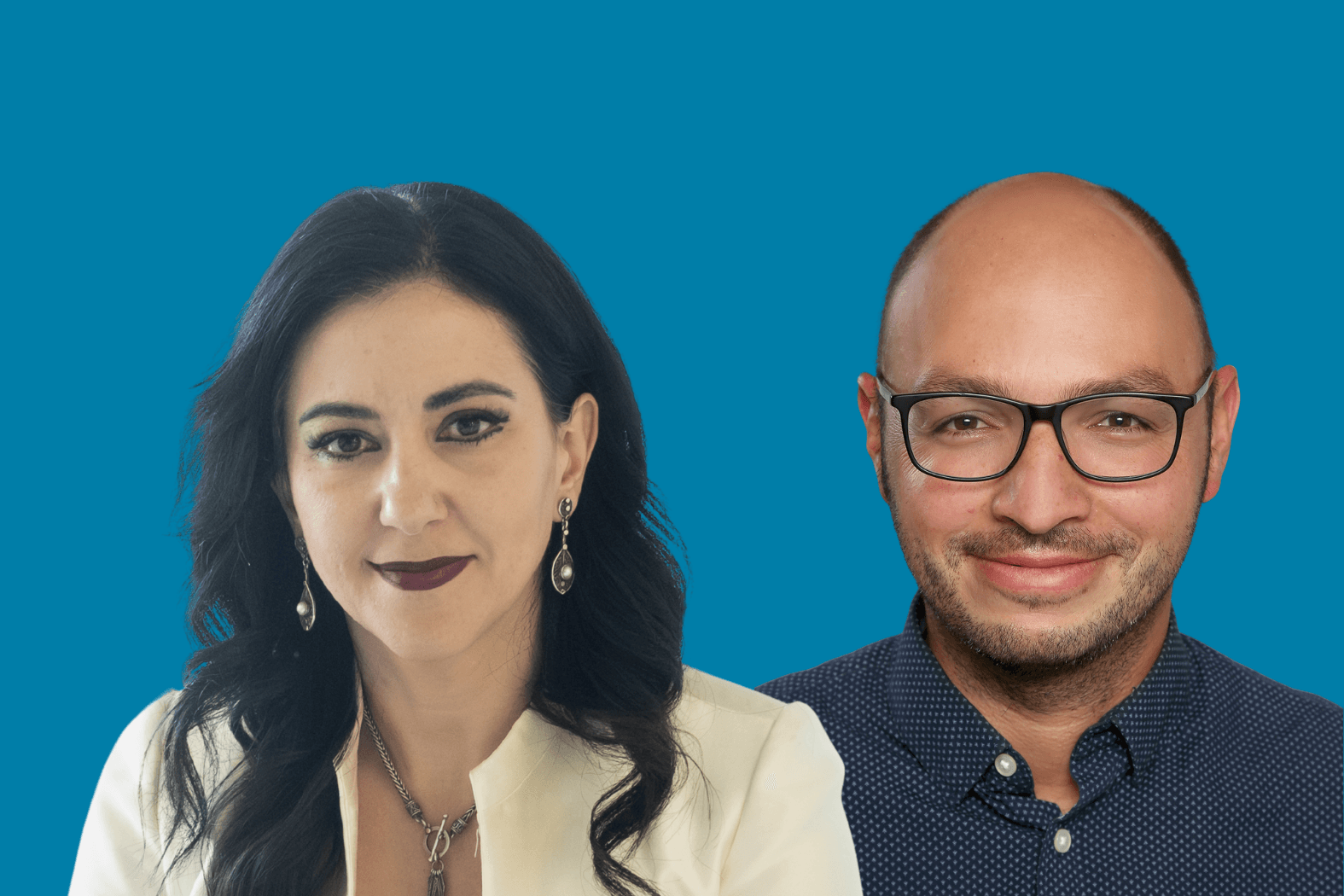
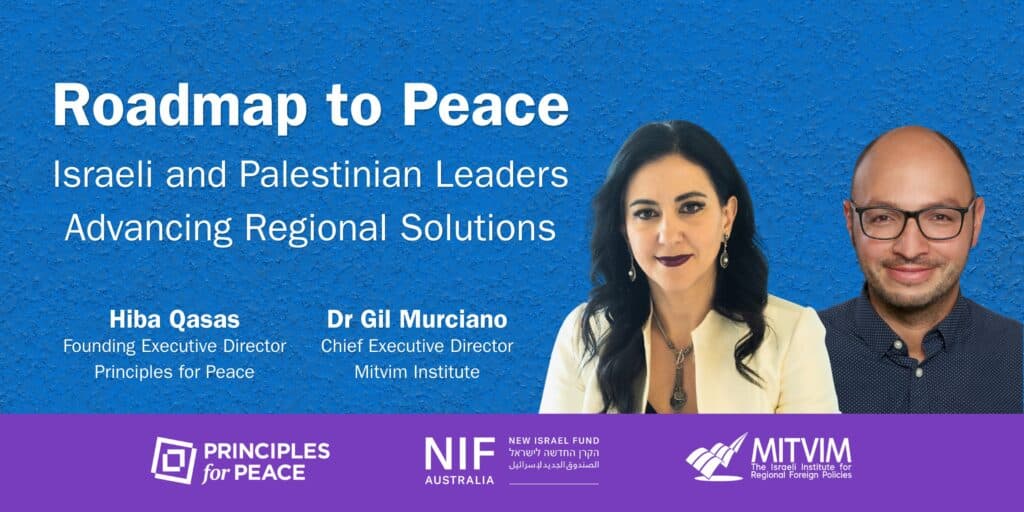
Hiba Qasas and Dr Gil Murciano will speak at NIF Australia events in Sydney and Melbourne in June. (Images: provided by NIF)

Published: 27 May 2026

Last updated: 28 May 2026

When Dr Gil Murciano heard that Kibbutz Be'eri was under attack on 7 October, 2023, his mind went straight to a close friend who lived there. For weeks he avoided checking Facebook, afraid to see the inevitable. Eventually he learned his friend had been killed defending the kibbutz. Murciano says he feels "fortunate" not to have lost family as well as friends that day. But the word catches in his throat: the trauma of that morning shapes every sentence he utters about Israel's future. 

For Hiba Qasas, the violence is just as intimate. She grew up in Nablus during the First Intifada, walking to school between rocks and bullets. In the Second Intifada, her family home was shelled. As a young woman she lost her boyfriend, shot by the IDF. She speaks of these events calmly, but they sit in the background of everything she says about justice, security and dignity. 

Both have buried loved ones. Both carry deep scars. And yet, ahead of their joint visit to Australia in June as guests of New Israel Fund (NIF) Australia, they have chosen to work together: an Israeli security analyst and a Palestinian peacebuilder, insisting that the only sustainable future is one they build side by side. 

Since October 7 and the devastation in Gaza, calls for revenge have echoed across both societies. Murciano and Qasas understand that impulse better than most, and both consciously refuse to be guided by it. 

Murciano, a former IDF officer who became a national security and diplomacy expert, acknowledges that a powerful "quest for revenge" swept Israel after the massacre. He understands the temptation, especially for bereaved families, to conclude that October 7 revealed "the real face" of Palestinians and that peace is naive. Yet his professional life has been shaped by a different conviction.
For years, he warned about what he calls "the fallacy of sitting idly by and letting reality lead" – the belief that time is on Israel's side, that avoiding initiative is safer than taking political risks. For him, October 7 was not only a military failure, but the consequence of a long-term political vacuum. If Israel responds only with force and never with a credible political horizon, he believes, it is condemned to repeat the same cycles of violence. 

Qasas watched the war in Gaza with another kind of grief, tens of thousands killed, the vast majority of the population displaced, lives and livelihoods pulverised. Many Palestinians, she acknowledges, feel a burning desire for revenge. She knows exactly where that comes from. But she refuses to let it define her. 

"You can spend your life trying to do justice for the past," she says, "and miss the chance for justice in the future." Her goal is emancipation rather than vengeance: ending occupation, ending perpetual insecurity, securing self-determination for both peoples. For both Murciano and Qasas, justice with no plan for the future is not justice at all. 

Murciano leads the Mitvim Institute, an Israeli foreign policy think tank dedicated to integrating Israel into its region and advancing Israeli–Palestinian peace as a realistic policy, not a nostalgic slogan. He and his colleagues work on regional frameworks – which link normalisation to progress on the Palestinian issue – reconstruction plans for Gaza tied to political reform and security arrangements, and concrete steps, development, energy projects and Palestinian state-building that build the reality of two states on the ground. 

He draws on a phrase coined by his Palestinian colleague Samer Sinijlawi: "the peace of no choice." For decades Israelis were taught about "wars of no choice." Now, he argues, the logic has flipped. For without peace, Israel has no future.  

After 17 years working for the United Nations across the Middle East and in climate-affected regions, Qasas left a secure international career to found Principles for Peace in Geneva, determined to challenge the global peacemaking orthodoxy that keeps reproducing failure. For two decades she deliberately stayed away from the Israeli–Palestinian conflict. It was too close, too painful. But after October 7 she felt she had no moral right to stand aside. If she believed in what she had built, she had to bring it to the hardest room of her life. 

The Jewish Independent

Qasas' organising idea is "enlightened self-interest." The status quo has failed Israelis and Palestinians alike; neither people can secure safety, dignity or self-determination at the other's expense.  

Under the banner "Uniting for a Shared Future," she now convenes more than 550 Israeli, Palestinian, regional and international leaders, many of them not natural members of the traditional peace camp, but people who recognise the status quo is unsustainable and that both peoples feel existentially threatened. 

At the conclusion of our interview, I asked both, when there is peace, what will your life look like? 

Murciano dreams of finally having space to ask what it means to be Israeli and Zionist in the second half of the twenty-first century without being defined by permanent conflict, to be authentically Middle Eastern, connected naturally to neighbours rather than fortified against them. 

Qasas imagines something more modest and just as radical: her mother driving to visit her sister without fear of settlers on the road, Palestinian government employees receiving regular salaries without permission from Israel, crossing to Jerusalem freely without seeking permits for every visit to the holy city and businesses functioning without constant shutdown and strangulation. 

They do not deny the depth of trauma, the hatred, or the immense work of reconciliation ahead. However, together, Israeli and Palestinian, both bereaved, both scarred, they insist that another future remains possible. 

For an Australian-Jewish community caught between fear of rising antisemitism and concern for Palestinian suffering, there may be no more important voices to hear right now than Murciano and Qasas, not in separate rooms, but together on the same stage, modelling the shared, risky, deeply human courage that real peace will demand. 

Dr Gil Murciano and Hiba Qasas will speak at NIF Australia events in Sydney on Monday June 1 and in Melbourne on Thursday June 4.

You might also like
  • The Altalena should be a warning, not a political weapon
    Shahar Burla
  • Turkey emerges as military threat to Israel
    Dror Doron
  • Because of my Zionist values, I’m joining an Arab party
    Yoav Segalovitz
logomark.67a07ee3
We believe in the free flow of information

Republish our articles for free, online or in print, by using our Creative Commons licence

You might also like

    vandalism car woollahra fuk israel farhat
    Australia

    Court decision fails to understand when ‘Fuk Israel’ becomes antisemitic

    Jeremie Bracka 2
    Ofer_Winter_2026
    Israel Votes 2026AnalysisIsrael

    Who is Ofer Winter and could he upset Netanyahu’s election?

    Shahar Burla
    Royal Commission final
    Royal CommissionNewsAustralia

    Strategies for cohesion final focus of Royal Commission hearings

    Peter Kohn 1

Comments1

  • Avatar of Mark Ian

    Mark Ian29 May at 04:36 am

    Many would have the feeling that Dr Gil and Hiba Qasas are especially Humane and Idealistic People like the Righteous Amongst the Gentiles during WW2 and many other conflicts.
    But it is a tremendous relief that people like this are in this world .
    Around them circles ought be built not naive but also security minded and hope for a Force that will propel them to the majority.

About the author

Ittay Flescher

Ittay Flescher

Ittay Flescher is the Jerusalem Correspondent for The Jewish Independent. For over twenty years, he has worked as an educator, journalist, and peacebuilder in Melbourne and Jerusalem. His book, The Holy and the Broken: A Cry for Israeli-Palestinian Peace from a Land that Must Be Shared, was longlisted for the 2025 Walkley Book Awards.

More from the author

AnalysisIsrael

What ‘Zionism’ means in Israel:  it’s not what you think

AnalysisIsrael

From haven to hotbed: how Israel’s perception of Australia has changed

FeatureIsrael

New wave of Russian-speaking migrants may be key to Israel’s future

AnalysisIsrael

How a new International Peace Fund could make a tangible difference