Aa
  • Read, Watch, Listen
  • TJI Series
  • Community Action
  • Events
  • Zedi
Follow us and continue the conversation
  • LinkedIn
  • Instagram
  • FaceBook
  • X
  • YouTube
Test yourself with the TJI Quiz!

Adjust size of text

Aa

Follow us and continue the conversation

  • LinkedIn
  • Instagram
  • FaceBook
  • X
  • YouTube

Your saved articles

You haven't saved any articles

What are you looking for?

Original reporting, insightful analysis and diverse views, delivered straight to your inbox

  • LinkedIn
  • Instagram
  • FaceBook
  • X
  • YouTube
Your support fuels our mission to inform, entertain and inspire.

The Jewish Independent is bound by the Standards of Practice of the Australian Press Council. If you believe the Standards may have been breached, you may approach The Jewish Independent or make a complaint to the Australian Press Council in writing at www.presscouncil.org.au. The Council may also be contacted on 1800 025 712.

  • Our Story
  • Contact us
  • Our Team
  • Support us
  • Guidelines
  • Pitch your idea
  • Republishing us
  • Community Action
  • Our Awards
  • LinkedIn
  • Instagram
  • FaceBook
  • X
  • YouTube
Aboriginal FlagTorres Strait Islanders Flag

The Jewish Independent acknowledges Aboriginal and Torres Strait Islander peoples as the Traditional Owners and Custodians of Country throughout Australia. We pay our respects to Elders past and present, and strive to honour their rich history of storytelling in our work and mission.

© The Jewish Independent 2026All Rights Reserved
Website design and development by Your Creative, MelbourneTerms & ConditionsPrivacy Policy
HomeRead, Watch, ListenIsrael
ReflectionIsrael

When grief needs a secret address

I thought I'd left hidden locations behind with Diaspora antisemitism, but in Israel hostility to a joint Palestinian-Jewish memorial ceremony demands the same precautions.
Ittay Flescher
Print this
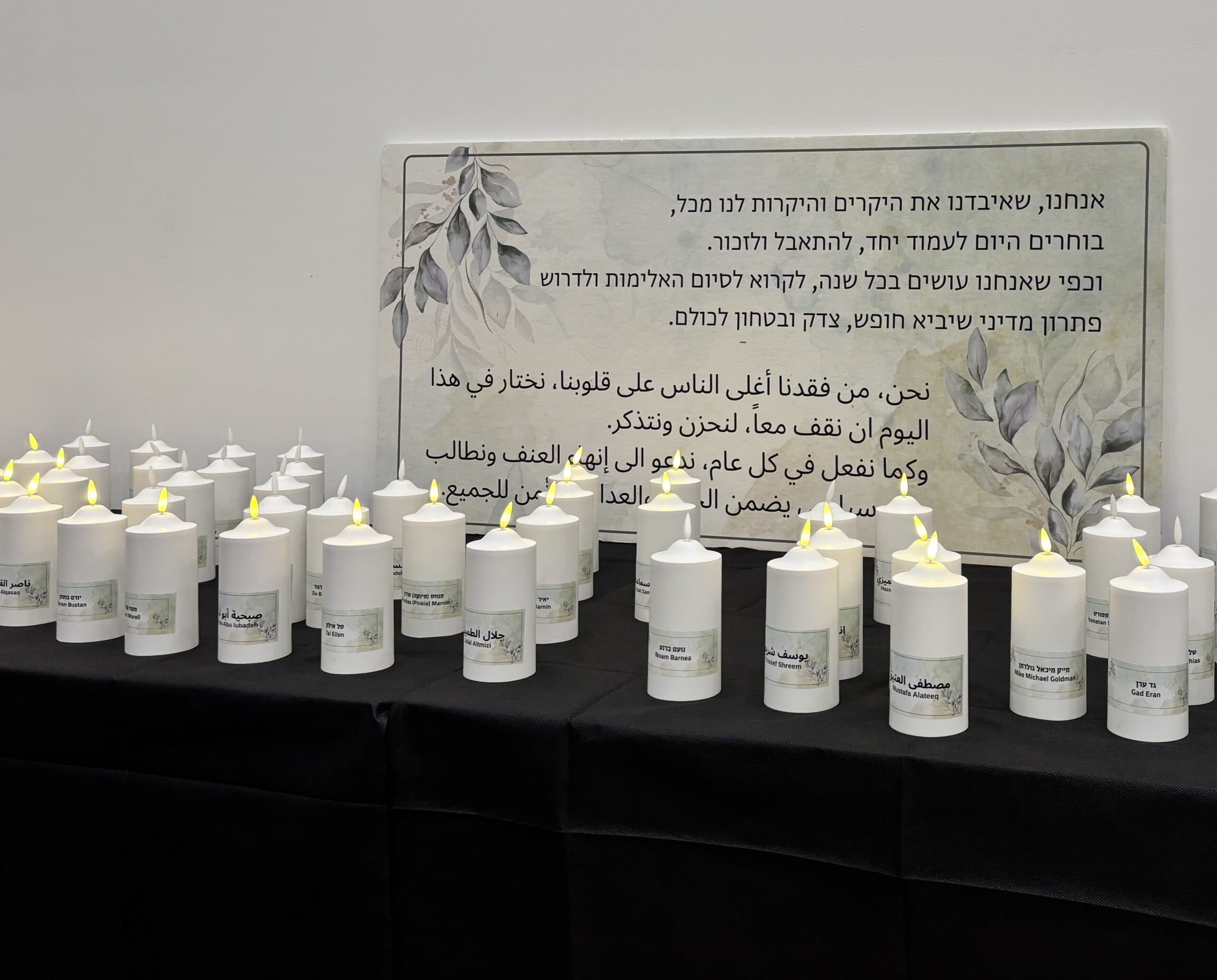
joint memorial yom hazikaron candles

Memorial candles marked in Hebrew and Arabic at the Bereaved Families Forum Combatants for Peace joint memorial ceremony (Ittay Flescher)

Published: 22 April 2026

Last updated: 22 April 2026

For most of my life in Melbourne until I moved to Jerusalem in 2018, community events were rarely printed with an address. The location would arrive in your inbox or on your phone only 24 hours before the event, shared only with those vetted and registered.

I used to think this practice was a little paranoid. But after the attempted arson of the East Melbourne Hebrew Congregation during a Shabbat meal and the massacre at a Chanukah celebration on Bondi Beach, I sadly understand why this is necessary. It is a precaution born of a deep-seated need to protect Jewish life from the scourge of antisemitism and is sadly necessary.

When I speak to friends in Australia about the necessity of hiding the location of Jewish events, they sometimes confide that they dream of moving to Israel. They imagine where I live now to be a place where they would never have to hide who they are or their political beliefs, a land where their Jewishness can be celebrated in the public square without fear.

They are mostly right, but not always.

On Yom HaZikaron, Memorial Day for Israel’s fallen, I found myself waiting for that familiar 24-hour ahead notification in order to attend the joint memorial ceremony on Monday night, a gathering of Israelis and Palestinians mourning the loss of their loved ones together.

The Parents Circle Bereaved Families Forum and Combatants for Peace were not worried about Neo-Nazis or fringe hate groups; they were worried about our own. They feared that Jewish extremists might attack the event, as they did at a screening of last year’s memorial in a Raanana synagogue, where thugs used stones and fists to disrupt a space meant for shared tears.

Tampering with the formula of memory that is dominant, is often seen as sacrilege
It is the first time I have attended an event in Israel that felt compelled to hide its location.  It is a profound and unsettling irony: the caution I was taught as a minority in the diaspora has been introduced for the few who seek to humanize the "other" on our memorial day.

I understand why the vast majority of Israelis and Palestinians oppose a joint memorial at a time when our two nations are at war. Given how politized memory is in both countries, the ways we remember or fallen are mixture of civic rituals that have taken on a sacredness that goes far beyond many religious rituals. Therefore, tampering with the formula of memory that is dominant, is often seen as sacrilege.

So, why do I go to these ceremonies? Over my years living here, I often haven’t known what to do with myself on Yom HaZikaron. The official narrative has felt too narrow, too focused on the "us versus them" binary that has cost us so much blood.

Over time, I found a home in the peace-building community of Jerusalem. Here, I discovered a community connected by a simple, radical idea: a person is a person, pain is pain, and loss is loss. Grief is not a finite resource to be owned by one side.

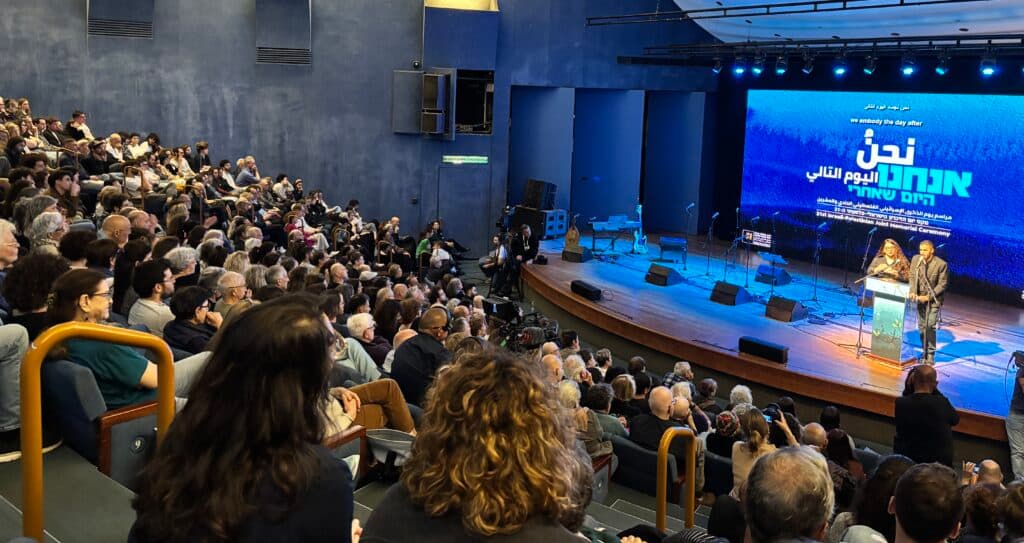
Bereaved families listen to Jewish and Palestinian speakers at the joint memorial ceremony (Ittay Flescher)

At this year’s memorial, speakers included Liora Eylon, whose son Tal was killed by Hamas in Kibbutz Kfar Azza on October 7. She described a recurring vision of Tal sitting "up above" with a Palestinian also killed in the conflict, the two of them sharing coffee and exchanging stories.

Nahil Hanuna, a photographer from Gaza who lost her brother, sister-in-law, and members of her husband's family in the war, spoke in a video message of a dream she carries with her: "We Palestinians are human beings like anyone else," she said. "We were not created to spend our lives in war, hostility, and displacement... We want to raise our children safely and watch them grow without fear."

She added that the religions of this region carry the same message: "God created us to build this world, not to destroy it."

We refuse the false choice that says we must choose between the security of one people and the humanity of another

While I don’t always align with every framing of the speeches or music choices at these ceremonies, of all the events I attend held by the peacebuilding community, this remains one of the most impactful in articulating a clear vision of how memory and loss will be marked when there is peace. Perhaps that is why this year's event was held under the banner: "We are the day after."

This is the 21st year of the joint ceremony and hostility towards it has increased.  In Palestinian society, it’s seen as an act of normalization, and deeply opposed by the BDS movement. In Jewish-Israeli society, especially after the horrors of October 7, the space for empathy is also shrinking.

At the 2023 memorial, several hundred protesters gathered to hurl insults at those gathered at the ceremony in Tel Aviv, playing loud music to drown out the testimonies of the grieving bereaved families. In 2025, a Raanana synagogue screening the event was attacked. That synagogue chose chose not to hold a screening of the memorial this year.

Yet, despite the hostioity, I look at the community that gathers, whether in person at the secret location in Tel Aviv, or online from Jericho, Melbourne, or New York, and I see something resilient. We are a courageous community that chooses differently. We refuse the false choice that says we must choose between the security of one people and the humanity of another.

There were only 700 of us in the hall this time, but across the country and the world, hundreds of thousands joined us. They were moved by bereaved parents who, despite their catastrophic loss, refuse to let their grief be used as a weapon for more war.

By next year, I hope we won't need to send the location of our mourning as a coded secret. I hope we can hold this space in a public venue where any bereaved parent, from Gaza, the West Bank, Sderot, or the kibbutzim, can remember their loved ones in safety, together.

Because until this land is a home for all who live between the river and the sea, it will never truly be a home for any of us.

You might also like
  • The Altalena should be a warning, not a political weapon
    Shahar Burla
  • Turkey emerges as military threat to Israel
    Dror Doron
  • Because of my Zionist values, I’m joining an Arab party
    Yoav Segalovitz
logomark.67a07ee3
We believe in the free flow of information

Republish our articles for free, online or in print, by using our Creative Commons licence

You might also like

    settler outpost west bank
    NewsIsrael

    Israel is cementing its control over the West Bank and East Jerusalem while the world is distracted

    Martin Kear
    fly to vote
    Israel Votes 2026OpinionIsrael

    Flying to vote is an act of love, not impudence

    Shahar Burla
    Ofer_Winter_2026
    Israel Votes 2026AnalysisIsrael

    Who is Ofer Winter and could he upset Netanyahu’s election?

    Shahar Burla

Comments2

  • Avatar of Mark Light

    Mark Light30 April at 01:39 am

    The Pesach Seder Tradition of Removing a drop of wine with every Plague mentioned reflects Jewish compassion for the Innocent Peoples killed in Wars due to their Leaders Malevolent Crimes .
    Some talk of Suicidal Empathy but this applies to pity for Terrorists who order or commit Barbarism.
    Not for people Palestinian Jewish and Humanitarian people who fell strong empathy for all the unnecessary deaths of War .

  • Avatar of Sandy

    Sandy23 April at 11:14 am

    Thank you Ittay for your work with young people and community in bringing people together across our humanity

About the author

Ittay Flescher

Ittay Flescher

Ittay Flescher is the Jerusalem Correspondent for The Jewish Independent. For over twenty years, he has worked as an educator, journalist, and peacebuilder in Melbourne and Jerusalem. His book, The Holy and the Broken: A Cry for Israeli-Palestinian Peace from a Land that Must Be Shared, was longlisted for the 2025 Walkley Book Awards.

More from the author

AnalysisIsrael

What ‘Zionism’ means in Israel:  it’s not what you think

AnalysisIsrael

From haven to hotbed: how Israel’s perception of Australia has changed

FeatureIsrael

New wave of Russian-speaking migrants may be key to Israel’s future

AnalysisIsrael

How a new International Peace Fund could make a tangible difference