Aa
  • Read, Watch, Listen
  • TJI Series
  • Community Action
  • Events
  • Zedi
Follow us and continue the conversation
  • LinkedIn
  • Instagram
  • FaceBook
  • X
  • YouTube
Test yourself with the TJI Quiz!

Adjust size of text

Aa

Follow us and continue the conversation

  • LinkedIn
  • Instagram
  • FaceBook
  • X
  • YouTube

Your saved articles

You haven't saved any articles

What are you looking for?

Original reporting, insightful analysis and diverse views, delivered straight to your inbox

  • LinkedIn
  • Instagram
  • FaceBook
  • X
  • YouTube
Your support fuels our mission to inform, entertain and inspire.

The Jewish Independent is bound by the Standards of Practice of the Australian Press Council. If you believe the Standards may have been breached, you may approach The Jewish Independent or make a complaint to the Australian Press Council in writing at www.presscouncil.org.au. The Council may also be contacted on 1800 025 712.

  • Our Story
  • Contact us
  • Our Team
  • Support us
  • Guidelines
  • Pitch your idea
  • Republishing us
  • Community Action
  • Our Awards
  • LinkedIn
  • Instagram
  • FaceBook
  • X
  • YouTube
Aboriginal FlagTorres Strait Islanders Flag

The Jewish Independent acknowledges Aboriginal and Torres Strait Islander peoples as the Traditional Owners and Custodians of Country throughout Australia. We pay our respects to Elders past and present, and strive to honour their rich history of storytelling in our work and mission.

© The Jewish Independent 2026All Rights Reserved
Website design and development by Your Creative, MelbourneTerms & ConditionsPrivacy Policy
HomeRead, Watch, ListenIsrael
Israel Iran WarAnalysisIsraelWorld

Lebanese president challenges Hezbollah, advocates for diplomacy with Israel

President Joseph Aoun has called for an end to the decades-long conflict, advocating for diplomacy over military confrontation and criticising Iranian interference in Lebanese affairs
Shahar Burla
Print this
Lebanese president Joseph Aounn

Lebanese President Joseph Aoun in May 2025 (Antonio Masiello/Getty Images)

Published: 18 June 2026

Last updated: 18 June 2026

Lebanese President Joseph Aoun did something almost unheard of last week. In an interview with CNN's Christiane Amanpour last week, he looked directly into the camera and addressed the Israeli public. "Are you fed up with war since 1948?" he asked. "Do you really want to live in peace? Let's sit and talk."

For Israelis accustomed to hearing threats from Hezbollah and hostility from Beirut, the remarks were striking. For Lebanese audiences, they were even more extraordinary. Aoun did not simply call for an end to fighting. He challenged decades of assumptions about Lebanon's relationship with Israel, criticised Iranian interference in Lebanese affairs, and openly argued that diplomacy, not military confrontation, offers the only realistic path forward.

The comments are particularly notable because they come from a president whose personal history is deeply shaped by conflict. A former army commander wounded in combat and a veteran of Lebanon's long years of instability, Aoun is hardly a pacifist idealist. Yet since taking office in January 2025, he has emerged as perhaps the strongest Lebanese advocate for restoring state sovereignty and reducing the influence of Hezbollah and its Iranian backers.

Challenging Iran's grip on Lebanon

Aoun's interview went well beyond his appeal to Israelis. In some of his strongest remarks since becoming president, he directly accused Iran of treating Lebanon as a bargaining chip in its regional strategy. "It's not your country, it's our country," Aoun said when discussing Tehran's role in Lebanon. He argued that ordinary Lebanese were paying the price for Iranian interests and criticised attempts to tie Lebanon's future to broader negotiations involving Iran, Israel and the US.

The comments represent a significant departure from the cautious language traditionally used by Lebanese leaders when discussing Iran and Hezbollah. For decades, Hezbollah has operated as both a political party and a heavily armed militia, maintaining a military capability far beyond the control of the Lebanese state. Aoun has repeatedly argued that this situation is unsustainable.
Lebanon's government has committed itself to eventually bringing all weapons under state control, a clear reference to Hezbollah's arsenal. Yet Aoun has also acknowledged the limits of what can be achieved through force. "Hezbollah is not an objective you can see," he told CNN. "It's an idea."

Dear Mr President, 

We heard your message to the Israeli public in your interview with Christiane Amanpour, and especially your question: Do we really want to live in an endless war? Our answer is no

An Open Letter from Israeli Women to Lebanese President Joseph Aoun

That assessment reflects the difficult reality facing Lebanon. Hezbollah remains deeply embedded within parts of Lebanese society, particularly among sections of the Shiite community. Any attempt to forcibly disarm the organisation risks plunging the country back into the kind of internal conflict that devastated Lebanon during its 15-year civil war. Instead, Aoun has advocated a gradual process of negotiation and persuasion. "I will try to negotiate and reason with them," he said. "Eventually they will be persuaded, but the cost will be high."

The challenge is compounded by continued Israeli military operations in southern Lebanon and the ongoing presence of Israeli forces in parts of Lebanese territory. Aoun argues that progress on Hezbollah's weapons and progress on Israeli withdrawal must occur together through diplomacy rather than military escalation.

Hezbollah strikes back

Aoun's willingness to speak openly has triggered a fierce backlash. Hezbollah Secretary-General Naim Qassem dismissed direct talks with Israel as a form of surrender and accused the government of making unnecessary concessions. Hezbollah leaders continue to insist that any discussions with Israel should remain indirect and have strongly opposed government initiatives aimed at restricting the group's military activities.

The criticism has extended well beyond formal political statements. Pro-Hezbollah media outlets have accused Aoun of capitulation. Hezbollah-aligned newspapers have published headlines portraying him as rushing towards peace rather than reconstruction. Social media campaigns have labelled him a traitor and foreign agent.

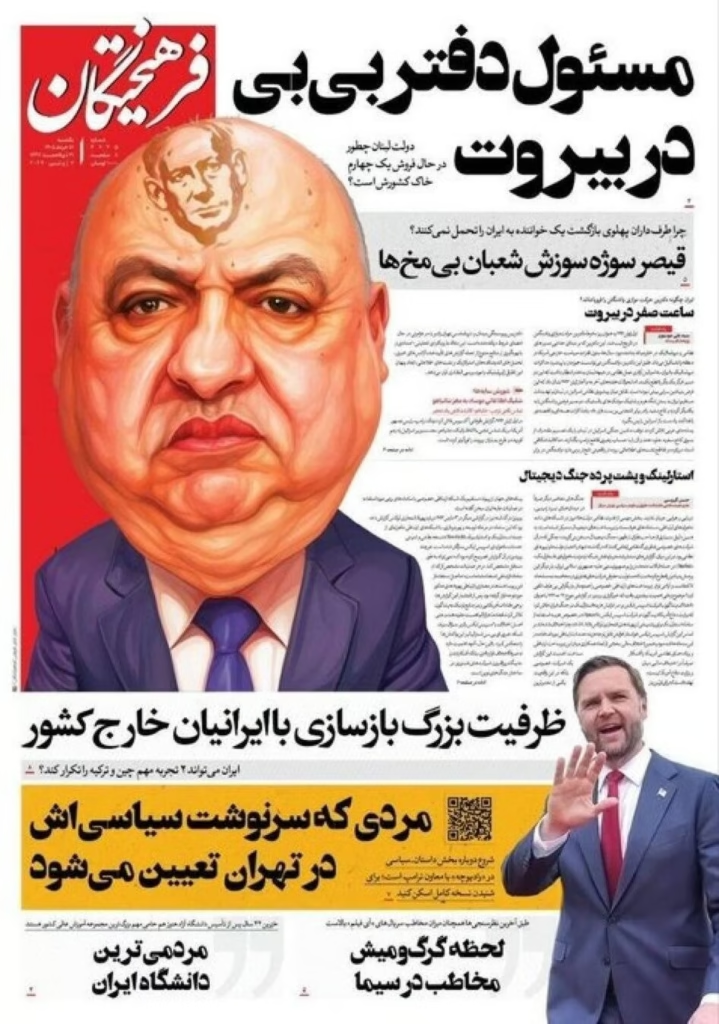
One Iranian newspaper went so far as to describe him as "the manager of Netanyahu's office" in Beirut. AI-generated images circulated online have depicted Aoun wearing a kippah or standing beside Israeli flags. Other images showed Hezbollah fighters humiliating the Lebanese president.

Iranian newspaper published last week calls Aoun 'the manager of Netanyahu’s office'<br><br>
Iranian newspaper published last week calls Aoun 'the manager of Netanyahu’s office'

The attacks reflect growing anxiety within Hezbollah and among its supporters about the direction of the Lebanese state.

For years, Hezbollah justified its military role as necessary to defend Lebanon from Israel. Aoun's argument is different. He contends that endless conflict has weakened Lebanon, undermined its sovereignty and trapped its people in cycles of destruction.

His response to critics has remained consistent. "Negotiation is safer than war," he said recently. "It is not surrender, nor is it concession. It is a solution to stop wars with the lowest possible cost."

That position has become increasingly difficult to maintain as Israeli strikes continue and casualties mount. Every new attack creates additional pressure on Aoun to explain why diplomacy remains preferable to confrontation. Yet despite the criticism, neither Aoun nor Prime Minister Nawaf Salam has retreated from their position that direct engagement remains Lebanon's best option.

Israeli women respond to Aoun's peace message

While Hezbollah condemned Aoun's remarks, the response in Israel was more nuanced. President Isaac Herzog welcomed the Lebanese leader's comments and reiterated Israel's stated desire for peace with Lebanon. His response was largely in line with Israel's longstanding position: peace is possible, Herzog argued, but Lebanon's leadership must first free itself from the influence of Hezbollah and Iran. In effect, he welcomed Aoun's message while placing the responsibility for progress back on Beirut.

More noteworthy was the reaction from parts of Israeli civil society. Several peace organisations, including Women Wage Peace, the Israeli-Palestinian Bereaved Families Forum, the Women's Cabinet – Security, Policy and Society, and Mothers' Cry, organised an open letter responding directly to Aoun's appeal. More than 1,250 Israeli women signed the initiative.

Their answer to Aoun's question about whether Israelis were tired of war was unequivocal: "Our answer is no" – no, they do not want endless conflict.

The signatories said they were encouraged to hear a Lebanese president speak directly to the Israeli public about the possibility of a different future. Acknowledging the suffering experienced by both peoples, they argued that neither Israelis nor Lebanese could achieve lasting security through military means alone.

The initiative should not be overstated. The organisations involved represent a relatively small but persistent peace camp within Israeli society, operating at a time when security concerns dominate public debate. Yet their response offered a rare glimpse of the voices on both sides of the border continuing to argue that diplomacy, however distant it may seem, remains preferable to perpetual war.

That may not amount to a political breakthrough, but it does suggest that Aoun's message found at least some receptive ears across the border.

Who is Joseph Aoun?

Joseph Aoun's emergence as Lebanon's most prominent advocate for diplomacy reflects an unusual career path. Born in 1964 in the southern Lebanese village of Aichiye, he joined the Lebanese military during the country's civil war and steadily rose through the ranks. He holds degrees in both political science and military sciences and spent decades serving in the armed forces.

In 2017, as army commander, he oversaw operations against Islamic State militants along Lebanon's border with Syria. During his tenure, the military also navigated some of the country's most challenging crises, including the 2019 anti-government protests, the Beirut port explosion and the conflict between Israel and Hezbollah.

Unlike many Lebanese political figures, Aoun built a reputation for avoiding partisan politics. Former US officials who worked with him have described him as deeply non-political and focused almost exclusively on the military's professional responsibilities.

That reputation helped him secure the presidency in January 2025, ending more than two years of political deadlock. His election was supported by a broad coalition of lawmakers and backed by international actors eager to see a functioning Lebanese government emerge after years of paralysis.

Yet his presidency has quickly become more political than many anticipated. Faced with a weakened state, a powerful Hezbollah movement and growing public frustration, Aoun has increasingly positioned himself as a defender of Lebanese sovereignty. His willingness to publicly challenge Iran, confront Hezbollah and speak directly to Israelis suggests a leader attempting to redefine Lebanon's place in the region.

Whether he succeeds remains uncertain. Hezbollah remains powerful. Israeli military operations continue. Lebanon's economic crisis is far from resolved. And regional tensions remain dangerously high.

Although in a Middle East where leaders often speak only to their own constituencies, Aoun's decision to address Israelis directly, and to argue that diplomacy is preferable to war, represents one of the more unusual and potentially significant political gestures of the past year.

Whether it leads anywhere is another question. But for now, the former general who says he hates war has opened a conversation that many believed impossible.

READ MORE 

Exclusive: Lebanese president accuses Iran of using his country as a bargaining chip in peace talks with the US (CNN)

Who is Joseph Aoun, a low-profile army chief who is now Lebanon’s president? (AP News) 

Shown in kippah, Hezbollah camp brands Aoun a traitor as Israel talks advance (Ynetnews) 

Military pressure will not topple Hezbollah, and neither will flattening southern Lebanon (Ehud Barak, Haaretz)  

You might also like
  • Tame apologises – but with little grace
    Deborah Stone
  • Confronting Richard Flanagan and the myth of the Israel lobby
    Mary Garden
  • UK’s dramatic policy change on Israel-Palestine
    Colin Shindler
logomark.67a07ee3
We believe in the free flow of information

Republish our articles for free, online or in print, by using our Creative Commons licence

You might also like

    Arab Israeli Palestinian election vote
    Israel Votes 2026FeatureIsrael

    Fear of Netanyahu victory may drive big surge in Palestinian voter turnout

    Ben Lynfield
    ISRAEL-LGBTQ-PRIDE-PARADE-PALESTINIAN-CONFLICT-HOSTAGES
    NewsIsrael

    LGBT asylum seekers caught between Palestinian violence and Israeli bureaucracy

    Jarod Rhine-Davis
    haredi street guitar
    Photo EssayArts & Culture

    Jerusalemites through the lens

    Sharon Gabay

Comments

No comments on this article yet. Be the first to add your thoughts.

About the author

Shahar Burla

Shahar Burla

Dr Shahar Burla is a Sydney-based researcher, lecturer and Contributing Editor of TJI. Shahar holds a Master’s degree in political science from Hebrew University and a PhD in political science from Bar-Ilan University. He is the author of Political Imagination in the Diaspora: The Construction of a Pro-Israeli Narrative (2013) and co-editor of Australia and Israel: A Diasporic, Cultural and Political Relationship (2015).

More from the author

FeatureIsrael

New evidence Netanyahu was warned about October 7

OpinionIsrael

The Altalena should be a warning, not a political weapon

AnalysisIsrael

Who is Ofer Winter and could he upset Netanyahu’s election?

AnalysisIsrael

Bennett’s balancing act: can he win over the right without losing the centre?