Published: 19 April 2019
Last updated: 4 March 2024
"It is bleak," Mkhaimar Abusada, a political scientist at al-Aksa University in Gaza City told The Jewish Independent. "The picture is dark black for Palestinians and there is nothing much we can do."
The idea that Israel would carry out formal annexation and the application of its law in the West Bank was once far-fetched, in part due to expected international opposition. But now, with the US last month recognising Israeli sovereignty over the Golan Heights, the analysts take Netanyahu's election eve promise to annex settlements as something to be taken extremely seriously.
While Abusada sees it as a promise that will definitely be implemented, West Bank analyst Khalil Shikaki views it as a serious possibility. "The extent to which Netanyahu assesses there will be consequences at the international level will be the most important factor," says Shikaki, director of the Palestinian Centre for Policy and Survey Research in Ramallah.
"American reaction is decisive, but given what we know of Trump policy, the Americans will not deter Netanyahu."
"The extent to which Netanyahu assesses there will be consequences at the international level will be the most important factor."
The Trump administration refrained from comment when Netanyahu made the annexation promise on the eve of the polling, which gave the right wing and religious bloc 65 of the 120 seats in the Knesset. "Sure, he can get away with it, if the reaction of the international community is not strong enough," Shikaki said.
Abusada concurs. "Not much can be done to stop this," he says, because internally the Palestinians are weak and divided between bitter rivals Hamas in Gaza and Palestinian Authority president Mahmoud Abbas in the West Bank.
[gallery columns="1" size="large" ids="27704"]
And regionally, the Palestinians lack wider Arab backing, he notes. "The Gulf countries are preoccupied with the Iranian threat and others are preoccupied with what's happening in their own countries, be it Iraq Libya, Yemen, Sudan and Algeria. The Palestinians can't hope that the Arabs will stand firmly behind them."
Abusada believes a change in leadership is necessary for the Palestinians to face up to the results of the election in Israel. The last Palestinian presidential election was in 2005, the last legislative ballot in 2006.
Referring to the 83-year old Abbas, Abusada said that "Abu Mazen is too old to deal with the big issues facing Palestinians. We need young, energetic capable leadership that can stand up to Netanyahu and rally Arabs and the international community in support of the Palestinians.
"Abu Mazen has exhausted all his abilities," he continued. "But Abu Mazen is no different than any other Arab leader. When they are in power, they are glued to their seats."
Netanyahu's re-election drives home to the Palestinian public the non-viability of the two-state solution long advocated by Abbas. And, in Shikaki's view, it will strengthen a trend already underway of increased public support for violence against Israeli targets, including civilians.
Given that Abbas is unlikely to change his own stances of backing the two-state solution and opposing violence, "the question arises of whether people will turn against their own leadership because of the gap between their positions and those of the leadership," Shikaki says.
He notes that only three weeks ago Gazans took to the streets in protests against dire living conditions that were violently suppressed by Hamas authorities. "Elections would be the best way for the public to express its desire for new leadership.
Given that Abbas is unlikely to change his own stances of backing the two-state solution, "the question arises of whether people will turn against their own leadership because of the gap between their positions and those of the leadership".
“But if elections are not an option, then the possibility people in the West Bank would do what people in Gaza did a couple of weeks ago, or what Algeria and Sudan are doing now, is [something] one needs to take into consideration given the realisation that Palestinians now have another four years of Netanyahu."
Shikaki was referring to protests by waves of youths in Algeria that forced long-time president Abdul Aziz Bouteflika to abandon plans to seek a fifth term and then continued in order to press for the ouster of all officials affiliated with him. In Sudan, popular protests have persisted even after generals removed long-standing dictator Omar Hasan al-Bashir last week.
An effort to overthrow the Abbas regime is not something contemplated for now, Shikaki says, but he believes it can brew as frustration mounts. "We can definitely say that one of the questions Palestinians are confronting is internal, about their own leadership and whether they need a different leadership."
In the view of Ghassan Khatib, a former Palestinian Authority planning minister, the election signifies that Israel has permanently become a country unwilling to make peace. "Israeli public opinion doesn't allow and won't allow in the future any room for a two-state solution," he said, speaking in Ramallah.
"It is true the American administration is taking sides with this Israeli right wing but it is also important to note growing unease in Europe towards Israeli policies and also unease among growing sectors of the Jewish community in the US," he says.
Khatib believes the new government will see its task as being "to digest the West Bank and make the Israeli control permanent". This will take the form of expanding settlements at a faster rate, annexing settlements gradually starting with the settlement blocs, and further restricting Palestinian use of land and water.
Khatib expects these steps regardless of whether and when the US announces the peace plan that has been drawn up by the Trump administration. "Israel will take all of these steps with American support," he says.
"The situation is grave. It is getting bleak."
READ MORE
Senior PA official said to warn Hamas plotting coup against Abbas in West Bank (Times of Israel)
A senior Palestinian Authority official has reportedly warned that Hamas means to exploit the economic situation in the West Bank and pay off PA officers and security forces to take control of the territory. The effort will resemble Hamas’s takeover of Gaza in 2007, the official said, according to a Tuesday report in Channel 12 news.
After election, Israel and Hamas prepare to enact long-term ceasefire in Gaza (Haaretz)
Indications that both sides are edging towards an agreement can be found in an account of Hamas leader Yahya Sinwar's talks with other Palestinian factions
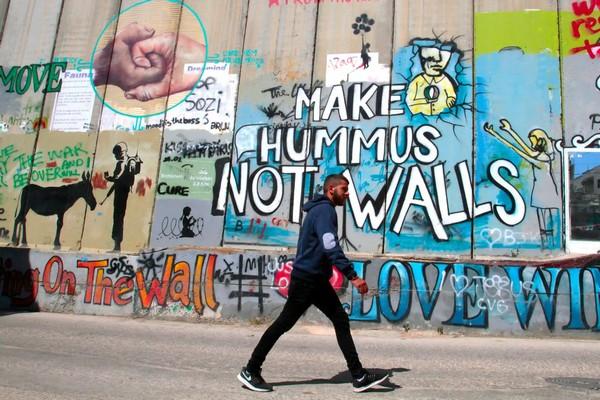
Main photo: A Palestinian walks past the separating wall in Bethlehem (Quique Kierszenbaum/The Observer)