Aa
  • Read, Watch, Listen
  • TJI Series
  • Community Action
  • Events
  • Zedi
Follow us and continue the conversation
  • LinkedIn
  • Instagram
  • FaceBook
  • X
  • YouTube
Test yourself with the TJI Quiz!

Adjust size of text

Aa

Follow us and continue the conversation

  • LinkedIn
  • Instagram
  • FaceBook
  • X
  • YouTube

Your saved articles

You haven't saved any articles

What are you looking for?

Original reporting, insightful analysis and diverse views, delivered straight to your inbox

  • LinkedIn
  • Instagram
  • FaceBook
  • X
  • YouTube
Your support fuels our mission to inform, entertain and inspire.

The Jewish Independent is bound by the Standards of Practice of the Australian Press Council. If you believe the Standards may have been breached, you may approach The Jewish Independent or make a complaint to the Australian Press Council in writing at www.presscouncil.org.au. The Council may also be contacted on 1800 025 712.

  • Our Story
  • Contact us
  • Our Team
  • Support us
  • Guidelines
  • Pitch your idea
  • Republishing us
  • Community Action
  • Our Awards
  • LinkedIn
  • Instagram
  • FaceBook
  • X
  • YouTube
Aboriginal FlagTorres Strait Islanders Flag

The Jewish Independent acknowledges Aboriginal and Torres Strait Islander peoples as the Traditional Owners and Custodians of Country throughout Australia. We pay our respects to Elders past and present, and strive to honour their rich history of storytelling in our work and mission.

© The Jewish Independent 2026All Rights Reserved
Website design and development by Your Creative, MelbourneTerms & ConditionsPrivacy Policy
HomeRead, Watch, ListenIsrael
AnalysisIsrael

Religious doesn’t have to mean right wing

A growing movement of religious Jews rejects the language of power and domination used by the politicians who have claimed the name “Religious Zionism”.
Ittay Flescher
Print this
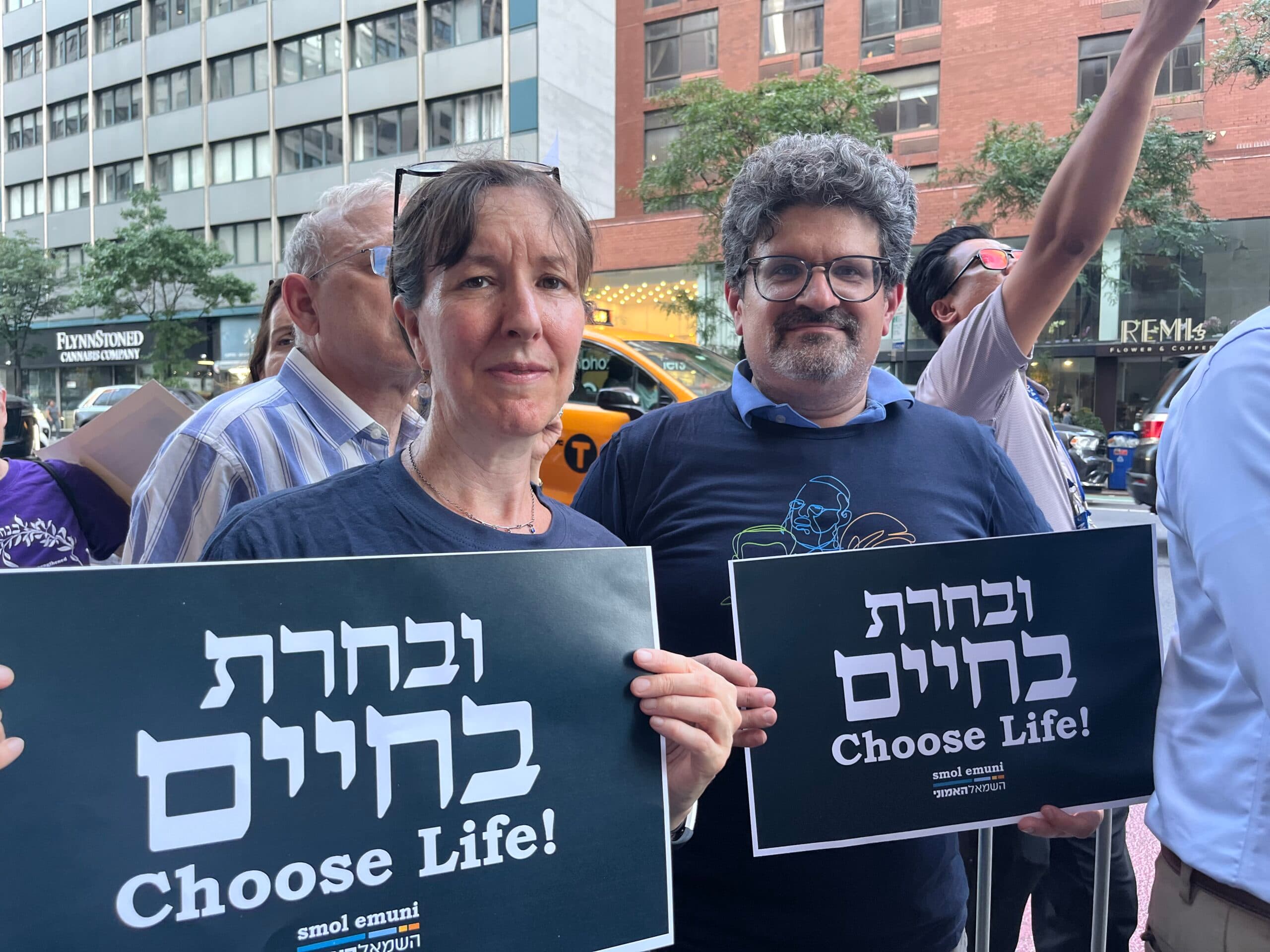
Smol Emuni protest against starvation in Gaza 2 Credit Solomon Fox

Members of Smol Emuni hold banners reading “Choose Life” in Hebrew and English at a protest against starvation in Gaza (Solomon Fox)

Published: 23 February 2026

Last updated: 23 February 2026

In the shadow of a religious Zionism increasingly defined by the hardline nationalism of Itamar Ben-Gvir and Bezalel Smotrich, a quiet yet firm alternative is brewing among religious Jews. 

Smol Emuni (Faithful Left) has become a sanctuary for those who refuse to choose between their commitment to Jewish law and their dedication to universal human rights.

The movement, which began in Israel three years ago, has now launched a Diaspora movement, starting in the US. For left-leaning religious Jews in Australia, it provides a critical blueprint for a future where "religious" and "liberal" are no longer treated as mutually exclusive identities. 

US founder Esther Sperber describes Smol Emuni as a movement that refuses to let the language of Torah be weaponised as a tool for vengeance or perpetual occupation. It offers direct counter-narrative to what she calls the "Smotrich-ification" of Jewish discourse.  

"That depiction of what Judaism means, which is kind of enamored or enthusiastic about power and domination and revenge, really needed a counter-voice," Sperber says. She argues that the religious right has been remarkably successful at branding its specific brand of nationalism as the only "authentic" Torah path, leaving those who believe in equality feeling ideologically homeless.  

In New York, Sperber and her colleagues realized that while similarly aligned organizations like J Street or the New Israel Fund perform vital functions, there was a specific need for a new zerem (meaning stream or movement) that speaks the language of faith rather than just secular advocacy. "I think we have a niche and an audience that is not part of those groups and would not necessarily join them," she explains. 

This vision is not merely about a progressive agenda; it is about reclaiming a Judaism deeply rooted in Torah that prioritises the dignity of all people.  

For Sperber, the choice of the name "Faithful Left" was a deliberate move to bridge the denominational divides that often fracture Jewish activism. In Israel, the term Emuni circumvents the rigid labels of Haredi, Masorti, or Dati. In the US, and potentially in Australia, it serves the same purpose.  

"It was very important for us to not just be another World Jewry American organization, but to have a very strong affiliation with Israeli Jewish activists on the ground in Israel who are doing this work," Sperber notes. By adopting the same name as the Israeli mothership, the group signals that they are not outsiders throwing stones, but stakeholders in a shared spiritual and national project. "It clearly messages our relationship with Israel: that we're not against Israel, we're for a different kind of Israel." 

In the Australian context, the Jewish community is characterized by strong, traditionalist institutions and a Zionism that often leans toward the defensive. Jewish criticism of ministers in Israel who hold all Palestinians responsible for the crimes of October 7, settler violence in the West Bank or extreme hunger caused by Israel blocking humanitarian aid for 77 days in 2025 is frequently met with concerns of inflaming antisemitism in the wider population who may express their anger at Israel on the local Jewish community.  

Esther Sperber addressing the Smol Emuni Conference (Credit: Liri Agami)

This is a dilemma Sperber knows well. "We feel squeezed on both sides," she admits. "There's the antisemitism from the right that is also very scary... and sometimes it feels like Jewish organizations have shifted towards those groups in the expectation that they would stave off the lefty antisemites." 

However, Sperber suggests a path of moral clarity over political pragmatism. She contends that while political silence is often calculated to protect the community, it carries a steep internal price. "I think often we have a reluctance to speak up morally because we’re afraid that it might not be the right political move," she reflects. "But if you feel like there is something that is really morally wrong, that is against your deepest values and your core beliefs, I think the question of how someone else might hear it might not be the most urgent question." 

For Australia, where the communal consensus is often guarded with iron discipline, this is a radical proposition. It suggests that the health of the Jewish soul is more important than the optics of a unified front. 

The stakes of this silence are particularly high for the next generation. Sperber points to the increasing number of American Jews who are becoming detached from or even hostile toward Israel because they feel their institutional homes do not represent their moral compass. "Being silent is kind of leaving the field to the people that are speaking the loudest who are not giving a nuanced answer," she says.  

When a young person sees settler violence or the introduction of the death penalty for in Israel and concludes they can no longer be a Zionist, Sperber meets them with empathy rather than excommunication.  

"I agree that the current government of Israel is promoting a vision that is deeply problematic," she says. But she encourages them to stay engaged: "There is value in trying to support change in Israel and in the powerful voice that American Jewish people have in this discourse to help shift it." 

Australia’s liberal orthodox groups such as Or Chadash in Sydney or Shira and Beit Midrash Oz in Melbourne are uniquely suited for the Smol Emuni model. Unlike the more siloed denominational structure of the United States, the Australian community is fluid. A "Faithful Left" initiative in Australia could bridge the gap between traditional centers like Mizrachi and progressive synagogues, uniting those who crave a discourse that is both halakhically serious and politically brave.  

It would offer a home for those who, in Sperber’s words, are "walking a bit of a different kind of narrow line between the people who have kind of given up on Israel... and the people who are just supportive of Israel no matter what it does." This "complex line" is precisely where many Australian Jews find themselves, yet they lack the communal framework to stand on it securely. 

The practical activity of Smol Emuni US illustrates how this community can be built. They began with "salon talks" featuring diverse voices, with an approach that created a "thirst" for a deeper, more challenging conversation that ultimately led to a major conference. For Australia, the first step may not be a grand institution, but a series of these "faith-based" salons where the rights of Palestinians to freedom and dignity are discussed not as secular ideals, but as Jewish imperatives. 

Success for such a movement in Australia would not be measured in policy wins alone, but in the creation of cultural "backing." It would mean a teacher at a Jewish day school in Melbourne feeling empowered to discuss the complexities of Gaza because they know a community of parents and rabbis has their back. It would mean a student on a gap year who, horrified by the de facto annexation of the West Bank, finds a reason to stay within the Jewish tent to fight for its soul rather than walking away. As Sperber notes, "This community actually exists and just hasn't had a name and a way to identify and a language to speak in." 

The movement envisions a world where "Smol Emuni" is more than a political label, it is an identity. Sperber hopes it will eventually impact synagogues, schools, summer camps, and the very fabric of communal life.  

Register to watch the livestream of the Smol Emuni US 2026 Conference on March 8, 2026 at https://www.smolemunius.com/conference-2026 

You might also like
  • ‘Israel is systemically eliminating Palestinian collective life’:  B’Tselem
    Deborah Stone
  • Tame apologises – but with little grace
    Deborah Stone
  • Confronting Richard Flanagan and the myth of the Israel lobby
    Mary Garden
logomark.67a07ee3
We believe in the free flow of information

Republish our articles for free, online or in print, by using our Creative Commons licence

You might also like

    Rozana Beit Oula
    PeacebuildingOpinionIsrael

    Peacebuilding through the eyes of a sceptic

    Ron Finkel
    Segalovitz Abbas
    Israel Votes 2026AnalysisIsrael

    Segalovitz decision to join Arab party is a paradigm change for Israel

    Eetta Prince-Gibson
    Woman with land and houses behind her
    NewsAustralia

    Australia to increase sanctions against West Bank settlements

    Deborah Stone 2

About the author

Ittay Flescher

Ittay Flescher

Ittay Flescher is the Jerusalem Correspondent for The Jewish Independent. For over twenty years, he has worked as an educator, journalist, and peacebuilder in Melbourne and Jerusalem. His book, The Holy and the Broken: A Cry for Israeli-Palestinian Peace from a Land that Must Be Shared, was longlisted for the 2025 Walkley Book Awards.

More from the author

AnalysisIsrael

What ‘Zionism’ means in Israel:  it’s not what you think

AnalysisIsrael

From haven to hotbed: how Israel’s perception of Australia has changed

FeatureIsrael

New wave of Russian-speaking migrants may be key to Israel’s future

AnalysisIsrael

How a new International Peace Fund could make a tangible difference

Comments

No comments on this article yet. Be the first to add your thoughts.