Aa
  • Read, Watch, Listen
  • TJI Series
  • Community Action
  • Events
  • Zedi
Follow us and continue the conversation
  • LinkedIn
  • Instagram
  • FaceBook
  • X
  • YouTube
Test yourself with the TJI Quiz!

Adjust size of text

Aa

Follow us and continue the conversation

  • LinkedIn
  • Instagram
  • FaceBook
  • X
  • YouTube

Your saved articles

You haven't saved any articles

What are you looking for?

Original reporting, insightful analysis and diverse views, delivered straight to your inbox

  • LinkedIn
  • Instagram
  • FaceBook
  • X
  • YouTube
Your support fuels our mission to inform, entertain and inspire.

The Jewish Independent is bound by the Standards of Practice of the Australian Press Council. If you believe the Standards may have been breached, you may approach The Jewish Independent or make a complaint to the Australian Press Council in writing at www.presscouncil.org.au. The Council may also be contacted on 1800 025 712.

  • Our Story
  • Contact us
  • Our Team
  • Support us
  • Guidelines
  • Pitch your idea
  • Republishing us
  • Community Action
  • Our Awards
  • LinkedIn
  • Instagram
  • FaceBook
  • X
  • YouTube
Aboriginal FlagTorres Strait Islanders Flag

The Jewish Independent acknowledges Aboriginal and Torres Strait Islander peoples as the Traditional Owners and Custodians of Country throughout Australia. We pay our respects to Elders past and present, and strive to honour their rich history of storytelling in our work and mission.

© The Jewish Independent 2026All Rights Reserved
Website design and development by Your Creative, MelbourneTerms & ConditionsPrivacy Policy
HomeRead, Watch, Listen
Feature

‘The dread is back; this is an awful moment – but also an opportunity”

Eetta Prince-Gibson
Print this

Published: 1 April 2022

Last updated: 4 March 2024

EETTA PRINCE-GIBSON: The government is led by a right-wing religious prime minister and a Palestinian Islamist, who could make a historic choice to create a more cohesive society

SINCE THE KILLINGS in Bnei Brak earlier this week, I've been waking up with a horribly familiar feeling of dread. It's the dread I felt during the five years of the Second Intifada.

Between 2000 and 2005, there were 1,048 suicide attacks against Israel, of which 903 were thwarted by Israeli security forces. In those attacks, and in Israeli operations, 6,651 people were killed — 5,524 Palestinians, 1,053 Israelis and 64 foreign citizens. More than 10,000 people were wounded.

The Second Intifada never ended; the violence just somehow ebbed, then subsided, and we pretended we were over it. Sure, we told ourselves, there might be some scars, but the wounds healed. I am resilient, I told myself.

And now the dread has come back.

In the first three weeks of March, there were five knife attacks by Arab Israelis, one of them less than 300 meters from my house; no one was killed. In the last week of March, there were four terrorist attacks, and 11 people were killed. Our intelligence leaders are telling us to expect a wave of terror over the next few months.

I am filled again with all the awful memories and emotions that I never really forgot. I remember, viscerally, not riding on buses. Not going to out malls or supermarkets or restaurants. Trying not to go out at all.

How we pretended we could calculate magic formulas that could predict when it would be safe to be there, or that we could compute imaginary algorithms to tell us when it would be safe to be here.

The Second Intifada never ended; the violence just ebbed and we pretended we were over it. I am filled again with awful emotions that I never really forgot.
My children are grown now, but I remember not wanting them to travel in the same carpool, so they wouldn't be in the same place at the same time.

I had thought I had pushed the dread away, but I'd only pushed it aside. It was lurking there, all that time, waiting.

I dread the fear, and I dread the return to the familiar, useless routine. The so-called experts will ask why the famed Israeli intelligence didn't know about these potential killers. The security forces will promise to be more alert, beef up their patrols, and clamp down on the terrorists. There will be more roadblocks, house demolitions, arrests and administrative detention, and more Palestinian deaths. And more terrorist attacks. 

Some on the Left will be silent and blame the occupation, as killing of innocents and non-combatants can ever be explained and justified and as if, so far, the majority of the attackers have been citizens of Israel or residents of Jerusalem.

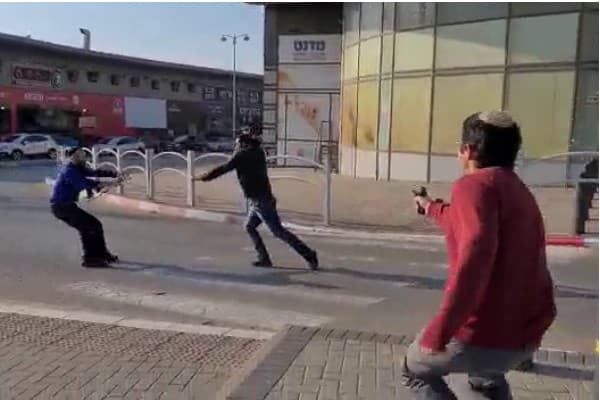
The Beersheva terrorist is cornered and shot dead by armed Israeli civilians

Some on the Right will call for even more aggressive collective punishment, as if the Palestinians who are citizens of Israel have no human or civil rights.  Many will collectively blame all Palestinians and demand that their leaders in and outside of Israel condemn the murders.

Within Israel, Palestinians will fearfully avoid going to Jewish towns. In the territories, I fear that violent settlers will rampage through Arab villages.

The politicians, especially the extremists from parties like Otzma Yehudit (Jewish Power), will use the deaths as a political opportunity, arriving at the scene to incite and foment more violence and shore up their constituencies.  Their partners in hate in the occupied West Bank will hand out candies.

It's already happening. 

And we will all be flattened down into "us" and "them". All the “we's” will blame all the “thems” for hurting all of us. That is how the Intifada pushed Israeli society to the right, making us suspicious and fearful, willing to tolerate abuse of the other as long as we are safe.  But terror doesn't sort out us out into categories. In Bnei Brak, the terrorist murdered an Arab policeman who was killed in the line of duty, protecting innocent civilians.

The politicians, especially the extremists, will use the deaths as a political opportunity. Their partners in hate in the occupied West Bank will hand out candies.

In those years of the Intifada, I felt that that my very being had been flattened down.  Once, I had thought of myself as a multi-layered person - a partner, a mother, friend, an activist, a professional. But terror and dread reduced me to a thin layer of fear for the lives of my children and my loved ones. 

Defence Minister Benny Gantz said on Wednesday that Israel will “break the wave of terror”. I don't know if the events of this past month will turn into a wave.  But I do know that security has to mean more than the absence of violence. Otherwise, the dread will overwhelm and flatten us all. 

This is an awful moment, and the near future may be dreadful. But this is also an opportunity. This government is led by a right-wing religious prime minister and a Palestinian who heads the Islamic Movement. Together, they could make a historic choice to create a more cohesive society committed to equality and social justice.

To really withstand and overcome the trauma, we need to feel safe not only as individuals. We need to feel fulfilled in our shared spaces and in our separate collective and national identities.

Only hope drives away dread.

READ MORE
Israel preparing for a months-long escalation after fatal terror attacks
(Haaretz)
Terror attacks in Israel turn settlers against Bennett
(Al-Monitor)

Photo: Israeli police officers and medics are seen at the scene of a terrorist shooting attack in Bnei Brak, on March 29 (Avshalom Sassoni/Flash90)

You might also like
  • Terror plot to kill hundreds of Arab Israelis thwarted
    Ben Lynfield
  • British Greens equate Zionism with racism
    Ruth Eglash
  • Diaspora Jews can’t vote, but Israel’s election result will affect them
    Vanina Vaisman-Levy
logomark.67a07ee3
We believe in the free flow of information

Republish our articles for free, online or in print, by using our Creative Commons licence

You might also like

    Israel Hamas WarFeature

    Inside Hamas’s sophisticated spider web of tunnels

    TJI Wrap
    Copy of Politica Podcast Social Tiles (600 x 400 px)
    Israel Iran WarPodcastIsrael

    Politica – Israeli Politics Explained

    The Jewish Independent 1
    Feature

    While still holding off the ground invasion, Israel praises Qatar over hostage talks

    TJI Wrap

About the author

Eetta Prince-Gibson

Eetta Prince-Gibson, who lives in Jerusalem, was previously Editor-in-Chief of The Jerusalem Report, is the Israel Editor for Moment Magazine and a regular contributor to Haaretz, The Forward, PRI, and other Israeli and international publications.

More from the author

AnalysisIsrael

Segalovitz decision to join Arab party is a paradigm change for Israel

AnalysisIsrael

Netanyahu pre-election juggling act

AnalysisIsrael

Women disadvantaged by new powers for Israel’s religious courts

AnalysisArts & Culture

The Sea: deserving award-winning film or one-sided disgrace?