Aa
  • Read, Watch, Listen
  • TJI Series
  • Community Action
  • Events
  • Zedi
Follow us and continue the conversation
  • LinkedIn
  • Instagram
  • FaceBook
  • X
  • YouTube
Test yourself with the TJI Quiz!

Adjust size of text

Aa

Follow us and continue the conversation

  • LinkedIn
  • Instagram
  • FaceBook
  • X
  • YouTube

Your saved articles

You haven't saved any articles

What are you looking for?

Original reporting, insightful analysis and diverse views, delivered straight to your inbox

  • LinkedIn
  • Instagram
  • FaceBook
  • X
  • YouTube
Your support fuels our mission to inform, entertain and inspire.

The Jewish Independent is bound by the Standards of Practice of the Australian Press Council. If you believe the Standards may have been breached, you may approach The Jewish Independent or make a complaint to the Australian Press Council in writing at www.presscouncil.org.au. The Council may also be contacted on 1800 025 712.

  • Our Story
  • Contact us
  • Our Team
  • Support us
  • Guidelines
  • Pitch your idea
  • Republishing us
  • Community Action
  • Our Awards
  • LinkedIn
  • Instagram
  • FaceBook
  • X
  • YouTube
Aboriginal FlagTorres Strait Islanders Flag

The Jewish Independent acknowledges Aboriginal and Torres Strait Islander peoples as the Traditional Owners and Custodians of Country throughout Australia. We pay our respects to Elders past and present, and strive to honour their rich history of storytelling in our work and mission.

© The Jewish Independent 2026All Rights Reserved
Website design and development by Your Creative, MelbourneTerms & ConditionsPrivacy Policy
HomeRead, Watch, ListenIsrael
Israel Hamas WarExplainerIsrael

Everything you need to know about Trump’s Gaza plan

Hope for an end to the war is tempered by doubts over whether Hamas will agree and whether the plan is feasible even if they do.
Shahar Burla
Print this
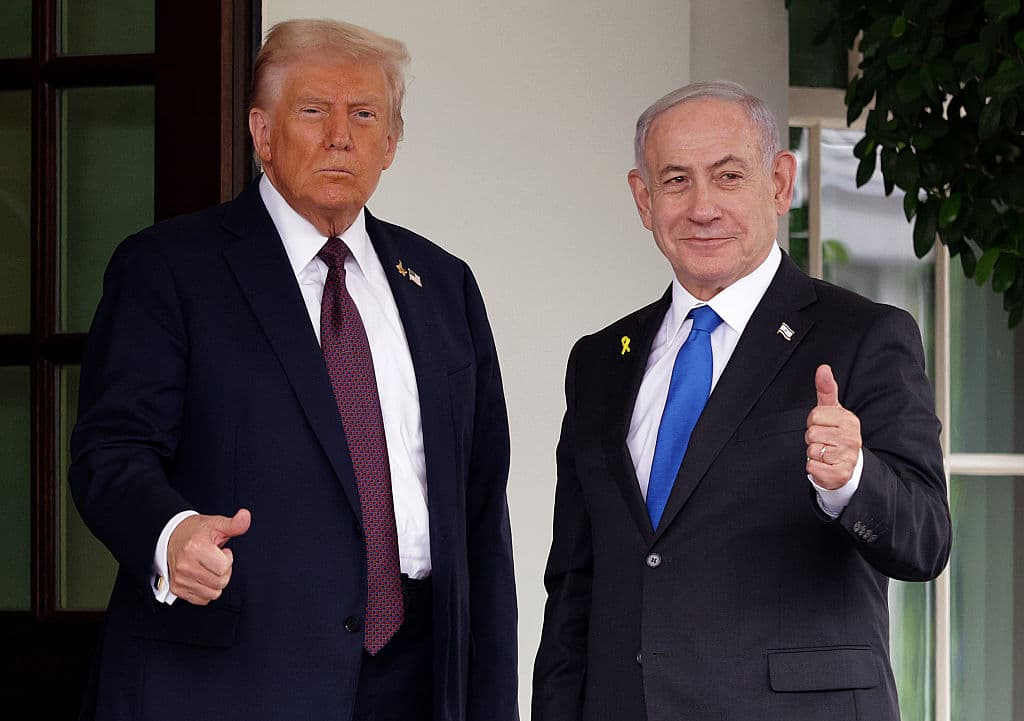
President Donald Trump (L) and Israeli Prime Minister Benjamin Netanyahu as he arrives at the White House on September 29, 2025 in Washington, DC ahead of announcing their ceasefire plan for Gaza

President Donald Trump (L) and Israeli Prime Minister Benjamin Netanyahu as he arrives at the White House on September 29, 2025 in Washington, DC ahead of announcing their ceasefire plan for Gaza (Alex Wong/Getty Images)

Published: 30 September 2025

Last updated: 30 September 2025

US President Donald Trump and Prime Minister Benjamin Netanyahu stood side by side at the White House on Monday to announce Israel’s agreement to an American peace plan aimed at ending the two-year war in Gaza.

Trump laid out a 20-point proposal that he described as a “historic day for peace,” promising an immediate ceasefire and the release of all remaining hostages within 72 hours of Israel’s formal approval.

The plan calls for a phased Israeli withdrawal, Hamas’ disarmament, the release of hundreds of Palestinian prisoners, and the establishment of a temporary international governing body for Gaza headed by Trump and including former British Prime Minister Tony Blair.

Netanyahu posted a video on social media early Tuesday in which he summed up his trip to the United States as an “excellent” success. He claimed Israel had “flipped the script” by isolating Hamas, stating that global pressure, including from Arab and Muslim nations, was now focused on the group to accept a deal.

Netanyahu said Trump vowed to give Israel his “full backing to complete the military operation for its elimination” if Hamas refused the terms. He also stressed that the proposed deal would allow the IDF to remain in most of Gaza.

Hamas still needs to be brought onboard

It remains uncertain whether Hamas will accept the terms.

A significant incentive is Israel’s agreement to release of 250 Palestinians serving life sentences for terrorism along with 1,700 other prisoners and detainees.

Trump and Netanyahu made clear that a refusal would mean increased Israeli attacks on Gaza.
“Israel would have my full backing to finish the job of destroying the threat of Hamas. But I hope that we’re going to have a deal for peace, and if Hamas rejects the deal … Bibi, you’d have our full backing to do what you would have to do,” Trump said.

The Israeli prime minister added ominously: “If Hamas rejects your plan, Mr President, or if they supposedly accept it and then do everything to counter it, then Israel will finish the job by itself. This can be done the easy way or it can be done the hard way, but it will be done. We’d prefer the easy way, but it has to be done. All these goals must be achieved because we didn’t fight this horrible fight, sacrifice the finest of our young men, to have Hamas stay in Gaza and threaten us again and again with these horrific massacres.”

Mahmoud Mardawi, a Hamas official, told Reuters that Hamas had not even received the plan. It was later briefed that Qatari and Egyptian mediators met with Hamas on Monday evening to provide details of the proposal.

Main points of the Trump plan

1. End of war & hostages

  • War ends immediately if Israel and Hamas accept the deal; IDF withdraws gradually.
  • All hostages (alive and deceased) returned within 48 hours.
  • Israel frees 250 long-term Palestinian prisoners and over 1,700 detainees arrested since October 7.

2. Hamas & security

  • Hamas removed from power and stripped of military capabilities.
  • Rebuilding of Gaza’s essential infrastructure begins once the ceasefire is in effect.
  • Members pledging peaceful coexistence gain amnesty or safe passage abroad.
  • International force (with Arab partners) deploys to oversee security, train a Palestinian police force, and guarantee compliance.
  • Israel commits not to occupy or annex Gaza.
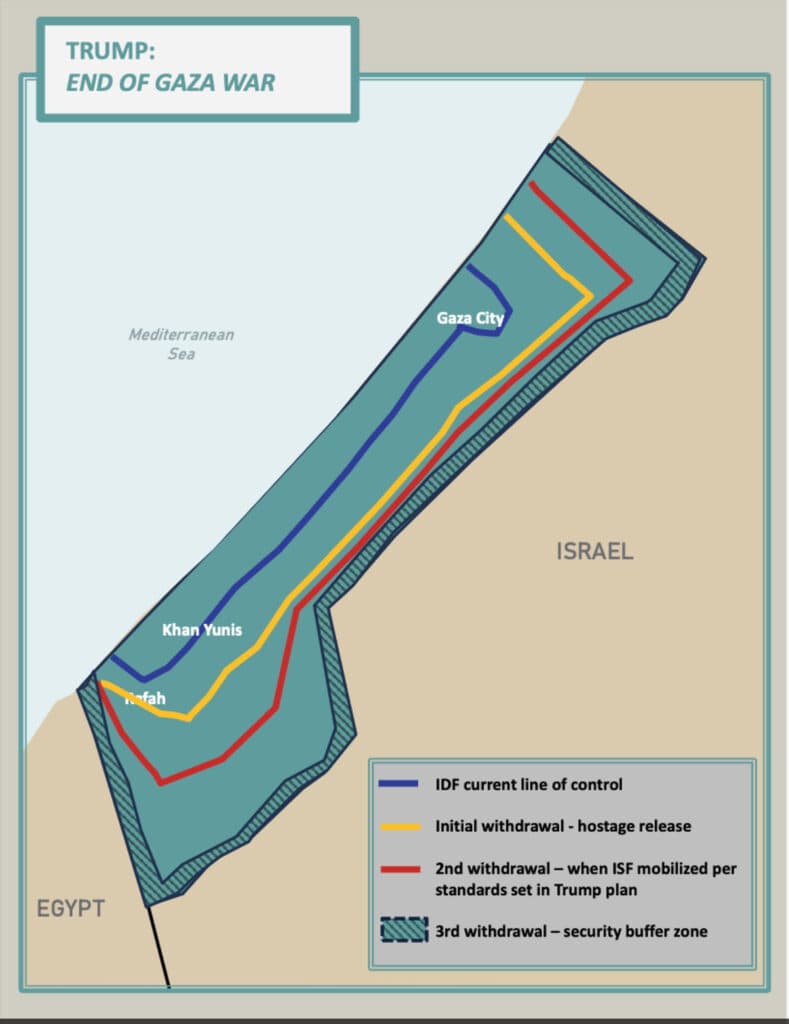
  • IDF will progressively withdraw to a security perimeter along Israel’s border, maintaining forces in a buffer zone until Gaza is deemed secure from renewed threats.

3. Governance & reconstruction

  • Interim administration of Palestinian technocrats supervised by a US-led international body.
  • No mass displacement; Gazans encouraged to remain.
  • UN, Red Crescent and others distribute aid without interference, at least 600 trucks per day.
  • Major investment program to rebuild infrastructure, create jobs, and establish an economic zone.

4. Palestinian Authority

  • PA must reform institutions, ensure transparency, and pursue de-radicalisation before assuming control of Gaza.
  • Transitional governance continues until reforms are complete.

5. Regional & international role

  • Regional security partners back the deal; Israel agrees not to strike Qatar.
  • Interfaith dialogue and de-radicalisation programs to shift narratives.
  • Pathway to Palestinian statehood tied to Gaza’s redevelopment and PA reform.
  • US to oversee implementation and initiate dialogue on a long-term political horizon.
The stages of Israeli military withdrawal, as outlined in Trump's plan to end the Gaza war, released on Monday.&nbsp;Credit: <em>White House</em>.
The stages of Israeli military withdrawal, as outlined in Trump's plan to end the Gaza war, released on Monday. Credit: White House.

The challenges

Despite the upbeat presentation, serious obstacles remain.

  • Hamas has not accepted the terms, and it is unlikely to embrace a plan that demands it surrender its weapons and allow a technocratic “Council of Peace,” led by Trump, to govern Gaza.
  • The proposal is vague on critical details, especially the boundaries of Israel’s security perimeter and the timeline for troop withdrawals. The White House map offers little clarity.
  • Netanyahu continues to reject any role for the Palestinian Authority (PA). While the US plan envisions an interim board managing Gaza’s redevelopment until the PA completes reforms and is ready to assume control, Netanyahu has dismissed this as unrealistic. He argues that meaningful change in the PA would be “miraculous,” declaring that Gaza’s future administration must be run “neither by Hamas nor by the Palestinian Authority.”
  • The issue of Palestinian statehood remains unresolved. The proposal makes an oblique reference to to "a credible pathway to Palestinian self-determination and statehood, which we recognise as the aspiration of the Palestinian people" after PA reform but when asked whether the two leaders had agreed to the establishment of a Palestinian state, Netanyahu responded “Absolutely not, that is not even written in the agreement.” He reiterated Israel’s strong opposition to a Palestinian state, a position he said Trump “understands.”

Reactions in Israel

Support for Trump’s Gaza peace plan outweighs opposition, even among government coalition voters, according to a Maariv poll published on Saturday. It found that 41% of coalition voters back the plan, compared with 33% who oppose it—the first time Netanyahu’s base has shown more support than resistance since the war began. Among opposition voters, 72% are in favour and only 4% against. Overall, 53% of the public supports the plan, 17% oppose it, and 30% remain undecided.

But public scepticism about a successful resolution is widespread. Support for a Palestinian state among Israelis is falling, and Palestinians doubt Trump can deliver a breakthrough. A Gallup poll released Monday found only 20% of both Israelis and Palestinians believe lasting peace is possible, while about two-thirds on each side say it will never happen.

Families of Israeli hostages welcomed Trump’s plan, emphasising the urgency of swift implementation: “Our hostages do not have time, our soldiers do not have time.”

Netanyahu faced backlash from the right. Former spokesman Omer Dostri called the plan “an absolute failure,” accusing the prime minister of raising a white flag. Smotrich warned that his Religious Zionism party would oppose any deal giving the Palestinian Authority or Qatar a role in postwar Gaza.

READ MORE

Trump’s plan for Gaza is ambitious but peace is far from guaranteed (Jason Burke, The Guardian)

The 'Magic Number' That Could Convince Hamas to Accept the Trump Plan (Amir Tibon, Haaretz)

‘The closest we’ve ever come’: Full text of Trump, Netanyahu statements on deal to end Gaza war (Times of Israel)

Trump Forced the Gaza Peace Plan on Netanyahu. But a Lot Could Still Go Wrong (Ben Samuels, Haaretz)

Analysis: Trump and Netanyahu close ranks. But is a Gaza ceasefire really in reach? (Jacob Kornbluh, The Forward)

You might also like
  • ‘Israel is systemically eliminating Palestinian collective life’:  B’Tselem
    Deborah Stone
  • Tame apologises – but with little grace
    Deborah Stone
  • Confronting Richard Flanagan and the myth of the Israel lobby
    Mary Garden
logomark.67a07ee3
We believe in the free flow of information

Republish our articles for free, online or in print, by using our Creative Commons licence

You might also like

    Woman with land and houses behind her
    NewsAustralia

    Australia to increase sanctions against West Bank settlements

    Deborah Stone 2
    Yoav Segalovitz Mansour Abbas
    Israel Votes 2026OpinionIsrael

    Because of my Zionist values, I’m joining an Arab party

    Yoav Segalovitz 1
    Netanyahu
    Israel Hamas WarFeatureIsrael

    New evidence Netanyahu was warned about October 7

    Shahar Burla 2

Comments1

  • Avatar of eric lundberg

    eric lundberg30 September at 07:31 am

    Seems to me that the plan is very similar to the Sunni State proposition put forward some time ago. That the Netanyahu government basically ignored, despite its major improvements on past positions, including disavowal of Hamas.

    This is an enormous opportunity if Hamas and Netanyahu (Smotrich and Ben Gvir) don’t find a way to destroy it. Yes it is vague. Hardly surprising. Its meant to break a deadlock. If it goes forward it will break this coalition. Thats a win. It will likely break Hamas. An even bigger win.

    Trump (and his son in law) no doubt see lots of ‘benefits’ coming their. So they have an incentive. It would not be the first time right wingers produced a peace dividend for Israel. It would certainly make a change from Netanyahu’s practice.

    Here’s hoping.

About the author

Shahar Burla

Shahar Burla

Dr Shahar Burla is a Sydney-based researcher, lecturer and Contributing Editor of TJI. Shahar holds a Master’s degree in political science from Hebrew University and a PhD in political science from Bar-Ilan University. He is the author of Political Imagination in the Diaspora: The Construction of a Pro-Israeli Narrative (2013) and co-editor of Australia and Israel: A Diasporic, Cultural and Political Relationship (2015).

More from the author

FeatureIsrael

New evidence Netanyahu was warned about October 7

OpinionIsrael

The Altalena should be a warning, not a political weapon

AnalysisIsrael

Who is Ofer Winter and could he upset Netanyahu’s election?

AnalysisIsrael

Bennett’s balancing act: can he win over the right without losing the centre?