Aa
  • Read, Watch, Listen
  • TJI Series
  • Community Action
  • Events
  • Zedi
Follow us and continue the conversation
  • LinkedIn
  • Instagram
  • FaceBook
  • X
  • YouTube
Test yourself with the TJI Quiz!

Adjust size of text

Aa

Follow us and continue the conversation

  • LinkedIn
  • Instagram
  • FaceBook
  • X
  • YouTube

Your saved articles

You haven't saved any articles

What are you looking for?

Original reporting, insightful analysis and diverse views, delivered straight to your inbox

  • LinkedIn
  • Instagram
  • FaceBook
  • X
  • YouTube
Your support fuels our mission to inform, entertain and inspire.

The Jewish Independent is bound by the Standards of Practice of the Australian Press Council. If you believe the Standards may have been breached, you may approach The Jewish Independent or make a complaint to the Australian Press Council in writing at www.presscouncil.org.au. The Council may also be contacted on 1800 025 712.

  • Our Story
  • Contact us
  • Our Team
  • Support us
  • Guidelines
  • Pitch your idea
  • Republishing us
  • Community Action
  • Our Awards
  • LinkedIn
  • Instagram
  • FaceBook
  • X
  • YouTube
Aboriginal FlagTorres Strait Islanders Flag

The Jewish Independent acknowledges Aboriginal and Torres Strait Islander peoples as the Traditional Owners and Custodians of Country throughout Australia. We pay our respects to Elders past and present, and strive to honour their rich history of storytelling in our work and mission.

© The Jewish Independent 2026All Rights Reserved
Website design and development by Your Creative, MelbourneTerms & ConditionsPrivacy Policy
HomeRead, Watch, ListenIsrael
Israel Hamas WarInterviewIsrael

Did Israel get what it wanted from attacking Iran?

Israel’s goal was protecting itself, not regime change, says the country’s UN international spokesperson.
Gideon Cohen
Print this
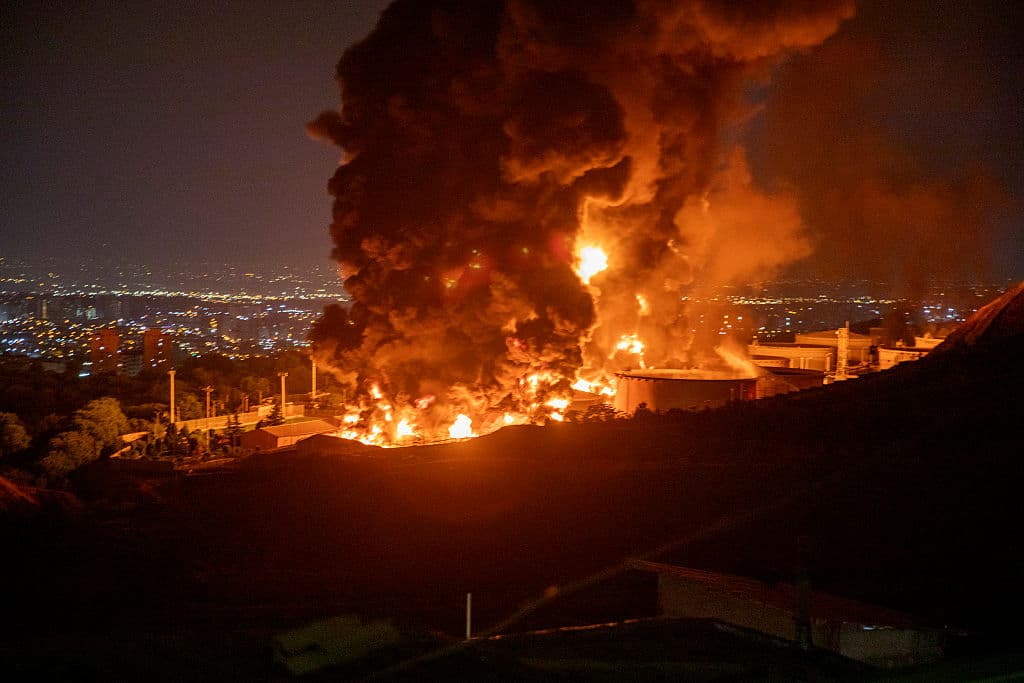
Fire and smoke rise into the sky after an Israeli attack on the Shahran oil depot

Fire and smoke rise into the sky after an Israeli attack on the Shahran oil depot on June 15 (Image: Stringer/Getty Images).

Published: 24 June 2025

Last updated: 24 June 2025

Israel and Iran have agreed to a ceasefire after 12 days of fighting, which began when Israel attacked Iranian military targets on June 13.

The war has met Israel's core goals, which were strictly security-based and not aimed at regime change, according to the country's UN International Spokesperson Jonathan Harounoff.

In an interview with The Jewish Independent, Harounoff said Israel's attack was a carefully planned operation with specific military objectives.

“The timing was not an impulsive decision, it was the culmination of years and years of intelligence gathering, pointing towards a very concrete, concerning plan to completely annihilate the state of Israel through multiple means,” Harounoff said.

The first, most existential threat to Israel was nuclear. Harounoff says Israeli intelligence showed that the Islamic Republic of Iran “was closer than ever to reaching the point of no return” in its nuclear capabilities.

The second, which Harounoff says is focused on much less in the media, was the Islamic Republic’s accumulation of a significant arsenal of ballistic missiles, drones, and other weaponry that could reach Israel and well beyond.

“And third, there was a whole army of senior officials and military political scientists, who were all working together to create a sort of October 7, 2.0,” he added. “That would have been much more destructive and would have involved many of the Islamic Republic’s proxies attacking Israel at the same time.”

Given these combined threats, Harounoff says Israel had to take action when it did. “Every kind of attack against the Islamic Republic, when it comes to its nuclear program, has to be pre-emptive. You can't wait until a mushroom cloud appears over Jerusalem or Tel Aviv until we strike, that would be too late.”

Jonathan Harounoff addresses the UN Security Council (Image: supplied).

Harounoff, a British born Jew of Persian descent who has served as Israel’s UN International Spokesperson since September 2024, has extensive knowledge about the conflict. His qualifications include a master’s degree in Arabic, Persian and Middle Eastern Studies from Cambridge, and a forthcoming book on the “Woman, Life, Freedom” protests.

The combination of the Israel Defense Forces (IDF) and Mossad’s coordinated attacks and the recent US attacks on several nuclear sites have dealt a massive blow to Iran’s military capacity.

US President Donald Trump claims Iran’s key nuclear enrichment facilities have been “completely and totally obliterated”.

Israeli attacks have also destroyed the last of the Islamic Republic’s air defence systems; taken out close to half of the regime’s missile launchers; and eliminated both senior IRGC military leaders and nuclear scientists and experts.

The cost for Israel in Iran's response was considerable, with at least 24 deaths, dozens of injuries, and massive mental health and economic costs for a population that has spent days regularly sheltering from missile attacks on civilian areas.

What about regime change?

Beyond military targets, Israel also attacked the Islamic Republic of Iran News Network (IRINN) and its television station, reportedly cheered on by Iranian citizens, who oppose the regime.

Israeli Prime Minister Benjamin Netanyahu directly addressed the "proud people of Iran", telling them that Israel was "clearing the path" for them to achieve freedom.

But Harounoff does not believe a ceasefire without regime change means Israel did not achieve its goals.

“Israel’s goal was not regime change. Israel’s goal is to eliminate the existential threat that it was facing, in the form of the nuclear uranium enrichment, the ballistic missile accumulation, and the senior officials working towards Israel's destruction.

“However, Israel does stand with the people of Iran and any regime change that does take place inside Iran will come from the people of Iran. It would be their decision to make, but we do stand with them.”

Iran’s opposition in exile is clearly hoping the war will set off regime change – and the danger of that may be one reason Iran agreed to a ceasefire.

"There have been many occasions when the UN could have done a lot more to condemn the actions of the Islamic Republic."

Exiled crown prince Reza Pahlavi released a video statement stating there are plans for a 100-day transition period if the Islamic Republic falls. “Iran will not descend into civil war or instability,” said Pahlavi. “We are prepared for the first 100 days of the transitional period after the fall, and for the establishment of a national and democratic government by the Iranian people and for the Iranian people.”

Pahlavi also directed part of his message to military, police, and state workers, many of whom he claims have contacted him, calling on them to stand with the people and not the regime.

Harounoff sees it as a hopeful sign: “It does suggest that the people of Iran want to have a separation of state and church, so to speak. They want to return to some kind of democratic future, but again, it would be up to the people, everyone, to decide.”

Prior to the outbreak of the war, Harounoff had been focused on the plight of Iranian citizens protesting against the oppressive Islamic Republic. His book, Unveiled: Inside Iran’s #WomanLifeFreedom Revolt, is out in September. The book draws on interviews with survivors of the 2022 Woman, Life, Freedom protests and key Iranian opposition leaders in the diaspora.

“In the Islamic Republic's 46-year history, since 1979, the Iranian people have shown how they feel with their feet by protesting, taking [to] the streets on many occasions,” Harounoff said. Those protests include the 2009 Green Revolution, following the contested re-election of Iranian president Mahmoud Ahmadinejad; economic protests in 2017 and 2018; and the Woman, Life, Freedom protests in 2022.

Those women-led protests, which Harounoff’s book calls the most existential threat to the regime to date – prior to the war with Israel – broke out after 22-year-old Kurdish-Iranian woman Mahsa Jina Amini was killed by the moral­i­ty police for alleged­ly wear­ing her hijab too loose­ly.

The Islamic Republic’s response to the protests were horrifically brutal, from killing at least 551 protestors, to shooting protestors’ eyes out, and using rape, torture, arrests and executions to suppress further demonstrations.

“If you view the goals of the Woman, Life, Freedom revolt as trying [to] overthrow the regime, while it came extremely close to doing that, it ultimately didn't succeed, because the Islamic Republic still exists today,” says Harounoff. “So, the book also looks at some of the reasons why the movement fell short in its ultimate goals as well.”

International failure

As a spokesperson to the UN, Harounoff says criticism must also be levelled at the organisation for its legitimisation of the regime.

“There have been many occasions when the UN could have done a lot more to condemn the actions of the Islamic Republic, not least during the Woman, Life, Freedom protests.

“Even in recent years, giving them a platform, allowing them to chair the Human Rights Council, while they were carrying out gross human rights violations in their own country, is just inconceivable, unthinkable, and inexplicable.”

Ultimately, should the regime fall, Harounoff hopes it will lead to a reunion between two nations. In an opinion piece published by Newsweek on Friday, he wrote: “As a British Jew of Persian descent living in New York, I yearn for the day when the people of Israel and Iran can rekindle the friendship they once had.”

You might also like
  • ‘Israel is systemically eliminating Palestinian collective life’:  B’Tselem
    Deborah Stone
  • Tame apologises – but with little grace
    Deborah Stone
  • Confronting Richard Flanagan and the myth of the Israel lobby
    Mary Garden
logomark.67a07ee3
We believe in the free flow of information

Republish our articles for free, online or in print, by using our Creative Commons licence

You might also like

    Woman with land and houses behind her
    NewsAustralia

    Australia to increase sanctions against West Bank settlements

    Deborah Stone 2
    Netanyahu
    Israel Hamas WarFeatureIsrael

    New evidence Netanyahu was warned about October 7

    Shahar Burla 2
    haredi street guitar
    Photo EssayArts & Culture

    Jerusalemites through the lens

    Sharon Gabay

About the author

Gideon Cohen

Gideon Cohen

Gideon Cohen is a Melbourne-based journalist and a content creator and editorial assistant at TJI. He holds a master's degree in journalism from the University of Melbourne and his work has appeared in various publications including Broadsheet and The Jewish Chronicle.

More from the author

InterviewArts & Culture

‘L’chaim for the next 1,500’: Israeli drummer celebrates Cirque Du Soleil milestone

InterviewArts & Culture

Rachel Moshel: Creating a space for Jewish art and joy

NewsAustralia

Who will get the money from the Cranbourne windfall?

FeatureArts & Culture

Israeli ingredients a recipe for ‘Pearly Spurtle’

Comments

No comments on this article yet. Be the first to add your thoughts.