Aa
  • Read, Watch, Listen
  • TJI Series
  • Community Action
  • Events
  • Zedi
Follow us and continue the conversation
  • LinkedIn
  • Instagram
  • FaceBook
  • X
  • YouTube
Test yourself with the TJI Quiz!

Adjust size of text

Aa

Follow us and continue the conversation

  • LinkedIn
  • Instagram
  • FaceBook
  • X
  • YouTube

Your saved articles

You haven't saved any articles

What are you looking for?

Original reporting, insightful analysis and diverse views, delivered straight to your inbox

  • LinkedIn
  • Instagram
  • FaceBook
  • X
  • YouTube
Your support fuels our mission to inform, entertain and inspire.

The Jewish Independent is bound by the Standards of Practice of the Australian Press Council. If you believe the Standards may have been breached, you may approach The Jewish Independent or make a complaint to the Australian Press Council in writing at www.presscouncil.org.au. The Council may also be contacted on 1800 025 712.

  • Our Story
  • Contact us
  • Our Team
  • Support us
  • Guidelines
  • Pitch your idea
  • Republishing us
  • Community Action
  • Our Awards
  • LinkedIn
  • Instagram
  • FaceBook
  • X
  • YouTube
Aboriginal FlagTorres Strait Islanders Flag

The Jewish Independent acknowledges Aboriginal and Torres Strait Islander peoples as the Traditional Owners and Custodians of Country throughout Australia. We pay our respects to Elders past and present, and strive to honour their rich history of storytelling in our work and mission.

© The Jewish Independent 2026All Rights Reserved
Website design and development by Your Creative, MelbourneTerms & ConditionsPrivacy Policy
HomeRead, Watch, ListenIsrael
Israel Hamas WarAnalysisIsrael

Hamas reasserts control with widespread executions 

The longer it takes the international community to step in, the greater the chance for Hamas to destroy any alternative. 
Dror Doron
Print this
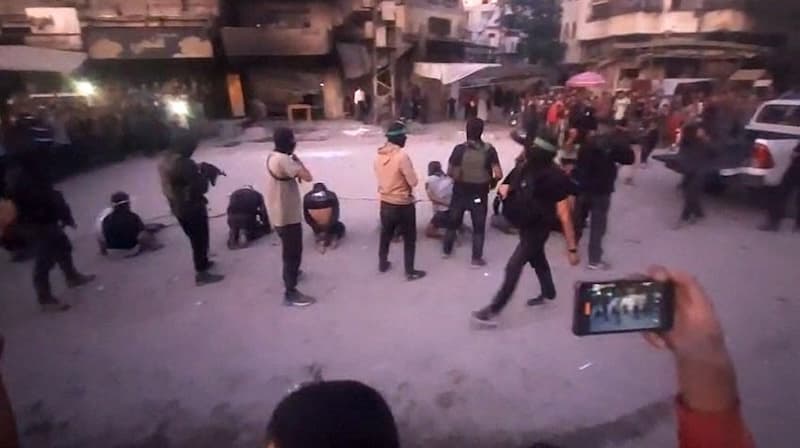
armed Hamas fighters standing behind blindfolded, bound and kneeling men as a crowd surrounds them in a street in Gaza City

Image grab from a handout video released by the Hamas-run al-Aqsa TV’s Telegram channel on October 13, 2025, shows armed Hamas fighters standing behind blindfolded, bound and kneeling men as a crowd surrounds them in a street in Gaza City (Photo by Al-Aqsa TV/AFP).

Published: 23 October 2025

Last updated: 23 October 2025

The shocking pictures coming out of Gaza showing Hamas security forces carrying out public executions of political opponents accused of collaborating with Israel should come as no surprise. 

The same practices were used by Hamas after previous military confrontations with Israel. After the 2009 “Cast Lead” operation, Human Rights Watch reported that Hamas executed more than 30 of its opponents. Following the 2012 week-long fighting, titled “Pillar of Defense” by Israel, the organisation documented seven extrajudicial executions. Similarly, after the 2014 “Protective Edge” operation, Amnesty International reported the extrajudicial execution of at least 23 Gazans by Hamas. 

Clan power 

The targets of Hamas’ current cleansing campaign are local clans and warlords, as well as traditional opposition factions.  

Hamas has prevented any formal political activity in Gaza for years, but opposition to its rule has developed based on localised family-based armed groups, each promoting the interests of its own family members. The decentralised and disorganised nature of those groups makes them vulnerable. 

‘Collaboration’ with Israel 

Hamas’ targets are clans it accuses of collaborating with Israel.  

Over the past months, Israel reportedly encouraged some local clans to operate as tactical security forces and administrators in the areas that were under IDF control. Now, following Israel’s withdrawal as part of the ceasefire agreement, those groups have found themselves in direct confrontation with Hamas forces. 
Among those groups are the popular forces operating in the southern town of Khan Yunis and headed by local warlord Yasser Abu Shabab, who admits his co-operation with Israel; an armed group identified with the rival Fatah movement headed by Rami Hellis in the city of Gaza; and a group headed by Hussam al-Astal, a former officer in the Palestinian Authority’s security forces operating in Southern Gaza. 

Radical opposition 

Hamas is also using the opportunity to target clans that have no connection to Israel, sending a deterring message to the population. 

These include the Doghmush clan, located in Gaza city, which embraces a radical Jihadist ideology and rejects Hamas' acceptance of a “western” political structure. The Doghmush family denies collaboration, but 33 of its members have been killed in the current violence, including eight men who were executed after surrendering to Hamas. 

Similarly, the al-Majida clan from the southern town of Khan-Yunis also denies any contacts with Israel but has been the target of Hamas' security forces attacks. 

Reasserting control 

These repeated executions and use of violence by Hamas underscore a consistent strategy: leveraging political intimidation and brutality to entrench its rule and eliminate challenges. Hamas rose to power in 2007 by carrying out a military coup against the Palestinian Authority, controlled by its rival Fatah. Targeted assassinations and public displays of violence have always been  a main tool in the movement’s efforts to stay in power. 

Despite the devastation of the war, October 7 and the ensuing war have not greatly affected support for Hamas. The most recent poll, conducted in May 2025, shows 37% of Gazans support Hamas (38% in September 2023). While this is well below majority support, it is greater than the support for Fatah at 25% or third parties at 23%, with don't knows or undecided at 15%.

But structurally, Hamas is currently at its weakest point in years. The decapitation of its leadership and the massive damage to its military and governmental capabilities require it to quickly assert control and crush any attempt of local opposition to challenge its rule.  

Given Hamas’ deeply entrenched regime and tendency to violently suppress any dissent, the international community faces a clear need to swiftly create alternative security and governance structures in Gaza. The longer it takes to implement alternative governance, the further Hamas is able to reassert its control. 

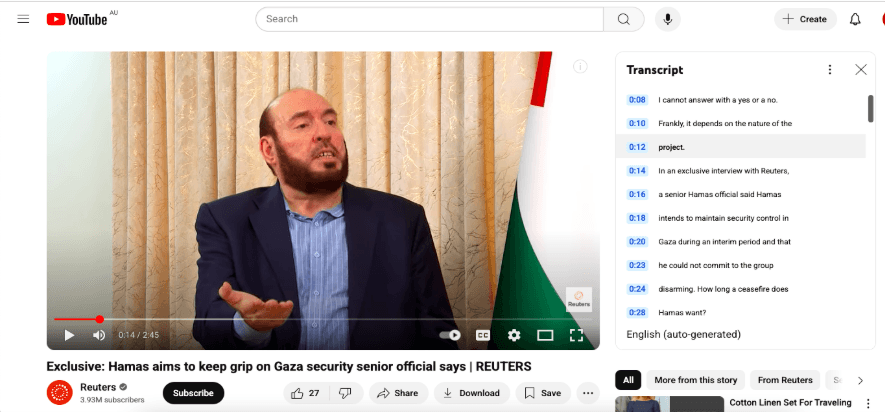
Hamas, of course, rejects any involvement of foreign forces in governing Gaza and refuses to negotiate the disarmament of its military wing, claiming that the issue of its arms should only be addressed within the framework of establishing a Palestinian state, in which it aspires to play a significant role in.  

Mohammed Nazzal, Hamas politburo member, rejected the idea of disarmament during an interview with Reuters (Image: Screenshot/YouTube).

While these positions directly contradict Trump’s plan, they reflect the true nature of Hamas as a fundamentalist Islamist terrorist organisation. Over the 18 years since Hamas’ brutal takeover of Gaza, the movement has established a ruthless religious regime implementing the Muslim Brotherhood’s vision of political Islam.  

Hamas has limited political liberties and uses political violence to crash potential opposition. It has also imposed restrictions on religious practices which are responsible for a 60% decline in the Christian population since 2007, outlawed same-sex relationships, and persecuted the gay community. The recent war, and the massive destruction it caused, highlighted Hamas’ disregard for civilian casualties, which movement leaders referred to as “martyrs” who die “for” the cause in what they call “Jihad” against Israel. 

Image taken from Hamas recordings of interrogations of political rivals caught by the IDF in Gaza (Image: public domain). 

Voices of disillusionment with Hamas’ disastrous political vision and calls for accountability from its leaders responsible for Gaza’s current catastrophe were heard but quickly silenced by Hamas’ security forces during the war.

It is highly unlikely that, after surviving Israel’s military wrath, Hamas will be willing to allow any challenge to its hold over Gaza or agree to a government that could weaken it further. After all, Hamas is a revolutionary movement, and from its radical perspective, survival itself is victory. Now is the time for rearming, rebuilding capabilities, and preparing itself for the next armed conflict against Israel. 

It is a major challenge for the international community, led by the Trump administration, to ensure the implementation of the ambitious “20-point plan”. The active involvement of Qatar and Turkey, both Muslim Brotherhood-affiliated countries and two of Hamas’ main supporters, and given the complex regional dynamics, we should not expect the establishment of a peaceful, moderate authority in the foreseeable future.  

RELATED STORIES

Hamas turns to executions as it tries to establish a monopoly on force in Gaza (The Conversation)
An uneasy ceasefire is still in place in Gaza despite Israeli strikes on what it called “Hamas terror targets” in response to what the Israel Defense Forces said were rocket attacks on its positions.

IDF Sees Hamas Restoring Control Over Gaza With No Opposition From Local Gangs (Haaretz)

According to Israel military sources, Hamas has staffed senior government positions and its police forces are operating on the ground. At the same time, fear is growing of clashes between soldiers and residents who will move toward the Yellow Line - the IDF withdrawal line - due to the insurmountable congestion

Trump says ‘rebels’ staged deadly attack on IDF troops in Gaza, echoing Hamas claim (Times of Israel)
US president claims terror group’s leadership may not be involved in ‘rambunctious’ shooting; doesn’t know if Israeli response strikes were justified, but truce still in effect

You might also like
  • Peacebuilding through the eyes of a sceptic
    Ron Finkel
  • The Altalena should be a warning, not a political weapon
    Shahar Burla
  • Turkey emerges as military threat to Israel
    Dror Doron
logomark.67a07ee3
We believe in the free flow of information

Republish our articles for free, online or in print, by using our Creative Commons licence

You might also like

    Activists attempt to deliver supplies to Palestinian families near Nablus
    OpinionIsrael

    Qusra siege exposes shared agenda of IDF and settler extremists

    Ben Lynfield
    settler outpost west bank
    NewsIsrael

    Israel is cementing its control over the West Bank and East Jerusalem while the world is distracted

    Martin Kear
    Yoav Segalovitz Mansour Abbas
    Israel Votes 2026OpinionIsrael

    Because of my Zionist values, I’m joining an Arab party

    Yoav Segalovitz 1

About the author

Dror Doron

Dror Doron

Dror Doron is a senior political analyst specialising in the Middle East, and is a senior adviser at United Against Nuclear Iran (UANI) focusing on Hezbollah and Lebanon.

More from the author

AnalysisIsrael

Turkey emerges as military threat to Israel

AnalysisWorld

New Saudi-Pakistan-Turkey alliance driven by failure of US to subdue Iran

AnalysisIsrael

Trump’s Hamas disarmament deal a mirage that’s quickly faded

AnalysisIsrael

Syria reimagined: From military threat to geostrategic competitor

Comments

No comments on this article yet. Be the first to add your thoughts.