Aa
  • Read, Watch, Listen
  • TJI Series
  • Community Action
  • Events
  • Zedi
Follow us and continue the conversation
  • LinkedIn
  • Instagram
  • FaceBook
  • X
  • YouTube
Test yourself with the TJI Quiz!

Adjust size of text

Aa

Follow us and continue the conversation

  • LinkedIn
  • Instagram
  • FaceBook
  • X
  • YouTube

Your saved articles

You haven't saved any articles

What are you looking for?

Original reporting, insightful analysis and diverse views, delivered straight to your inbox

  • LinkedIn
  • Instagram
  • FaceBook
  • X
  • YouTube
Your support fuels our mission to inform, entertain and inspire.

The Jewish Independent is bound by the Standards of Practice of the Australian Press Council. If you believe the Standards may have been breached, you may approach The Jewish Independent or make a complaint to the Australian Press Council in writing at www.presscouncil.org.au. The Council may also be contacted on 1800 025 712.

  • Our Story
  • Contact us
  • Our Team
  • Support us
  • Guidelines
  • Pitch your idea
  • Republishing us
  • Community Action
  • Our Awards
  • LinkedIn
  • Instagram
  • FaceBook
  • X
  • YouTube
Aboriginal FlagTorres Strait Islanders Flag

The Jewish Independent acknowledges Aboriginal and Torres Strait Islander peoples as the Traditional Owners and Custodians of Country throughout Australia. We pay our respects to Elders past and present, and strive to honour their rich history of storytelling in our work and mission.

© The Jewish Independent 2026All Rights Reserved
Website design and development by Your Creative, MelbourneTerms & ConditionsPrivacy Policy
HomeRead, Watch, ListenIsrael
Israel

How the Lebanon War changed Israel forever

Ben Lynfield
Print this

Published: 10 June 2022

Last updated: 5 March 2024

BEN LYNFIELD: 40 years on, Former Peace Now leader GALIA GOLAN and historian GERSHOM GORENBERG explain why the Lebanon War destroyed Israel’s innocence and gave the Left influence it has never regained

In the early part of Israel's disastrous 1982 invasion of Lebanon, Hebrew University graduate student Gershom Gorenberg's alarm clock sounded and by habit he immediately switched on the radio news.

The announcer was listing the most recent soldiers' deaths in the war that started forty years ago this week as Operation Peace for Galilee, ostensibly a limited 40 kilometer push into southern Lebanon to take northern Israeli towns outside the range of PLO Katyusha rockets.

But Gorenberg, who was then 26 and is now an eminent historian whose works include a landmark study of the origins of Israeli settlements, was jolted by the radio broadcast because of one of the names. "It was my friend's brother, whom I had put up in my apartment for Shabbat a couple of weeks before," he recalled during an interview with The Jewish Independent.

"Any time I hear anyone say Israel is more divided today than ever I laugh. It's nothing compared to the internal divisions at that time."

Gershom Gorenberg

"I realised my friend's brother had been killed and the list of names became very real and that something was happening over and over again to people all over the country. Obviously immediate families were being shattered. But there was a larger ring of casualties. People were asking why this was happening or others were trying to justify it."

As the death toll mounted and fighting continued way beyond the government's initially stated aims, something unprecedented was afoot in Israel:  people increasingly protested against a war while it was being waged.

Indeed the war, and its horrific climax with the massacre by Israeli-backed Lebanese Christian militiamen at Beirut's Sabra and Shatila refugee camps would become the most controversial conflict in Israeli history.
The Peace Now movement and the Left demonstrated a power and popularity to muster pressure on a right-wing government that would be inconceivable today.

Prominent among those protesting were reservists coming home on leave questioning why they were fighting a war that, for them, was not being waged in self defence.

Galia Golan, a political scientist and leader of Peace Now at the time, who is now 84, put it this way in an interview with The Jewish Independent:" Many of our people were called up as reservists. We had a dilemma. We were very puzzled. We had never demonstrated in time of war. But it became clear the goal wasn't [PLO] artillery range. As the summer went on it became clear this was a war of choice and we used that as our slogan."

To impress upon the public, and prime minister Menachem Begin the cost of the war, Peace Now set up a protest sign opposite the premier's residence that kept a running tally of the Israeli fatalities who were, in its view, dying for no good reason.

But the protests drew fury from people who identified with Begin and defence minister Ariel Sharon and viewed the fighting as a necessary war against a terrorist enemy, Gorenberg recalled "There was immense anger on the right at protests while the war was going on. Begin and Sharon were deeply admired, even worshipped by a lot of the population."

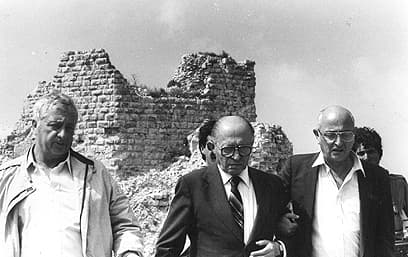
Begin and Sharon in Beaufort during the Lebanon War (IDF)

He added:”Any time I hear anyone say Israel is more divided today than ever I laugh. It's nothing compared to the internal divisions at that time."

Many of those angry over the protests saw them as an effort to return the Labor party and Left whom they despised as elitist to power after Begin had finally ousted them in 1977 elections. He won another victory over Labor in 1981.

After two months of simmering acrimony in Israel, events in Lebanon reached dimensions that shocked the public, including individuals not necessarily identified with the Left, who had not protested before. On Rosh Hashana the news broke that Israel's allies the Lebanese Christian militiamen had massacred a large number of Palestinian men, women and children in Sabra and Shatila.

"The protests began immediately," Gorenberg recalled. "The news came out on Rosh Hashana. As someone observant, I wasn't listening to the news. I was sitting at a meal with guests and we heard shouting. We didn't know what was going on. After the holiday, when we heard the news, we realised the shouting was a spontaneous demonstration at the prime minister's house. People were horrified."

"This war that started according to what we were told was defence ended up with this huge senseless massacre in which Israel was somehow implicated or connected. It was a huge shock and it crystalized every bit of anger that had been there before. The worst thoughts you could have about the war were exceeded by the massacre."

Golan and other Peace Now leaders sprang into action, meeting with Labor party leaders and helping to organize what would become the largest demonstration in Israeli history in Tel Aviv. Its precise numbers were likely less than the 400,000 the police estimated at the time but it spilled out from Kings of Israel square into nearby streets. The goal was to force the government to form a commission of inquiry to investigate Israel's role in the massacre.

The high turnout was because of a "cumulative effect", Golan said. "In the course of the summer it became clearer we didn't have to be in this war or to be up there. But it was also really shocking. It was a massacre of innocent people and not in a battle. It was going into the refugee camps. I think that's why people came out. It was a guilty conscience."

The demonstration was successful, a high point for Peace Now and the Left as an opposition force. Never again would the Left in opposition exert such influence. It forced an inquiry commission, which ousted Sharon from the defence ministry. But he remained in the cabinet as minister without portfolio and became rehabilitated over the years, being elected as premier in 2001

"Remembering back to that massive demonstration, we could never get that today. Today we couldn't fill the square."

Galia Golan

Looking back, the war was "an end of innocence for Israel," Golan said. "Until that time, the public thought every war we fought and every battle was forced on us, that poor little Israel is always under attack, which wasn't true but we didn't know it wasn't true. All of a sudden the army is attacking when it didn't have to. The moment we went beyond the forty kilometers it was clear it was nonsense."

But given that realisation, how did Israel move from mass protest at misuse of the military in 1982 to a situation today where the country has gone so far right that few raise their voices against the occupation or raise tough questions about the government and army's de facto annexation of the occupied West Bank?

Gorenberg cites the breakdown of the Oslo peace process and the Palestinian suicide bombings after the outbreak of the second intifada as among the keys to answering that question.

"People who were 6 to 15 during the Second Intifada and whose childhood was marked by bombs going off were less inclined to support a peace orientation because the sense was 'these people want to kill us'. Restoring trust is much harder than building it in the first place."

Gorenberg also believes that reduction of reserve duty is having an impact. After the 1973 war, during the Lebanon war and also during the first intifada which broke out in 1987, it was reservists who asked many of the tough questions about Israeli policy, he noted. "If we talk about men ages 21 to 50 with friends and family, far fewer people now have direct experience of what maintaining the occupation means.

Golan is not optimistic the Left will recover. "Remembering back to that massive demonstration, we could never get that today. Today we couldn't fill the square."

Dissatisfied that Peace Now was, in her view, moving too close to the center, Golan began to disengage from it about eight years ago and became active in the left-wing anti-occupation group Combatants for Peace. "I remain as active as I can be at my age. I can't run away from settlers and tear gas so there are a lot of things I don't go to.

"But I'm also very discouraged. We have to have a public that will elect a government that will make peace. I don't see that happening," she said.

RELATED STORIES

Lebanon War, 40 Years On: The Conflict That Changed Israel (Haaretz)

Colin Shindler: A watershed moment in how British Jews came to view Israel (Jewish Chronicle)

Photo: Peace Now demonstrations against the Lebanon War (Reddit)

You might also like
  • Israel election explainer: the main parties
    Shahar Burla
  • Sanctioning settlements is a defence of Israel, not an attack
    Elisheva Madar
  • Sanctions must influence, not just perform disapproval
    Adam Slonim
logomark.67a07ee3
We believe in the free flow of information

Republish our articles for free, online or in print, by using our Creative Commons licence

You might also like

    Woman with land and houses behind her
    NewsAustralia

    Australia to increase sanctions against West Bank settlements

    Deborah Stone 2
    altalena
    Israel Votes 2026OpinionIsrael

    The Altalena should be a warning, not a political weapon

    Shahar Burla 1
    Segalovitz Abbas
    Israel Votes 2026AnalysisIsrael

    Segalovitz decision to join Arab party is a paradigm change for Israel

    Eetta Prince-Gibson

About the author

Ben Lynfield

Ben Lynfield

Ben Lynfield covered Israeli and Palestinian politics for The Independent and served as Middle Eastern affairs correspondent at The Jerusalem Post. He writes for publications in the region and has contributed to the Christian Science Monitor, Foreign Policy and the New Statesman.

More from the author

FeatureIsrael

Fear of Netanyahu victory may drive big surge in Palestinian voter turnout

NewsIsrael

Abuse by IDF soldiers humiliates Muslim Palestinians

OpinionIsrael

Qusra siege exposes shared agenda of IDF and settler extremists

AnalysisIsrael

IDF ordered to evict West Bank camp in election show of strength