Aa
  • Read, Watch, Listen
  • TJI Series
  • Community Action
  • Events
  • Zedi
Follow us and continue the conversation
  • LinkedIn
  • Instagram
  • FaceBook
  • X
  • YouTube
Test yourself with the TJI Quiz!

Adjust size of text

Aa

Follow us and continue the conversation

  • LinkedIn
  • Instagram
  • FaceBook
  • X
  • YouTube

Your saved articles

You haven't saved any articles

What are you looking for?

Original reporting, insightful analysis and diverse views, delivered straight to your inbox

  • LinkedIn
  • Instagram
  • FaceBook
  • X
  • YouTube
Your support fuels our mission to inform, entertain and inspire.

The Jewish Independent is bound by the Standards of Practice of the Australian Press Council. If you believe the Standards may have been breached, you may approach The Jewish Independent or make a complaint to the Australian Press Council in writing at www.presscouncil.org.au. The Council may also be contacted on 1800 025 712.

  • Our Story
  • Contact us
  • Our Team
  • Support us
  • Guidelines
  • Pitch your idea
  • Republishing us
  • Community Action
  • Our Awards
  • LinkedIn
  • Instagram
  • FaceBook
  • X
  • YouTube
Aboriginal FlagTorres Strait Islanders Flag

The Jewish Independent acknowledges Aboriginal and Torres Strait Islander peoples as the Traditional Owners and Custodians of Country throughout Australia. We pay our respects to Elders past and present, and strive to honour their rich history of storytelling in our work and mission.

© The Jewish Independent 2026All Rights Reserved
Website design and development by Your Creative, MelbourneTerms & ConditionsPrivacy Policy
HomeRead, Watch, ListenAustralia
NewsAustralia

The biggest problem with Australian views of Jews and Israel

A statement comparing Israel’s treatment of Palestinians with the Nazis' treatment of Jews provided the most problematic response in Crossroads25.
Michael Visontay
Print this
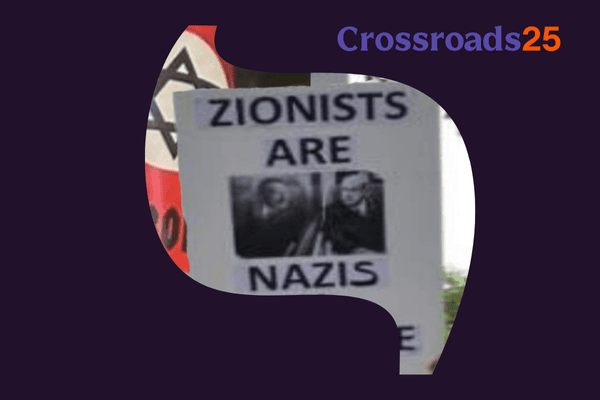
A placard in Sydney in 2004 displays the words 'Zionists are Nazis in disguise'

A placard in Sydney in 2004 displays the words ‘Zionists are Nazis in disguise’

Published: 13 November 2025

Last updated: 19 November 2025

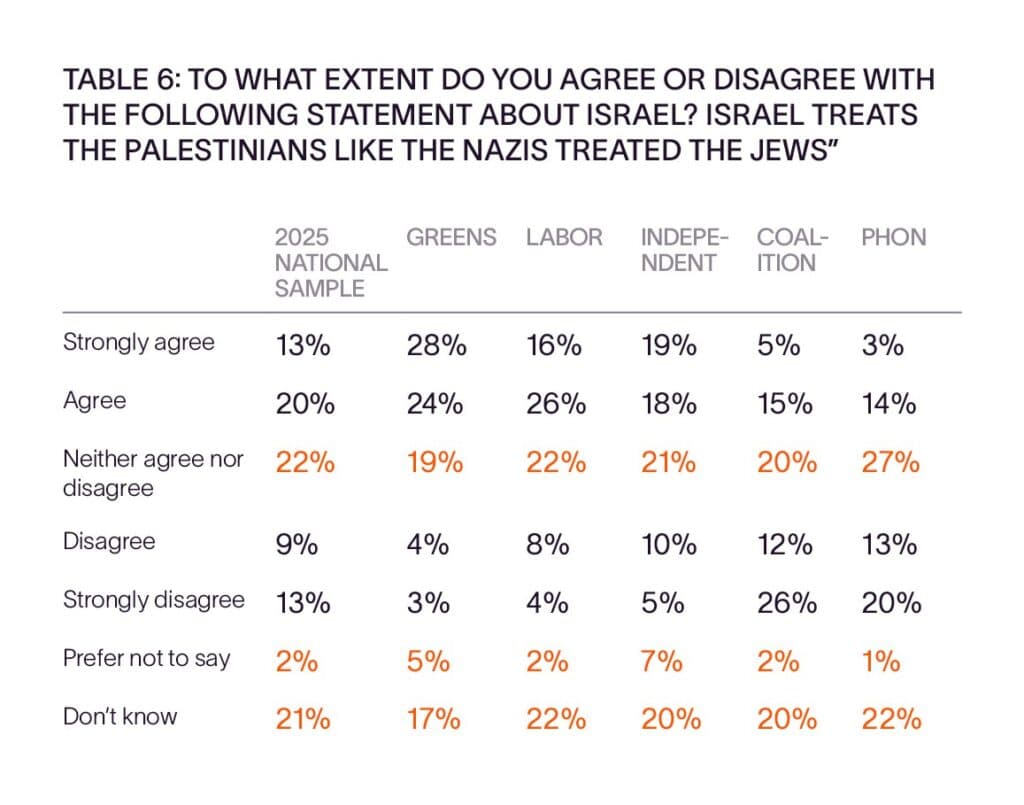
Of all the attitudes surveyed in Crossroads25, the response that raised the most red flags was the significant agreement with the statement “Israel treats the Palestinians like the Nazis treated the Jews”.

A third of respondents (33%) agreed with the Nazi comparison statement, compared with 22% who disagreed, and 43% who were neutral or uncertain. 

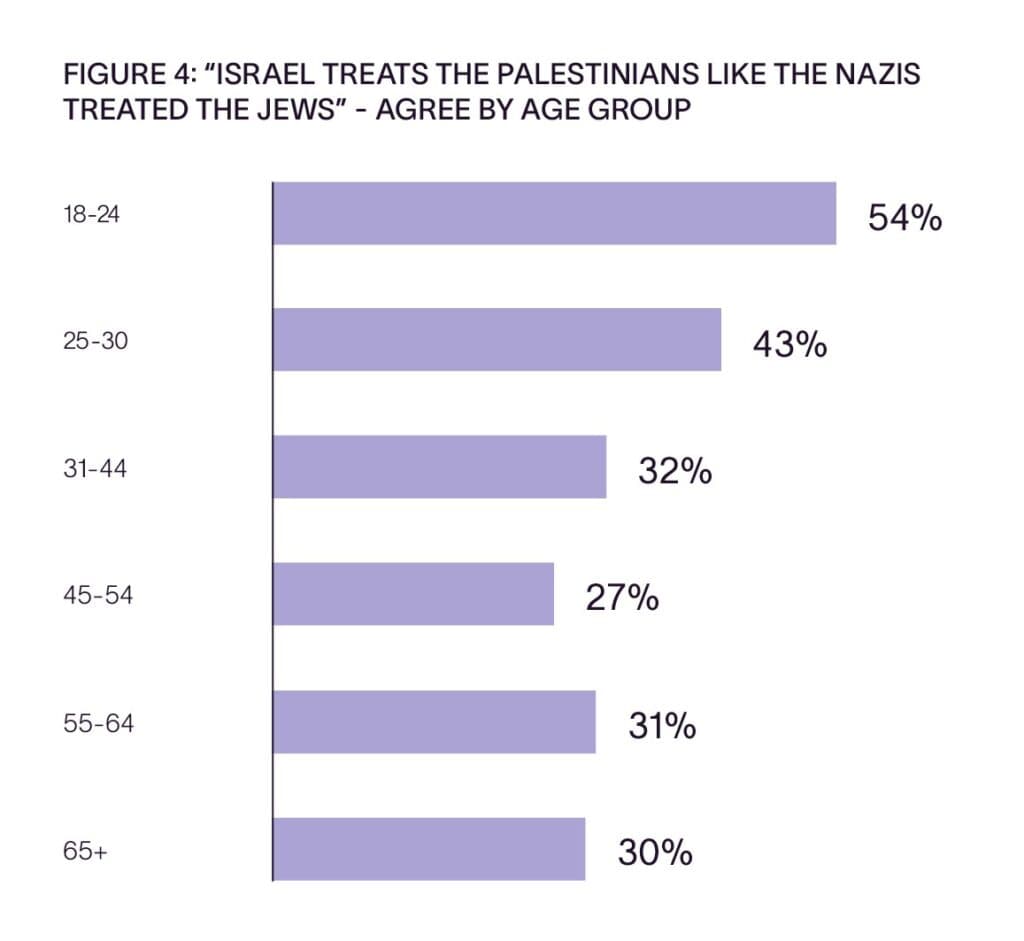
The comparison was heavily endorsed by young people: 54% aged 18-24 and 43% aged 25-30 agreed. Agreement declined with age but remained significant: 32% aged 31-44, 27% aged 45-54, and 30% of those 55 and over.
The Jewish Independent

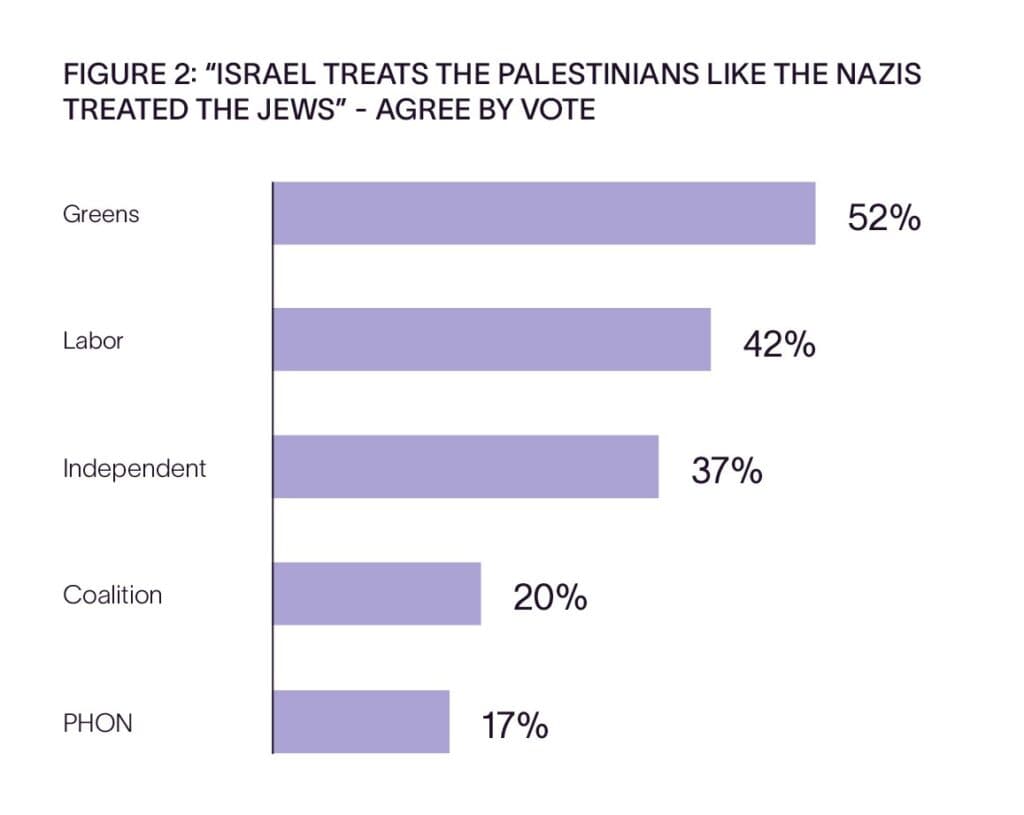
The statement also found strong agreement on the left side of politics: 52% of Greens voters, 42% of Labor and 37% of Independent, dropping to 20% of Coalition voters and 17% One Nation.

The significant agreement with a statement that is offensive to many Jewish people and arguably antisemitic demands examination.

Why we asked the question

Crossroads25 was commissioned by The Jewish Independent to measure Australian attitudes to Jews, Israel and antisemitism, and to provide a longitudinal comparison with Crossroads21.

The statement was controversial, not just because of the response it garnered. Some readers objected to the question being in the survey, either because they believe it makes an offensive and unjustified comparison, or because they feared it put an antisemitic idea into the minds of respondents who may not have otherwise thought to make the comparison.

Emeritus Professor Andrew Markus, who designed the survey, explained that the statement is part of the six-question Anti-Zionist Antisemitism scale (AzAs scale), developed by British academics to measure antisemitic attitudes, consistent with the International Holocaust Remembrance Alliance (IHRA) Working Definition of Antisemitism.

“Drawing comparisons of contemporary Israeli policy to that of the Nazis” is one of the illustrative examples used by the definition.

The scale is designed to measure endorsement of antisemitic attitudes directed at Israel and its supporters, as part of the Generalised Antisemitism Scale (GeAS) questionnaire, which measures all forms of antisemitism.

It is used in similar surveys such as the British Campaign Against Antisemitism survey conducted by YouGov in September 2025, enabling international comparisons.

A context of broader support for Israel

Crossroads25 revealed a striking contrast between attitudes to the Israeli state and the policies of the Israeli government. A large majority, 60%, supported Israel’s right to exist (just 6% disagreed) and 63% its right to defend itself (7% disagreed).

Many respondents who agree with the Nazi comparison did not hold broader anti-Zionist attitudes, nor did they hold traditional antisemitic attitudes.

On the other hand, a large number were ignorant or uncertain about the October 7 massacre, which started the Gaza war, and ambivalent or uncertain about the Israeli-Palestinian conflict.

Professor Markus said the statement yielded the most problematic response in the survey. "What the Nazis did to the Jews was the systematic annihilation of an unarmed population. That's very different from what happened in Gaza.

The Jewish Independent

“The willingness to agree with the comparison to Nazi treatment of Jews – selected by a substantial minority and by a majority in some population segments – is a significant finding that should not be overlooked.”

Professor Markus noted that the IHRA working definition of antisemitism states that “drawing comparisons of contemporary Israeli policy to that of the Nazis” is one of the illustrative examples of statements that may be antisemitic, depending on the context.

Antisemitic or just plain offensive?

The Jewish Independent asked Jewish community leaders and advocates whether they think the statement is antisemitic, regardless of context.

“The statement is blatantly antisemitic,” says Dr Andre Oboler, CEO of the Online Hate Prevention Institute, and an expert member of the Australian Government’s delegation to IHRA.

The statement is a form of “Holocaust inversion”, he says, citing the work of two antisemitism experts to support his assessment. Firstly, it exploits the defining metaphor for absolute evil which Nazism became after WWII, according to Professor Robert Wistrich.

Secondly, the inversion "attacks and humiliates the Jewish people by equating them with the perpetrators of the brutal genocide that nearly succeeded in exterminating the Jews completely," according to Dr Manfred Gerstenfeld.

Peter Wertheim, co-CEO of Executive Council of Australian Jewry, was highly critical of the statement’s inclusion but stopped short of calling it antisemitic, instead describing it as “tendentious, bordering on push polling” (an opinion poll in which the true objective is to sway voters’ attitudes by using loaded questions.)

Wertheim also pointed out that many respondents did not agree with the statement. “The fact that nearly half of the people who were surveyed declined to dignify this question with an ‘agree’ or ‘disagree’ response indicates that they saw it not merely as antisemitic but as gratuitously confronting, even in a survey on antisemitism.” 

The government’s antisemitism envoy Jillian Segal was also approached. She was travelling overseas and unavailable for comment.

International comparison

Australian levels of agreement with the statement are lower than those found in the US and the UK, and comparable to Germany – even though some of the data from overseas studies was collected before the war in Gaza, suggesting it may understate the level of agreement.

A comparable British survey from September 2025 found 45% of the British public agreed with the comparison, up from 33% in 2024. Among young people, agreement was at 60%. 

Survey data from 2022, before the Gaza War, found 40% of Americans and 36% of Germans agreed with the same statement.

The report on the British survey observed: “These attitudes among young Britons have enormous implications for young Jews on campus, on social media and starting out in the workplace.”

Judging by the findings of Crossroads25, those implications are also relevant for Australia.

READ MORE

Australian attitudes to Jews and Israel

Widespread ignorance over Oct 7

Younger Australians most negative

Crossroads25 reports

Crossroads21 report

You might also like
  • Tame apologises – but with little grace
    Deborah Stone
  • Confronting Richard Flanagan and the myth of the Israel lobby
    Mary Garden
  • UK’s dramatic policy change on Israel-Palestine
    Colin Shindler
logomark.67a07ee3
We believe in the free flow of information

Republish our articles for free, online or in print, by using our Creative Commons licence

You might also like

    Apple & rotten core Rosh hashanah
    EditorialAustralia

    Facing a new year with the knowledge life can be better

    The Jewish Independent
    vandalism car woollahra fuk israel farhat
    Australia

    Court decision fails to understand when ‘Fuk Israel’ becomes antisemitic

    Jeremie Bracka 6
    Woman with land and houses behind her
    NewsAustralia

    Australia to increase sanctions against West Bank settlements

    Deborah Stone 2

About the author

Michael Visontay

Michael Visontay

Michael Visontay is Commissioning Editor of TJI and was Editor-in-Chief from 2017-22. Michael is a former Assistant Editor of The Sydney Morning Herald and columnist with The Australian Jewish News. He has written six books, including Who Gave You Permission? with Manny Waks, and Welcome to Wanderland: Western Sydney Wanderers and the Pride of the West. His most recent book is Noble Fragments: the Maverick who broke up the world's greatest book (Scribe, 2024).

More from the author

ReflectionWorld

My memory of Gloria Steinem

NewsAustralia

No action to stop Hezbollah ally beaming antisemitic and anti-Israel content into Australia

NewsAustralia

Beinart takes a wrecking ball to Israel

AnalysisAustralia

Prime minister’s absence exposes weakness in Royal Commission hearings

Comments4

  • Avatar of Jo Thomson

    Jo Thomson15 November at 12:47 am

    I assumed that the problem referred to in the headline referred to the impact of Israel’s genocidal treatment of Palestinians on community sentiment.
    But no, it appears that the problem is conflating growing community hostility to relentless cruelty with anti-semitism.
    No one can tell me I’m antisemitic, whatever definition one chooses to deploy.

  • Avatar of Jesse McNicoll

    Jesse McNicoll13 November at 12:05 pm

    I find it interesting that a question about the respondents’ abhorrence of brutalisation of Palestinians is really about antisemitism?

  • Avatar of Janet Kossy

    Janet Kossy13 November at 09:35 am

    To categorically rule comparison of Israeli policy with the Nazis as antisemitic or offensive, is to say the Israeli Government could never engage in Nazi-like behaviour of any kind. Really?

    Comparison, saying things are alike in some way, doesn’t require them to be identical.

    Whatever view one has of Israel’s conduct toward people it has displaced and occupied, an automatic “antisemitism” label for any Nazi comparison is unfair and even racist. If, by definition, nothing done by Israel can legitimately be compared to the Nazis, it means that, unlike the rest of humanity, Israeli Jews are essentially incapable of such evil. No matter the scale of systematic dehumanisation and killing?

    The images from Gaza Australians have seen on our screens over the past two years have appalled us. Comparing the devastation of this Palestinian population to the work of Nazis may not be based on exact historical fact, but that doesn’t make it antisemitic. Rightly or wrongly, the world expected more of a country largely built by the victims of Nazi dehumanisation. Australians think of the Holocaust when they think of Jews and Israel, so the comparison comes easily.

    Michael Visontay’s Crossroads25 analysis doesn’t mention this obvious explanation.

  • Avatar of Ian Bowie

    Ian Bowie13 November at 06:13 am

    These survey results should be something of a wakeup for those who claim to speak for the ‘Jewish community’. It would have been useful to know about the attitudes of members of the small community who identify as Jewish by religion and a probably much larger group among Australians who have other Jewish cultural affiliations for whom Jewish spokespeople do not speak.