Aa
  • Read, Watch, Listen
  • TJI Series
  • Community Action
  • Events
  • Zedi
Follow us and continue the conversation
  • LinkedIn
  • Instagram
  • FaceBook
  • X
  • YouTube
Test yourself with the TJI Quiz!

Adjust size of text

Aa

Follow us and continue the conversation

  • LinkedIn
  • Instagram
  • FaceBook
  • X
  • YouTube

Your saved articles

You haven't saved any articles

What are you looking for?

Original reporting, insightful analysis and diverse views, delivered straight to your inbox

  • LinkedIn
  • Instagram
  • FaceBook
  • X
  • YouTube
Your support fuels our mission to inform, entertain and inspire.

The Jewish Independent is bound by the Standards of Practice of the Australian Press Council. If you believe the Standards may have been breached, you may approach The Jewish Independent or make a complaint to the Australian Press Council in writing at www.presscouncil.org.au. The Council may also be contacted on 1800 025 712.

  • Our Story
  • Contact us
  • Our Team
  • Support us
  • Guidelines
  • Pitch your idea
  • Republishing us
  • Community Action
  • Our Awards
  • LinkedIn
  • Instagram
  • FaceBook
  • X
  • YouTube
Aboriginal FlagTorres Strait Islanders Flag

The Jewish Independent acknowledges Aboriginal and Torres Strait Islander peoples as the Traditional Owners and Custodians of Country throughout Australia. We pay our respects to Elders past and present, and strive to honour their rich history of storytelling in our work and mission.

© The Jewish Independent 2026All Rights Reserved
Website design and development by Your Creative, MelbourneTerms & ConditionsPrivacy Policy
HomeRead, Watch, ListenIsrael
Israel Votes 2026FeatureIsrael

‘Elections are not a civil war’: the democracy threats worrying Israelis

Two recent surveys have revealed significant concern among Israelis regarding the integrity of the upcoming October election and the potential for violent internal conflict
Shahar Burla
Print this
Protest government election

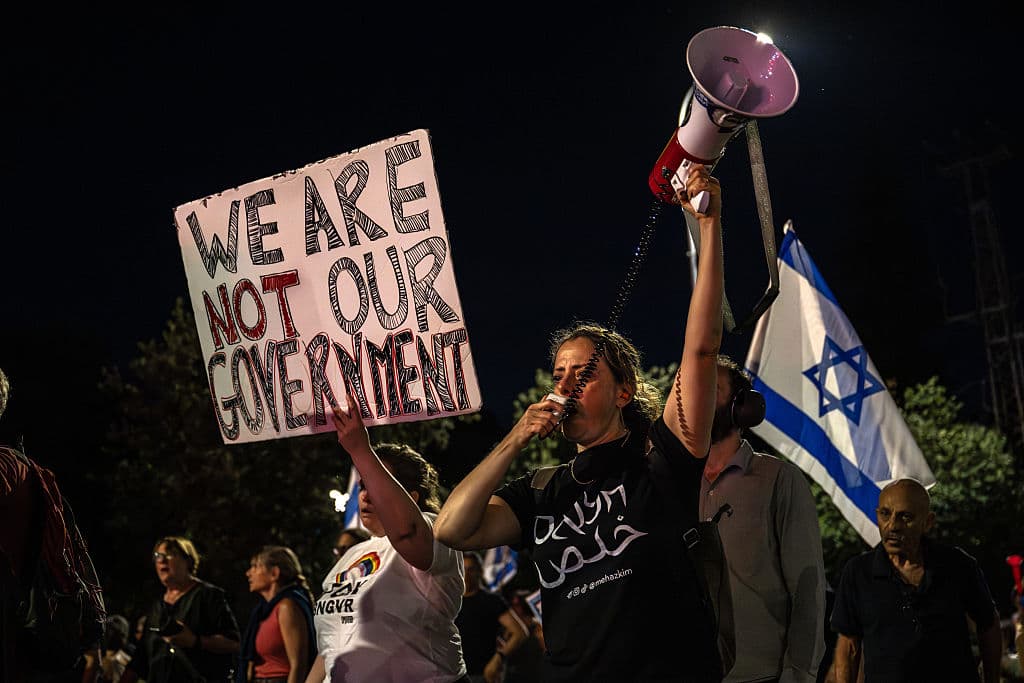
Anti-government protesters in Jerusalem in July ( Mostafa Alkharouf/Anadolu via Getty Images)

Published: 13 August 2026

Last updated: 13 August 2026

Two new surveys have revealed deep concern among Israelis about both the integrity of the country’s October election and the possibility of violent conflict within Israeli society. The findings reinforce warnings issued last month by President Isaac Herzog, who urged political leaders and activists not to cross democratic “red lines” during the campaign. Herzog warned that “violence is rearing its head” and reminded Israelis that “elections are not a civil war”. 

According to the Israel Democracy Institute’s July 2026 Israeli Voice Index, 70 per cent of Israelis believe there is a danger to the integrity of the election. Only 40 per cent expressed optimism about the future of Israeli democracy.

A separate survey by the Institute for National Security Studies (INSS) found that 39 per cent of Israelis regard violent conflict between social groups as one of the country’s three most serious strategic threats over the next five years. Internal violence ranked alongside Iran obtaining nuclear weapons.

Together, the surveys portray an electorate concerned not only about external security threats, but also about whether Israel’s political and democratic institutions can withstand an increasingly polarised campaign.

Broad concern about election integrity

Herzog warned of both internal and external threats to the election and called on law enforcement agencies to respond firmly. “Do not turn rivals into enemies,” he told politicians and activists.

His remarks followed a meeting with Shin Bet chief David Zini and Central Elections Committee chairman Justice Noam Sohlberg. According to Herzog, the officials presented several potential threats to the election and committed to supporting the committee and Israel’s security and law enforcement agencies.
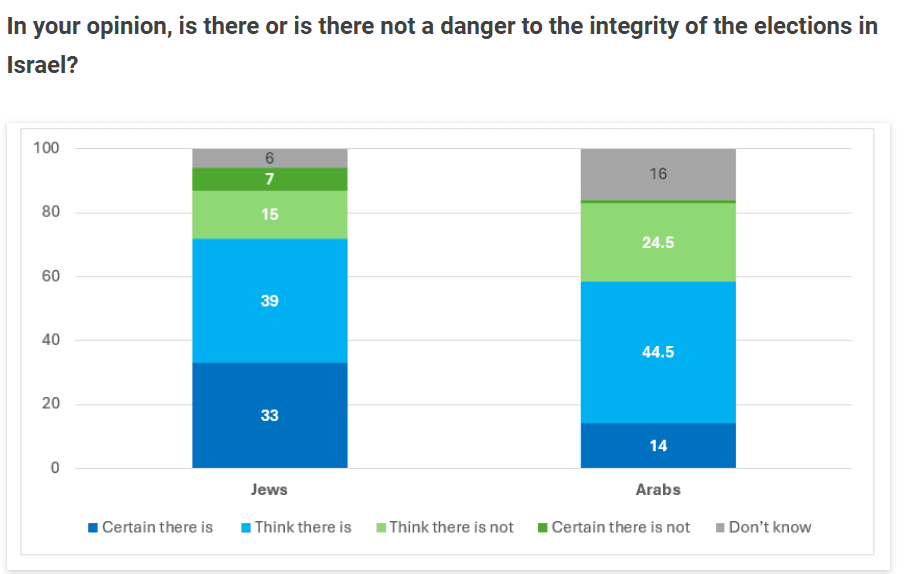
The Israeli Voice Index suggests those concerns are widely shared. Seventy-two per cent of Jewish respondents and 58.5 per cent of Arab respondents said they believed the integrity of the election could be endangered.

Concern extended across all three major Jewish political camps, although it was strongest on the left. Around 90.5 per cent of left-wing respondents identified a danger, compared with 76 per cent in the centre and 66 per cent on the right.

Credit: <em>The Israeli Voice Index</em>, July 2026
Credit: The Israeli Voice Index, July 2026

The findings indicate that anxiety about the election is not confined to opponents of Prime Minister Benjamin Netanyahu’s government, even if voters differ over where the danger may originate.

Public confidence in the future of democratic government also remains weak. Only 40 per cent of Israelis expressed optimism, up slightly from 37 per cent in the previous month. Optimism stood at 43 per cent among Jewish respondents but just 24.5 per cent among Arab respondents.

The debate has intensified following attacks by members of Netanyahu’s Likud party against the Central Elections Committee. In February, the Knesset Finance Committee cut the committee’s budget by NIS 50 million despite warnings about foreign interference and the growing capacity of generative artificial intelligence to spread disinformation.

Last week Sohlberg also barred polling-station committee members and party observers from reporting voters’ identities to political parties on election day. Parties previously used this information to identify supporters who had not voted and mobilise them through calls, messages, home visits and transport.

Citing Israel’s Privacy Protection Law, Sohlberg ruled that sharing a voter’s identity, voting time or type of polling station without consent violated privacy protections. Such information could expose sensitive personal circumstances, particularly when a person votes at a hospital, disability facility or shelter for women experiencing domestic violence.

Internal conflict rivals Iran as a national threat

The INSS survey shows that public anxiety extends beyond the administration of the election to the possibility that political and social tensions could become violent.

In July, 39 per cent of respondents selected violent conflict between groups within Israeli society as one of the country’s three most serious threats over the next five years. The same proportion selected Iran obtaining nuclear weapons.

Violent internal conflict was consequently judged to be the most damaging of all the scenarios examined. The erosion of Israel’s democratic character followed closely, with 68 per cent anticipating serious consequences

In February, internal conflict ranked slightly higher, at 42 per cent, compared with 40 per cent for a nuclear Iran.

The Jewish Independent

More than half of respondents, 54 per cent, assessed violent internal conflict as likely or very likely to occur. Sixty-nine per cent believed it would cause serious damage, while 64 per cent considered the state poorly prepared to manage it.

The anticipated impact was especially pronounced in relation to personal security and Israel’s emotional and social resilience, with 77 per cent expecting substantial damage in both areas.

Violent internal conflict was consequently judged to be the most damaging of all the scenarios examined. The erosion of Israel’s democratic character followed closely, with 68 per cent anticipating serious consequences.

The survey’s analysis argued that these dangers could reinforce one another. Democratic erosion and declining social cohesion could weaken Israel’s international legitimacy and its relationship with the United States, ultimately affecting its military and technological advantage.

Arab participation remains contested

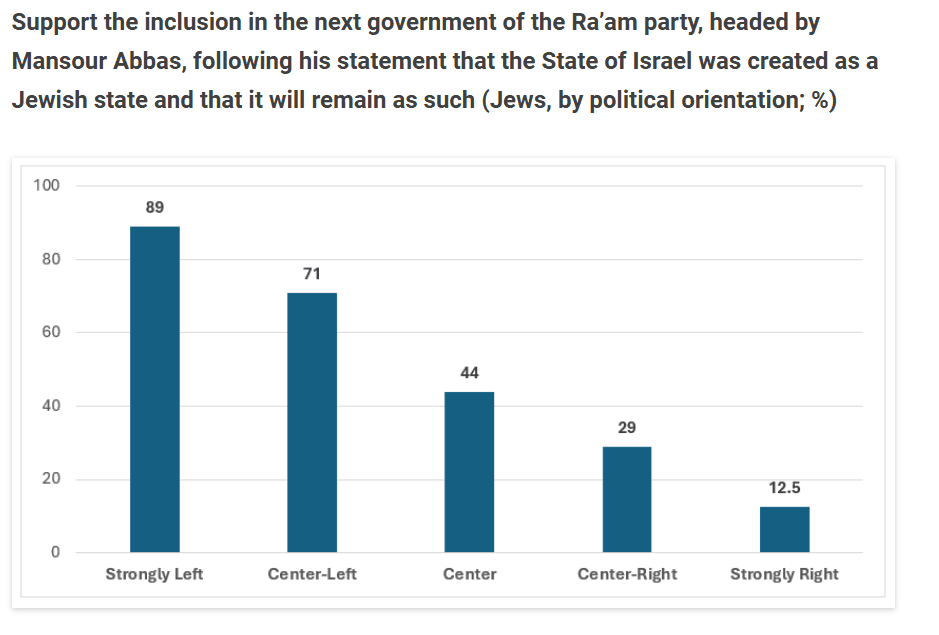
The Israeli Voice Index also examined attitudes towards the inclusion of Ra’am, led by Mansour Abbas, in the next government. Despite Abbas’s pragmatic and bold approach, 61 per cent of Jewish respondents opposed including Ra’am in the government. A similar proportion of Arab respondents – 60 per cent – also opposed its inclusion.

Support was concentrated among respondents on the left and centre-left. Only minorities of those identifying with the centre, centre-right and strong right supported Ra’am’s participation.

The survey also found broad, although uneven, support for the right of Arab citizens to vote in Knesset elections. Large majorities on the left, centre-left, centre and centre-right supported that right.

Credit: <em>The Israeli Voice Index</em>, July 2026
Credit: The Israeli Voice Index, July 2026

Among those identifying with the strong right, however, support fell to 46 per cent. It was lower among intended voters for United Torah Judaism, at 22 per cent, and Otzma Yehudit, at 32 per cent.

The findings add another dimension to concerns about the election’s democratic integrity: not only whether votes will be administered and counted fairly, but whether the political participation of an entire section of the population will be regarded as legitimate.

Limited support for pre-election legislation

The Israel Voice Index also found majority opposition to three controversial laws passed before the Knesset was dissolved.

Sixty-seven per cent opposed temporarily halting the arrest of yeshiva students who failed to report for military service, while only 25 per cent supported the measure.

Another 64 per cent opposed legislation expanding gender-segregated programs in higher education, with 31 per cent in favour. Fifty-five per cent opposed changing the attorney-general’s powers so that legal opinions would no longer bind the government and the attorney-general would lose exclusive authority to represent it in court; 32 per cent supported the proposal.

Support for all three measures was extremely low on the left and in the centre but higher on the right. Haredi respondents strongly supported the legislation, particularly the suspension of arrests for draft evasion.

As election day approaches, the two surveys suggest that Israelis are looking towards the campaign with anxiety on two closely connected fronts. Many fear attempts to undermine the electoral process itself, while a similarly troubling proportion believe the country’s political divisions could escalate into violence.

The Israeli Voice Index surveyed 751 adults between July 28 and August 2, including 600 Hebrew-speaking and 151 Arabic-speaking respondents. The maximum sampling error was 3.58 percentage points.

You might also like
  • ‘Israel is systemically eliminating Palestinian collective life’:  B’Tselem
    Deborah Stone
  • Tame apologises – but with little grace
    Deborah Stone
  • Confronting Richard Flanagan and the myth of the Israel lobby
    Mary Garden
logomark.67a07ee3
We believe in the free flow of information

Republish our articles for free, online or in print, by using our Creative Commons licence

You might also like

    haredi street guitar
    Photo EssayArts & Culture

    Jerusalemites through the lens

    Sharon Gabay
    Arab Israeli Palestinian election vote
    Israel Votes 2026FeatureIsrael

    Fear of Netanyahu victory may drive big surge in Palestinian voter turnout

    Ben Lynfield
    Erdogan Turkey
    AnalysisIsrael

    Turkey emerges as military threat to Israel

    Dror Doron

About the author

Shahar Burla

Shahar Burla

Dr Shahar Burla is a Sydney-based researcher, lecturer and Contributing Editor of TJI. Shahar holds a Master’s degree in political science from Hebrew University and a PhD in political science from Bar-Ilan University. He is the author of Political Imagination in the Diaspora: The Construction of a Pro-Israeli Narrative (2013) and co-editor of Australia and Israel: A Diasporic, Cultural and Political Relationship (2015).

More from the author

FeatureIsrael

New evidence Netanyahu was warned about October 7

OpinionIsrael

The Altalena should be a warning, not a political weapon

AnalysisIsrael

Who is Ofer Winter and could he upset Netanyahu’s election?

AnalysisIsrael

Bennett’s balancing act: can he win over the right without losing the centre?

Comments1

  • Avatar of Mark Ian

    Mark Ian18 August at 12:52 am

    If Likud Yachad and Yashar could pass 61 mandates this would be good for Israel with support flowing from other Zionist Opposition Parties .
    That is an aim that could result in a Eighty Seat Super Majority.