Aa
  • Read, Watch, Listen
  • TJI Series
  • Community Action
  • Events
  • Zedi
Follow us and continue the conversation
  • LinkedIn
  • Instagram
  • FaceBook
  • X
  • YouTube
Test yourself with the TJI Quiz!

Adjust size of text

Aa

Follow us and continue the conversation

  • LinkedIn
  • Instagram
  • FaceBook
  • X
  • YouTube

Your saved articles

You haven't saved any articles

What are you looking for?

Original reporting, insightful analysis and diverse views, delivered straight to your inbox

  • LinkedIn
  • Instagram
  • FaceBook
  • X
  • YouTube
Your support fuels our mission to inform, entertain and inspire.

The Jewish Independent is bound by the Standards of Practice of the Australian Press Council. If you believe the Standards may have been breached, you may approach The Jewish Independent or make a complaint to the Australian Press Council in writing at www.presscouncil.org.au. The Council may also be contacted on 1800 025 712.

  • Our Story
  • Contact us
  • Our Team
  • Support us
  • Guidelines
  • Pitch your idea
  • Republishing us
  • Community Action
  • Our Awards
  • LinkedIn
  • Instagram
  • FaceBook
  • X
  • YouTube
Aboriginal FlagTorres Strait Islanders Flag

The Jewish Independent acknowledges Aboriginal and Torres Strait Islander peoples as the Traditional Owners and Custodians of Country throughout Australia. We pay our respects to Elders past and present, and strive to honour their rich history of storytelling in our work and mission.

© The Jewish Independent 2026All Rights Reserved
Website design and development by Your Creative, MelbourneTerms & ConditionsPrivacy Policy
HomeRead, Watch, ListenAustralia
Israel Hamas WarNewsAustralia

Australian attitudes to Israel are stable on average, but there are pockets of sharp change

Four distinct trends can be identified over the past five years, which reflect the impact of Hamas’ October 7 attack and the Israel-Hamas war.
Michael Visontay
Print this
article Comparison Ben Bresley Melb protest

Photo of Melbourne protest: Ben Presley

Published: 11 November 2025

Last updated: 11 November 2025

Australian attitudes towards Jews have, on average, not changed much as a result of the war in Gaza and neither have feelings about Israel.

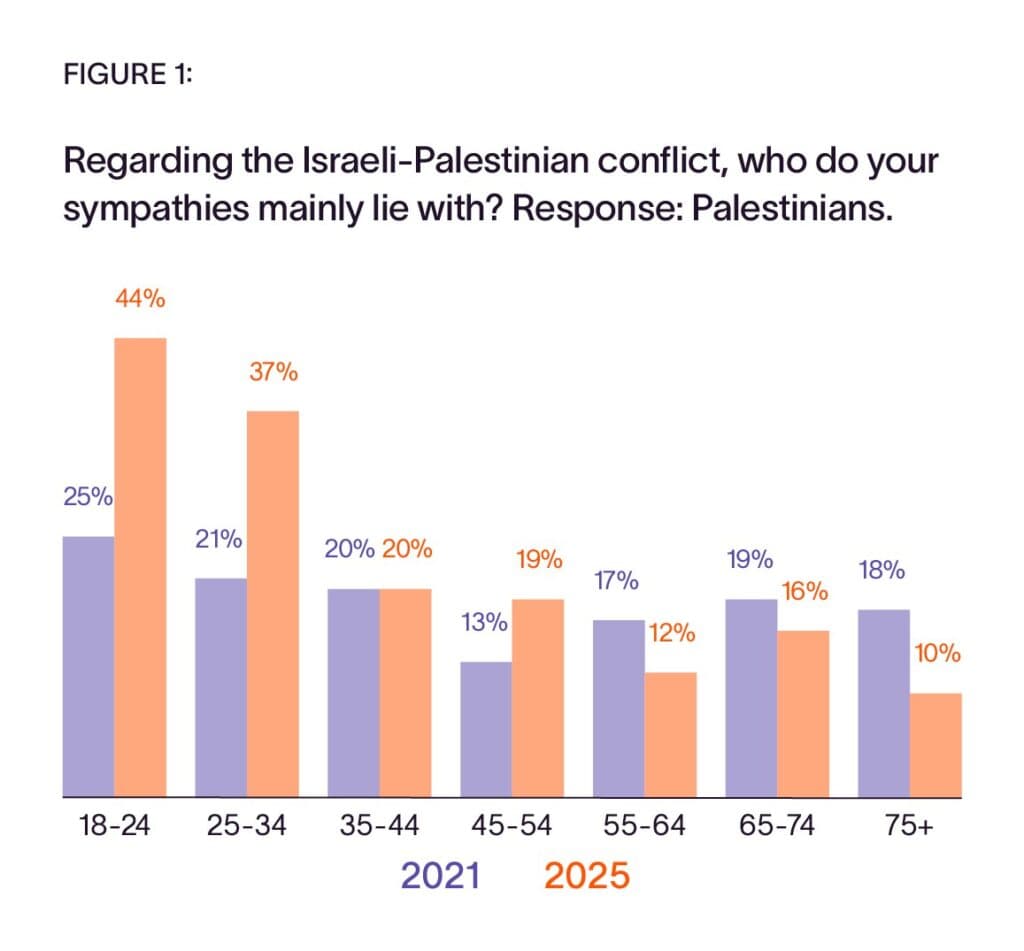
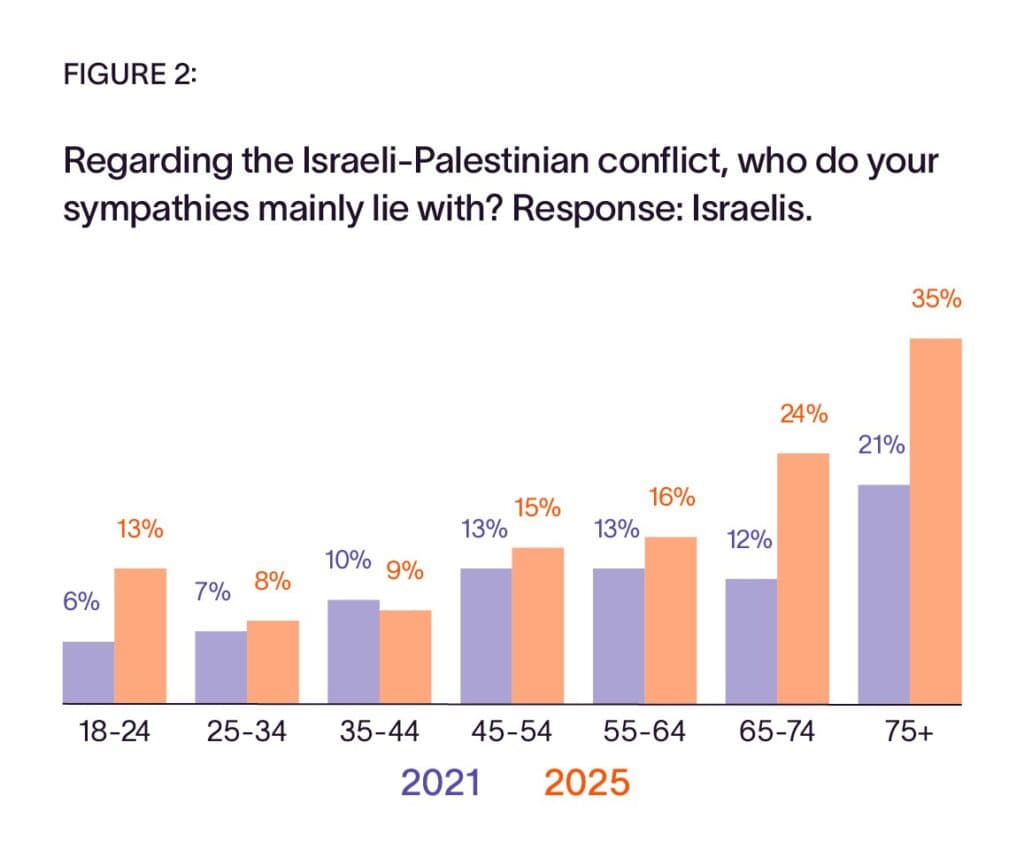
But at either end of the age range there has been a dramatic change. Young people have become significantly more sympathetic to Palestinians, while older people have increased their sympathy for Israel. Among those aged 18 to 24, pro-Palestinian sympathy increased by 76%. Among those aged 65 to 74, support for Israel doubled.

Clear evidence of Australian attitudes over time emerges from a comparison of the Crossroads21 and Crossroads21 surveys published by The Jewish Independent.

Four distinct trends can be identified over this period, which includes the two years since Hamas’ October 7 attack and the prolonged Israel-Hamas war.

  • The number of people holding antisemitic attitudes has not increased.
  • Interest in the Israel-Palestinian conflict has increased substantially.
  • Heightened interest has translated into greater uncertainty rather than a noticeable change of sympathies, on average.
  • Young people have become more sympathetic to Palestinians, while older people have become more sympathetic to Israel.

No significant spread in antisemitic attitudes

To measure antisemitism, both surveys used a six-question Judeophobic scale developed in the UK, addressing topics including Jewish friends, trusting Jews, Jews chasing money, etc. Strongly negative responses were virtually unchanged (3.8% in 2021, 4% in 2025) while milder negative opinions were lower (13.5% in 2021, 8.5% in 2025).
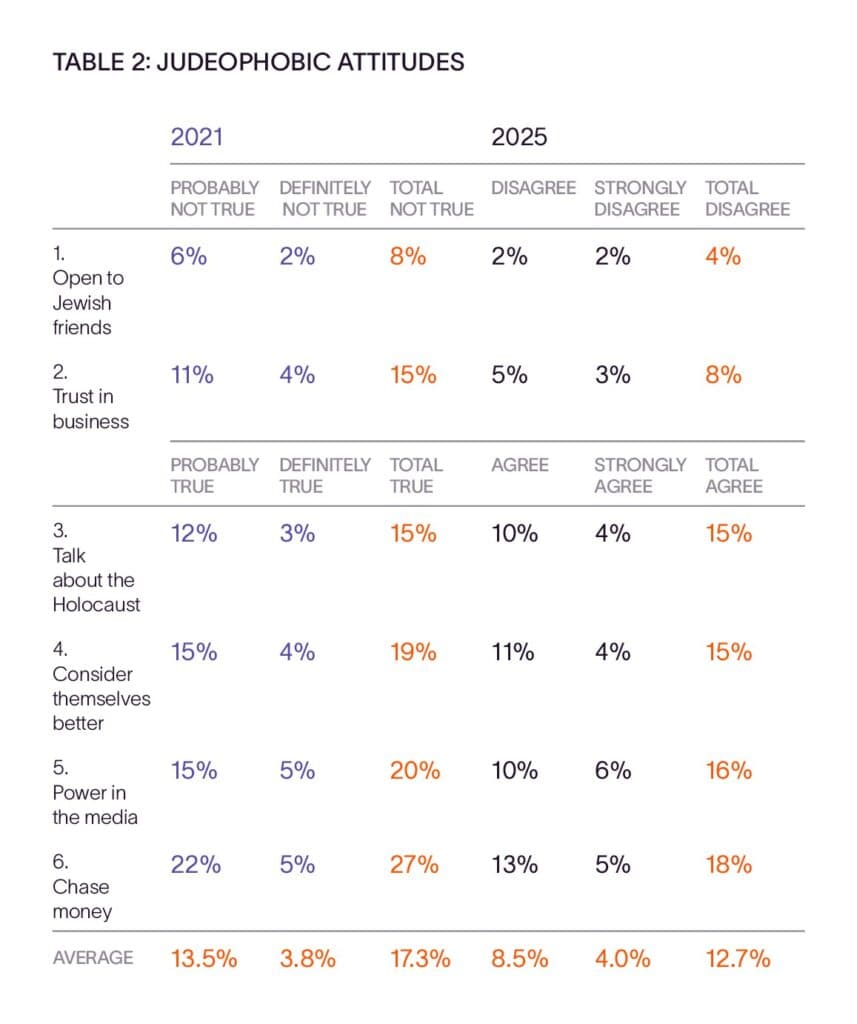
“These findings do not support an interpretation of a sharp increase in Judeophobic attitudes,” said Professor Andrew Markus, who designed both the 2021 and 2025 surveys for The Jewish Independent.

While acknowledging that violent behaviour towards Jewish and Israeli property, institutions and Jewish students has created a climate of fear within the community, he added that “stereotypical antisemitic attitudes continue to be held by only a small minority, apparently no larger than in 2021 when the Crossroads21 survey was conducted”.

The Jewish Independent

Professor Markus noted that the Crossroads25 survey was supported by the annual Scanlon Foundation social cohesion survey. The Scanlon survey found negative attitude to Jews was at 9% in 2021, rising to 15% in 2025, an increase which has been consistent with the increase for five of the six faith groups surveyed by Scanlon, he added.

Heightened interest in the Israel-Palestine conflict

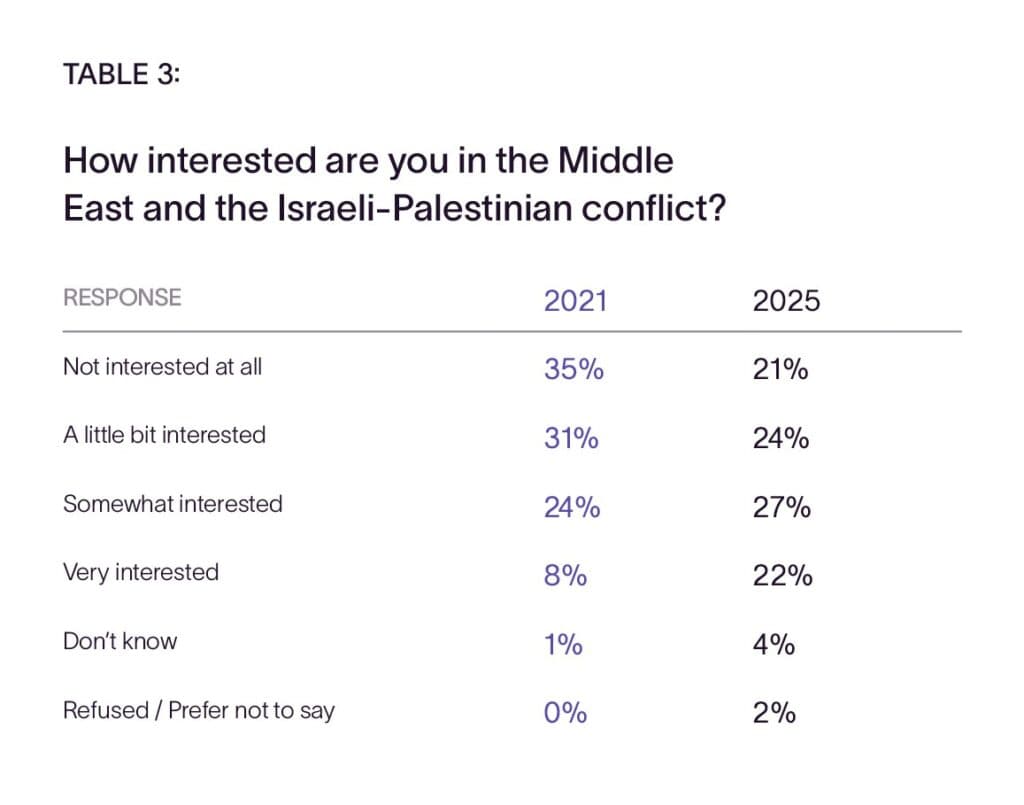
The 2021 and 2025 surveys contained three identically worded questions to compare attitudes to the Israel-Palestinian conflict – they address the extent of interest in the conflict, whether views towards it have changed, and indications of sympathy for both sides.

Interest in the conflict has increased substantially since 2021, with 49% of respondents saying they are “somewhat” or “very interested” compared to 32% in the first survey.

However, the level of disinterest also remains high, despite blanket media coverage of the conflict. Almost half the sample in 2025 indicate that they remain “not at all interested” (21%) or only “a little bit interested” (24%) – a combined 45%, compared to 66% in 2021.

The Jewish Independent

Shift towards uncertainty

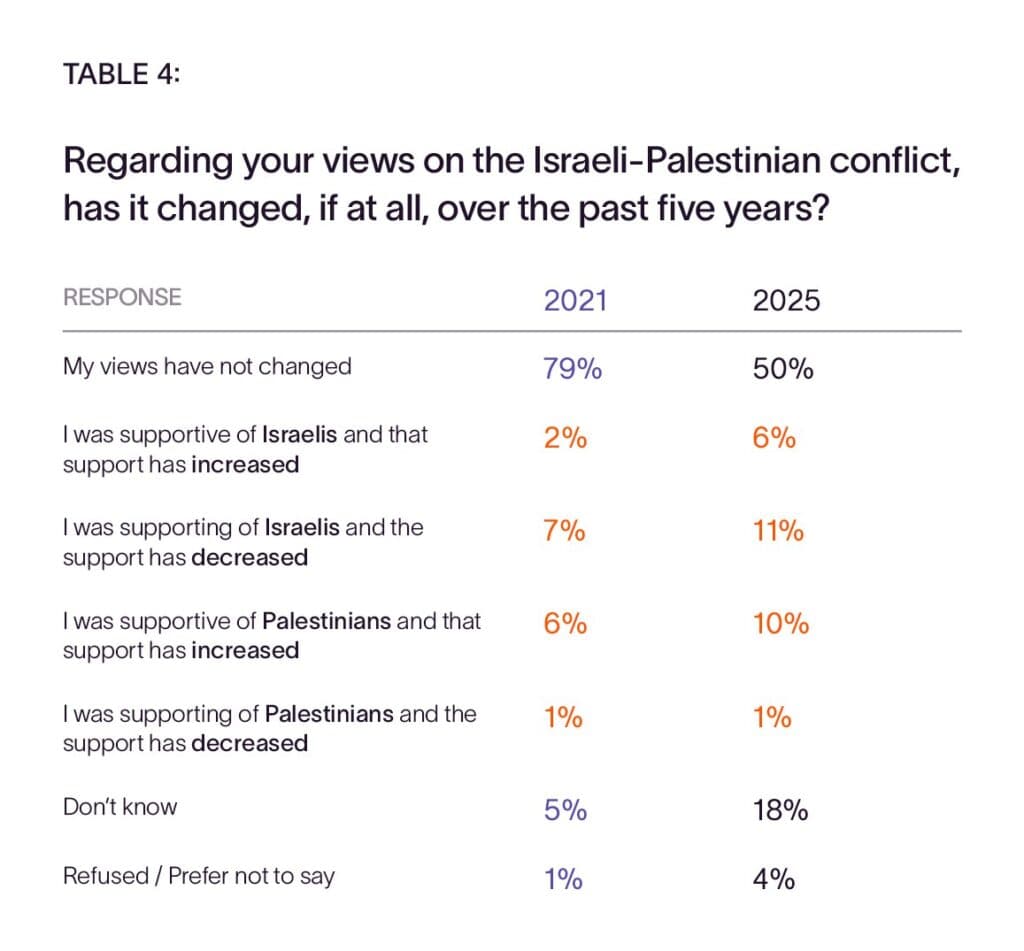
Asked if their views of the conflict had changed over the past five years, 50% said their views remain unchanged and 29% of respondents said their views had shifted. But the largest shift within that segment was not from one side to the other but towards uncertainty. Those responding “don’t know” or “prefer not to say” increased from 6% to 22%.

The Jewish Independent

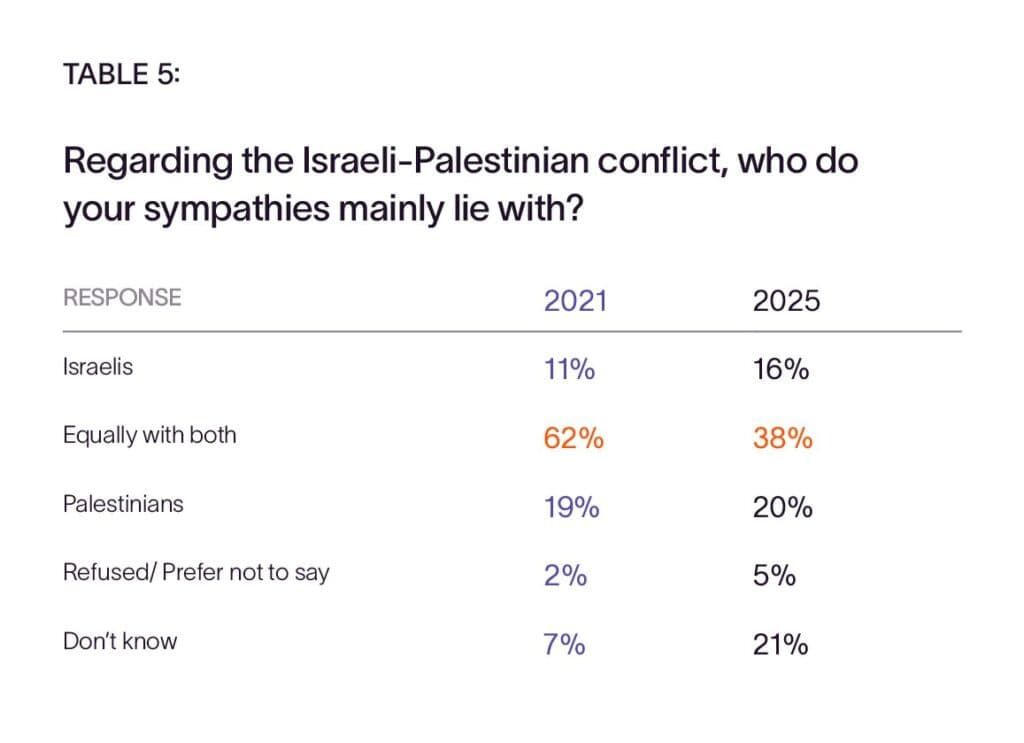
Respondents were then directly asked “Who do your sympathies mainly lie with?” to capture the underlying outlook of those whose views had not changed, as well as those who had.

This question captured a large drop in those whose sympathies were “equally with both”, which was down from 62% to 38% - a drop of 24%.

The Jewish Independent

However, just as with the previous question, the drop in shared sympathy did not result in a substantial increase in support for either the Israelis or Palestinians but in increased uncertainty. In 2021, 9% declined to answer or indicated “don’t know”, in 2025 this figure was 26%.

Average sympathy for Palestinians was almost unchanged (up 1% to 20%) and for Israelis up 5%, to 16%.

The Jewish Independent

Young and old more likely to change views

Although on average there was minimal change in sympathy for either side, drilling down to age cohorts shows some strong trends.

Younger respondents showed a substantial increase in sympathy for Palestinians. Among 18-24-year-olds, 25% said they “mainly sympathised” with Palestinians in 2021 but this rose to 44% in 2025. Among those aged 25-34, the proportion grew from 21% to 37% in 2025. 

Older age groups showed an equivalent increased sympathy for Israelis: in the 65-74 group, support doubled from 12% to 24%; for those over 75, it rose from 21% to 35%.

The Jewish Independent

Professor Markus said the age-related response pattern was consistent with the findings of recent surveys conducted in the United States and Britain. The American Harvard-Harris Poll conducted in August 2025 asked: “In the Israel-Hamas conflict, do you support more Israel or more Hamas?’” Across the population, 74% supported Israel, 26% Hamas, but among those aged 18-24, 60% supported Hamas.

“As Generation Z ages, there is the potential for a significant shift in the balance of opinion in attitudes to Israel – and in the political landscape. “The survey findings are also of immediate relevance,” Professor Markus said.

The report on the British Campaign Against Antisemitism survey, conducted by YouGov in September 2025, observed: “Bearing in mind that the overwhelming majority of British Jews identify as Zionists and with the Jewish state, these attitudes among young Britons have enormous implications for young Jews on campus, on social media and starting out in the workplace.”

Greens exhibit strong trend towards Palestinians

Comparing views according to political alignment, the only significant change in sympathy for Palestinians among political cohorts was among Greens voters. In 2021, 34% of Greens voters said their sympathies were with the Palestinian, in 2025, 49% indicated sympathies with Palestinians, making them by far the most pro-Palestinian group.

For all other groups, the level of sympathy for Palestinians was almost unchanged: for Labor voters, it moved from 25% in 2021 to 27%, Coalition voters remained static at 8%, minor parties (including One Nation), went from 8% to 6%. Independent voters, who were not surveyed in 2021 because it predated the advent of the Teals, indicated 23% sympathy for Palestinians.

On sympathy for Israel, the only significant change came from Coalition voters, whose sympathies increased from 19% in 2021 to 31% in 2025.  The results remained virtually the same for Greens voters, from 6% to 4%; Labor, 6% to 7%, Independent 8% (not surveyed in 2021) and minor parties, 27% to 26%.

Crossroads25, commissioned by The Jewish Independent, provides methodologically sound data on Australian attitudes to Jews, Israel and antisemitism, including longitudinal comparison with the Crossroads21 survey. The survey was designed by Emeritus Professor Andrew Markus and conducted during August by the polling company YouGov across a sample size of 2270 Australians.

READ MORE

Australian attitudes to Jews and Israel
Widespread ignorance over Oct 7
Younger Australians most negative
Crossroads25 reports
Crossroads21 report

Next: Belief in the claim that 'Israel treats Palestinians like the Nazis treated Jews'

You might also like
  • ‘Israel is systemically eliminating Palestinian collective life’:  B’Tselem
    Deborah Stone
  • Tame apologises – but with little grace
    Deborah Stone
  • Confronting Richard Flanagan and the myth of the Israel lobby
    Mary Garden
logomark.67a07ee3
We believe in the free flow of information

Republish our articles for free, online or in print, by using our Creative Commons licence

You might also like

    Woman with land and houses behind her
    NewsAustralia

    Australia to increase sanctions against West Bank settlements

    Deborah Stone 2
    Apple & rotten core Rosh hashanah
    EditorialAustralia

    Facing a new year with the knowledge life can be better

    The Jewish Independent
    funding handouts
    NewsAustralia

    Who will get the money from the Cranbourne windfall?

    Gideon Cohen

About the author

Michael Visontay

Michael Visontay

Michael Visontay is Commissioning Editor of TJI and was Editor-in-Chief from 2017-22. Michael is a former Assistant Editor of The Sydney Morning Herald and columnist with The Australian Jewish News. He has written six books, including Who Gave You Permission? with Manny Waks, and Welcome to Wanderland: Western Sydney Wanderers and the Pride of the West. His most recent book is Noble Fragments: the Maverick who broke up the world's greatest book (Scribe, 2024).

More from the author

ReflectionWorld

My memory of Gloria Steinem

NewsAustralia

No action to stop Hezbollah ally beaming antisemitic and anti-Israel content into Australia

NewsAustralia

Beinart takes a wrecking ball to Israel

AnalysisAustralia

Prime minister’s absence exposes weakness in Royal Commission hearings

Comments

No comments on this article yet. Be the first to add your thoughts.