Aa
  • Read, Watch, Listen
  • TJI Series
  • Community Action
  • Events
  • Zedi
Follow us and continue the conversation
  • LinkedIn
  • Instagram
  • FaceBook
  • X
  • YouTube
Test yourself with the TJI Quiz!

Adjust size of text

Aa

Follow us and continue the conversation

  • LinkedIn
  • Instagram
  • FaceBook
  • X
  • YouTube

Your saved articles

You haven't saved any articles

What are you looking for?

Original reporting, insightful analysis and diverse views, delivered straight to your inbox

  • LinkedIn
  • Instagram
  • FaceBook
  • X
  • YouTube
Your support fuels our mission to inform, entertain and inspire.

The Jewish Independent is bound by the Standards of Practice of the Australian Press Council. If you believe the Standards may have been breached, you may approach The Jewish Independent or make a complaint to the Australian Press Council in writing at www.presscouncil.org.au. The Council may also be contacted on 1800 025 712.

  • Our Story
  • Contact us
  • Our Team
  • Support us
  • Guidelines
  • Pitch your idea
  • Republishing us
  • Community Action
  • Our Awards
  • LinkedIn
  • Instagram
  • FaceBook
  • X
  • YouTube
Aboriginal FlagTorres Strait Islanders Flag

The Jewish Independent acknowledges Aboriginal and Torres Strait Islander peoples as the Traditional Owners and Custodians of Country throughout Australia. We pay our respects to Elders past and present, and strive to honour their rich history of storytelling in our work and mission.

© The Jewish Independent 2026All Rights Reserved
Website design and development by Your Creative, MelbourneTerms & ConditionsPrivacy Policy
HomeRead, Watch, ListenAustralia
Royal CommissionAnalysisAustralia

Where the hate crime laws went wrong

Having responded too slowly with the Royal Commission, the Prime Minister acted too quickly over new hate provisions, and negotiations over the revised Bill opened even deeper divisions.
Michael Visontay
Print this
ANTHONY ALBANESE PRESSER

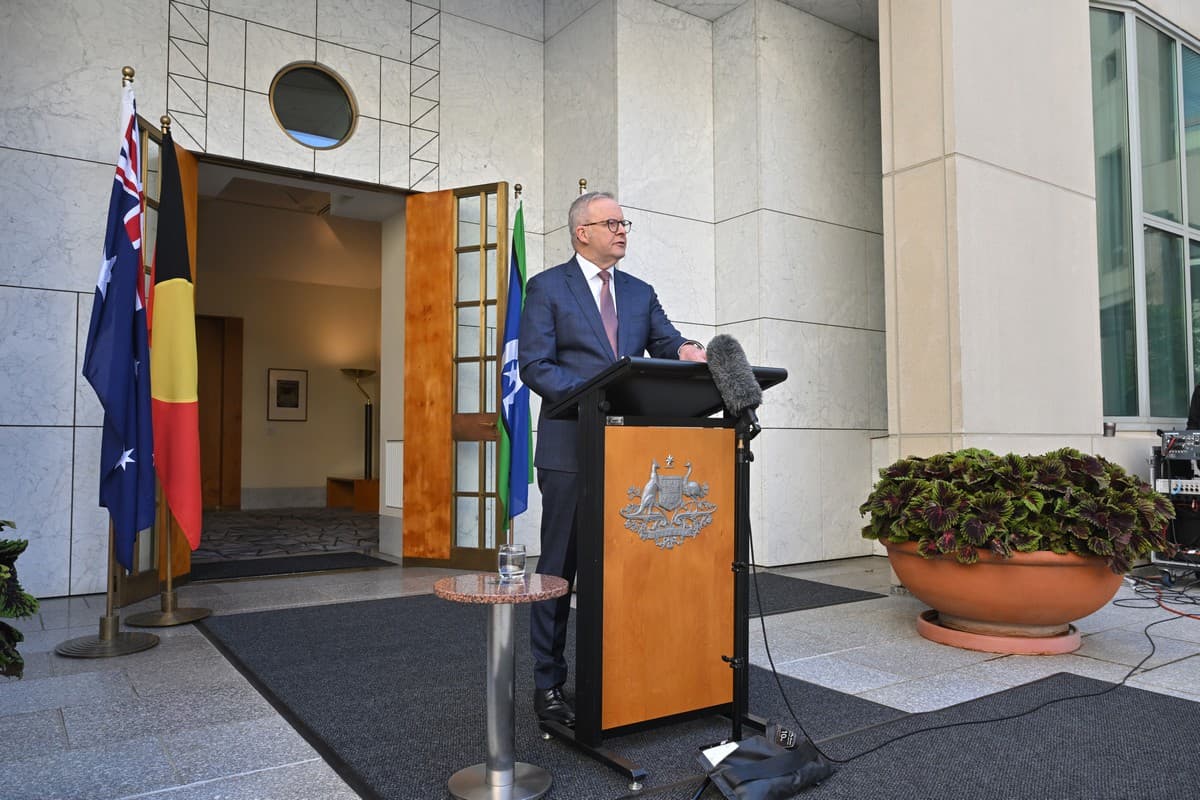
Prime Minister Anthony Albanese at a press conference at Parliament House, January 22 (AAP/Mick Tsikas)

Published: 22 January 2026

Last updated: 6 May 2026

The Jewish community has accused the Albanese government of many crimes and misdemeanours since the Hamas attacks of October 7, 2023.

Some of them have been demonstrably justified - Foreign Minister Penny Wong’s failure to visit the sites of Hamas attacks during her visit to Israel, the government’s tepid response to the university encampments, and the long delay in responding to Jillian Segal’s antisemitism plan.

Several other flashpoints have been driven by a feeling of resentment over the broader community’s solidarity with Palestine but blind eye to Hamas, which boiled over after the Sydney Harbour Bridge march and the government’s recognition of Palestinian statehood.

These grievances were felt so deeply that Prime Minister Albanese was not invited to the funerals of the Bondi Beach victims. The Governor-General, Sam Mostyn, told The Jewish Independent she has been inundated by people demanding that she sack him. The targeting of the prime minister is understandable, given the rise in antisemitic incidents under his watch, but he cannot be held personally accountable for what happened on December 14.

However, in the aftermath of the terror attack, there can be no doubt that Albanese has been found sorely wanting as a national leader, in terms of personal authority, political judgment and policy responses.

While the parliament was debating hate speech Young Labor Left posted images that came uncomfortably close

After weeks of unfathomable resistance, he was dragged into calling a Royal Commission into antisemitism. The overwhelming message of the delay, as the clamour grew around him, was that his heart was not in it. The fact that he called it an inquiry into “antisemitism and social cohesion” was clearly a compromise.

The Jewish community wanted an inquiry that focused exclusively on the physical attacks and hostility of the past two years; Albanese tends to the more generalist position that focuses on social cohesion as if antisemitism were just another form of racism with no specific causes or manifestations.

Continuing problems

The ongoing threat to Australian Jews was underscored by an incident in St Kilda on Tuesday night, when a ute drove past five teenage Jewish boys on Glen Eira Road and the occupants yelled antisemitic abuse at the boys, threatened to stab them and yelled "Heil Hitler" before almost hitting one of the boys as they fled across the road.

The prime minister labelled the incident “beyond disgusting”, declaring that “at a time when Australians are joining with the Jewish community in sorrow and solidarity, it is beyond disgusting to see these cowards shouting Nazi slogans at young people.”

And, while the parliament was debating hate speech, Young Labor Left was posting images that came uncomfortably close.

Politics v policy

Having acted too slowly with the Royal Commission, the new hate provisions Albanese announced last week went too far the other way. In his attempt to deliver a concrete peace offering to Jewish communal groups, the draft bill was rushed through too quickly and without sufficient heed to the implications for free speech and political comment.

Even then, the government put politics ahead of public policy and the common good. The hate provisions were bundled into an omnibus bill with a new gun buyback program, seemingly designed to prevent the Coalition – whose membership base is pro-guns - from passing the bill, thus casting the Opposition leader Susan Ley as rejecting new laws to support the Jewish community.

Ultimately the most powerful and controversial part of the expanded hate speech provisions failed.  A new racial vilification offence, under which a prosecutor would have need to prove that an accused person has knowingly promoted racial hatred, rather than be required to prove incitement of an audience – was rejected by both the Coalition and Greens, as well as a raft of legal and civil liberties experts, as too much of a free speech infringement.

Albanese’s vaunted sense of political judgment again deserted him. Over the weekend he conceded defeat and withdrew the bill, carved the gun control buyback program into a separate bill and removed the promotion of racial hatred provision to appease Coalition MPs worried about free speech. On Tuesday the Opposition agreed to the narrower hate crimes bill and the Greens approved the gun control bill, allowing both to eventually pass through Senate into law.

What do the new hate laws achieve?

The most impactful clause that has remained in the law is the establishment of a category of prohibited hate groups, which allows the minister to ban groups engaged in activities that are likely to increase the risk of politically motivated violence or communal violence.

The revised changes also include  a new aggravated offence for so-called hate preachers, expanded to also capture guest speakers. This provision is aimed at more easily achieving convictions against extremist Islamists like Wissam Haddad, who was convicted under the previous law last year.

The legislation also keeps hate speech on the parliamentary agenda, requiring two-yearly reviews of the laws by parliament’s Joint Committee on Intelligence and Security.

The Executive Council of Australian Jewry (ECAJ) has welcomed the revised bill but gave the impression, after all the fighting between the major parties, that it was doing so only because something is better than nothing.

“The Bill is another substantial step towards achieving effective laws against the deliberate promotion of hatred of groups or individuals based on their skin colour or national or ethnic origin,” ECAJ President Daniel Aghion said in a statement yesterday.

“Even though the creation of a criminal offence to that effect was deleted from the Bill, a new legal regime has been established to enable the government to proscribe extremist hate groups like Hizb ut-Tahrir and neo-Nazi organisations.”

The Australia Israel & Jewish Affairs Council echoed ECAJ’s response. “The new legislation is a very important and constructive start, although there is much work still ahead of us, said AIJAC Executive Director Dr Colin Rubenstein. “We also hope that we have not seen the last of the original proposed provision, withdrawn by the Government, to make severe hate speech a federal criminal offence.”

Privately, both groups view its removal as letting hate speakers off the hook too easily.

Hate in the ranks

Although Albanese can claim the new legislation as a success, negotiations with the hostile Coalition took its toll on his equilibrium: on Tuesday he accused the Morrison government of being soft on antisemitism, sparking a political spat that benefited nobody.

The blame game also included an offensive contribution from the Greens. When parliament reconvened to hear condolence speeches on Monday, Greens senator Mehreen Faruqi said in her speech that her Jewish friends were shocked at “powerful forces” using the massacre to influence political decisions – which verged on an old antisemitic trope.

Labor has its own hate speech problem on its far left flank. This week Young Labor Left posted a raft of images that unashamedly aligned the group with anti-Zionist and anti-Jewish hostility.

“From Warsaw to Gaza: Long live the intifada”, shouted one poster; “Globalise the resistance: Stop Israel’s ongoing genocide in Gaza”, screamed another; “Stop arming Israel: sanctions now”, said a third.

The conflation of Israel and the Holocaust would be offensive at any time, their publication at the present makes it even more so. The fact that they come from a branch of the governing political party will only reinforce Jewish anxieties about the future.

This outpouring by Young Labor Left is consistent with the findings of the Crossroads25 survey published last year by TJI, which found that younger Australians have the most negative views about both Israel and Jews and strongly sympathise with Palestinians.

Crossroads25 identified a significant correlation between age and sympathies over the Middle East: an average of 40% of those aged 18-34 were sympathetic to the Palestinians but only 10% from this age bracket said their sympathies were with Israel.

While Young Labor Left has traditionally been a black sheep among the Labor flock, it is nevertheless the incubator of its next generation of political leaders. If these social media posts are any guide, the Albanese government’s capacity to acknowledge the reality of antisemitism is destined to become even more fraught than it has been over this past month.

You might also like
  • New evidence Netanyahu was warned about October 7
    Shahar Burla
  • Who is Ofer Winter and could he upset Netanyahu’s election?
    Shahar Burla
  • Strategies for cohesion final focus of Royal Commission hearings
    Peter Kohn
logomark.67a07ee3
We believe in the free flow of information

Republish our articles for free, online or in print, by using our Creative Commons licence

You might also like

    Lobby
    OpinionAustralia

    Confronting Richard Flanagan and the myth of the Israel lobby

    Mary Garden 8
    Beinart Doogue 600
    Israel Hamas WarNewsAustralia

    Beinart takes a wrecking ball to Israel

    Michael Visontay 2
    ANNIKA WELLS PRESSER
    Israel Hamas WarNewsAustralia

    No action to stop Hezbollah ally beaming antisemitic and anti-Israel content into Australia

    Michael Visontay

About the author

Michael Visontay

Michael Visontay

Michael Visontay is Commissioning Editor of TJI and was Editor-in-Chief from 2017-22. Michael is a former Assistant Editor of The Sydney Morning Herald and columnist with The Australian Jewish News. He has written six books, including Who Gave You Permission? with Manny Waks, and Welcome to Wanderland: Western Sydney Wanderers and the Pride of the West. His most recent book is Noble Fragments: the Maverick who broke up the world's greatest book (Scribe, 2024).

More from the author

ReflectionWorld

My memory of Gloria Steinem

NewsAustralia

No action to stop Hezbollah ally beaming antisemitic and anti-Israel content into Australia

NewsAustralia

Beinart takes a wrecking ball to Israel

AnalysisAustralia

Prime minister’s absence exposes weakness in Royal Commission hearings

Comments3

  • Avatar of Miriam Feldheim

    Miriam Feldheim23 January at 10:01 pm

    Well said Paul Fletcher and Kim Lester.

  • Avatar of Paul Fletcher

    Paul Fletcher23 January at 03:06 am

    The Bondi attack was horrific. Murdering innocent civilians who were celebrating their religion is beyond forgiveness. The same holds true for the Palestinians in Gaza. All lives matter equally. There’s no justification for committing genocide. I am anti the actions of Israel and the IDF. I’m not anti Judaism nor anti Jewish people.

  • Avatar of Kim Lester

    Kim Lester22 January at 03:14 am

    I am not Jewish but support the human right of Jewish people anywhere in the world to express themselves without fear – anti semitism in this country sickens me.
    The appalling attacks on our PM in the far right commercial media and supported by community groups is what has created an atmosphere of chaos in Australia’s response to terror. Conservatives in this country failed the leadership test to work with the government. Albanese is a righteous man who is able to listen to debate unlike the conservatives leaders who just pile on hate at our PM.
    They have disgraced themselves.