Aa
  • Read, Watch, Listen
  • TJI Series
  • Community Action
  • Events
  • Zedi
Follow us and continue the conversation
  • LinkedIn
  • Instagram
  • FaceBook
  • X
  • YouTube
Test yourself with the TJI Quiz!

Adjust size of text

Aa

Follow us and continue the conversation

  • LinkedIn
  • Instagram
  • FaceBook
  • X
  • YouTube

Your saved articles

You haven't saved any articles

What are you looking for?

Original reporting, insightful analysis and diverse views, delivered straight to your inbox

  • LinkedIn
  • Instagram
  • FaceBook
  • X
  • YouTube
Your support fuels our mission to inform, entertain and inspire.

The Jewish Independent is bound by the Standards of Practice of the Australian Press Council. If you believe the Standards may have been breached, you may approach The Jewish Independent or make a complaint to the Australian Press Council in writing at www.presscouncil.org.au. The Council may also be contacted on 1800 025 712.

  • Our Story
  • Contact us
  • Our Team
  • Support us
  • Guidelines
  • Pitch your idea
  • Republishing us
  • Community Action
  • Our Awards
  • LinkedIn
  • Instagram
  • FaceBook
  • X
  • YouTube
Aboriginal FlagTorres Strait Islanders Flag

The Jewish Independent acknowledges Aboriginal and Torres Strait Islander peoples as the Traditional Owners and Custodians of Country throughout Australia. We pay our respects to Elders past and present, and strive to honour their rich history of storytelling in our work and mission.

© The Jewish Independent 2026All Rights Reserved
Website design and development by Your Creative, MelbourneTerms & ConditionsPrivacy Policy
HomeRead, Watch, ListenIsrael
Israel Hamas WarReflectionIsrael

‘As an Israeli Jew, I don’t want to be resilient anymore’

I want to be broken-hearted. I want to be vulnerable, because that is the only way to hold onto my soul, and maybe help save my country’s soul too.
Eetta Prince-Gibson
Print this
Hostages’ families mark first anniversary of 07 October attacks in Tel Aviv

Forced to display Israeli resilience, a mourner attends a memorial ceremony organised by the families of hostages held in Gaza, to mark a year since the deadly October 7 Hamas attacks in Tel Aviv, (URQUHART/ POOL/AAP).

Published: 11 September 2025

Last updated: 11 September 2025

Israeli national resilience is supposed to be a highly-admired national quality. Our government tells us, the Diaspora tells us, and, sometimes, we even tell ourselves that we can get through pretty much anything.

Social psychology tells us that resilient individuals and communities focus on what is possible in a given situation rather than on the negative aspects. They understand that they must change themselves in order to survive.

But as an Israeli Jew, I don’t want to be resilient anymore.  I don’t want merely to survive or to change the values that I believe in. I want to rage against what is happening so that I will have the energy to change reality. 

And I don’t to allow Prime Minister Benjamin Netanyahu and (perhaps unwittingly) the Jewish Diaspora to turn that purported resilience into a dangerous trap that fools us into believing that the situation is unchangeable.

We have seen horrors most of us never imagined. The Hamas attacks were savage and unforgivable, and their wounds — physical, emotional, national — are still open and raw. But the horror that we are creating will not heal our wounds. Entire families in Gaza have been erased. Cities have been turned to dust. Civilians cut off from food, water, and medicine and children are starving.

And in the name of resilience, we are told to look away. To feel and see nothing. To be strong. To live our lives, and to feel supported by the admiration of our government and much of the Diaspora.
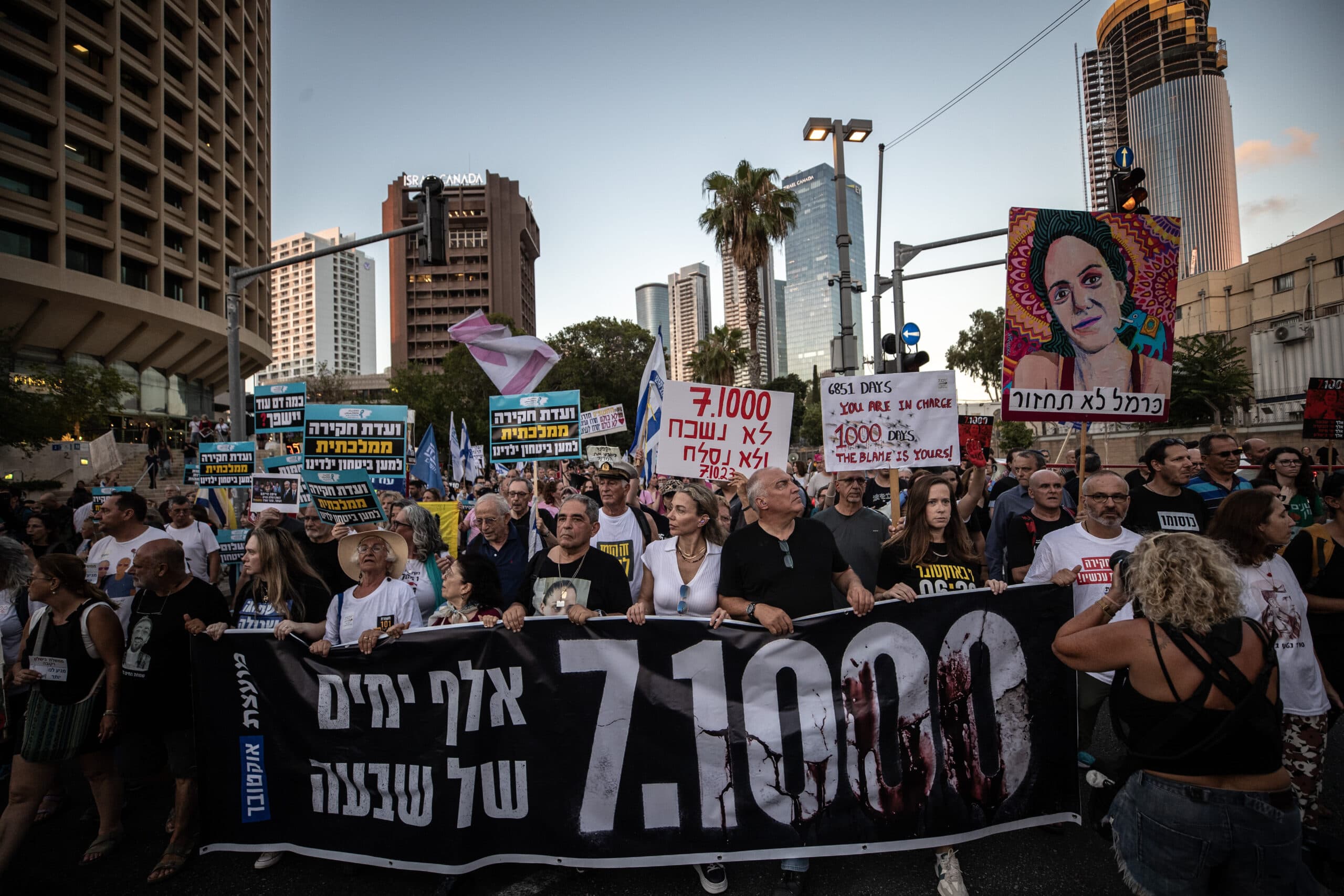

There’s something wrong, even cruel, in admiring people for being resilient in facing what they don’t have to - and shouldn’t - endure. None of this is inevitable.

Netanyahu has always manipulated the fears of the Israeli public and the Jewish people for his own political gain. But now he is doing something much more manipulative. He is marketing our purported resilience as justification for his own weakness.

In his speeches, Netanyahu lauds the strength of the families of the hostages; of the families of the soldiers who died in his useless ongoing war in Gaza; of the residents of the south; of the soldiers, of the Israeli people. But he never speaks of his own strength, because he has none. He holds up resilience to obscure his political cowardice, his deep corruption and his lack of vision.

He demands that we be strong to avoid accountability. He demands resilience because if we invest all of our energies in coping, we will have little energy left to create the civil unrest and the moral reckoning that might lead to the fall of this morally and politically bankrupt government. The longer we hold it together, the longer he stays in power.

And anyone who isn’t resilient or acknowledges that he has no strength left to cope, Netanyahu bellows, is a traitor to the Jewish people and to the State of Israel. 

Resilience is letting the Diaspora off the hook

This is a typically Netanyahuesque cynical manipulation of our noblest instincts. We love this country. We will fight for it. We will grieve for it.  But I will no longer pretend that I am resilient.  Resilience cannot become our prison. And yes, we will cope, because, after all, what choice do we really have in our day to day lives?

How do you cope? Friends, relatives and colleagues in the Diaspora ask me. How can you plan the Rosh Hashanah menu when missiles from Yemen sent you running to the shelter in the middle of the night? How do you take your children to school and help them with their homework when the sons and daughters of friends and family are risking their lives in Gaza?

How can you order a latte in your favourite café as Israel persists in fighting its morally illegal war in Gaza? How can you get yourself out to a protest every Saturday night – and sometimes several times a week?

There is often admiration in the voices of these people from abroad.  But there seems to be something more, too.  Lately, it has begun to seem to me that they are saying, that if we are so resilient, then maybe what’s happening here isn’t really quite so terrible.  Maybe the suffering – ours, the Palestinians’- is manageable.  After all, we Israelis are managing. 

I fear that this resilience is letting the Diaspora off the hook, so they can say, if we can endure what is happening, then they can support us without asking too many questions. They can love us without being burdened by the cost of that love.

I am neither naïve nor politically blind. I know Hamas is brutal. I know there are those want to wipe us out.  So, I know that we will continue to cope.

Time to stop pretending

But I also know that flattening Gaza will not bring back the murdered. It will not bring home our dead, or put an end to the ongoing nightmare of October 7, 2023.  And that there are good reasons to stop pretending that we can and should be resilient, no matter what the strategic or moral cost.

Strategically, there is no point to our ostensibly acquiescent resilience. Hamas is using the hunger as a weapon against us; if we refuse to accept it, then Hamas will no longer be able to use international condemnation as leverage against Israel. Moreover, Hamas would lose the money it makes from hijacking humanitarian aid if we actually effectively delivered enough aid to Gaza so that food would be financially accessible.

Within Israel and throughout the Diaspora, we could put a stop to the illusion that we are invincible.  We’re not, and we should not be expected to be.  No matter how much we smile or pretend or play the game, no matter how successfully we cope on a day-to-day basis, life in Israel right now is hell.  We are worn out by grief, fear, and exhaustion. 

How does a people bounce back from terror, war, and grief? I don’t think we do bounce back.  Coping leaves scars.  But if we have the courage to acknowledge our own lack of invincibility, if we recognise that it’s sometimes easier to pretend you are strong than to admit how much you hurt, then we can begin to heal. 

Untenable charade

But above all, we should put an end to this morally untenable charade because it is not who we are.  I do not want to normalise the situation. I need to acknowledge that I am not strong, and certainly don’t want to pretend to be in order to meet others’ needs or demands. 

Resilience has made us brittle where we should have been compassionate. Blind when we should have been insightful.  Arrogant when we should have been humble. Dulled when we should have been sharpening our moral imaginations. Complicit when we should have rebelled.

I don’t want to endure or normalise the unbearable.  I want to refuse it, to fight against it. I admit that I am broken-hearted, and that is much more difficult. 

I want to be broken-hearted. I want to be vulnerable. I want to be human.  Because that is the only way I know how to hold onto my soul — and maybe, just maybe, help save my country’s soul too. This is neither a call to a different set of arms nor a practical plan. 

Yet I have come to believe that true resilience means being willing to sit with the unbearable. Real does not ignore injustice. It does not protect the powerful from scrutiny. Real resilience includes the courage to speak, to demand, to break down if necessary — and to build something better.

You might also like
  • Tame apologises – but with little grace
    Deborah Stone
  • Confronting Richard Flanagan and the myth of the Israel lobby
    Mary Garden
  • UK’s dramatic policy change on Israel-Palestine
    Colin Shindler
logomark.67a07ee3
We believe in the free flow of information

Republish our articles for free, online or in print, by using our Creative Commons licence

You might also like

    Woman with land and houses behind her
    NewsAustralia

    Australia to increase sanctions against West Bank settlements

    Deborah Stone 2
    altalena
    Israel Votes 2026OpinionIsrael

    The Altalena should be a warning, not a political weapon

    Shahar Burla 1
    Netanyahu
    Israel Hamas WarFeatureIsrael

    New evidence Netanyahu was warned about October 7

    Shahar Burla 2

About the author

Eetta Prince-Gibson

Eetta Prince-Gibson, who lives in Jerusalem, was previously Editor-in-Chief of The Jerusalem Report, is the Israel Editor for Moment Magazine and a regular contributor to Haaretz, The Forward, PRI, and other Israeli and international publications.

More from the author

AnalysisIsrael

Segalovitz decision to join Arab party is a paradigm change for Israel

AnalysisIsrael

Netanyahu pre-election juggling act

AnalysisIsrael

Women disadvantaged by new powers for Israel’s religious courts

AnalysisArts & Culture

The Sea: deserving award-winning film or one-sided disgrace?

Comments1

  • Avatar of Emanuella

    Emanuella13 September at 06:58 am

    Thank you so much for this, Etta. Your words resonate with me deeply. I think, not only do we need to give ourselves the space to be more than resilient, but we need to let go of the pernicious idea of Jewish unity. As Elana Stzotman said, ‘calls for unity almost always imply that certain people should stop talking.’